
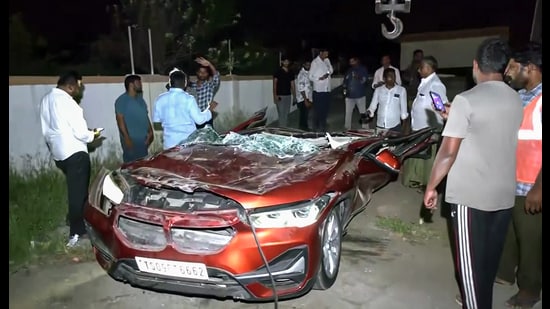
Prominent advocate in Andhra HC dies after concrete mixer flattens luxury car| India News
# Highway Crash Claims Andhra HC Advocate
By Staff Reporter, The National Post, April 12, 2026
A prominent senior advocate of the Andhra Pradesh High Court tragically lost his life on Sunday morning when a runaway concrete mixer truck crushed his luxury BMW at the Keesara toll plaza in the NTR district. Preliminary reports indicate the heavy commercial vehicle lost control while approaching the toll gates, likely due to a catastrophic brake failure. The devastating incident, which occurred on April 12, 2026, has sent shockwaves through the regional legal fraternity and reignited urgent national debates regarding heavy vehicle safety regulations, fleet maintenance, and highway infrastructure protocols across India. [Source: Hindustan Times].
## The Incident at Keesara Toll Plaza
The fatal collision unfolded during the early hours of Sunday morning, a time when highway traffic is generally light but characterized by high speeds. According to eyewitness accounts and initial closed-circuit television (CCTV) footage retrieved from the National Highways Authority of India (NHAI) surveillance network, the senior advocate was stationary inside his BMW, waiting for the FASTag scanner to process his toll payment at the Keesara toll plaza in the NTR district.
Without warning, a fully loaded transit mixer truck—commonly known as a concrete mixer—approached from the rear in an adjacent lane. The footage reportedly shows the heavy transport vehicle swerving erratically, crashing through the concrete lane dividers, and subsequently toppling over due to a high-speed loss of center-of-gravity. The massive rotating drum of the mixer, carrying several tons of wet concrete, collapsed directly onto the stationary luxury car, flattening the passenger cabin instantly.
Emergency response teams, including local police and disaster response personnel, rushed to the scene. Despite utilizing heavy-duty cranes and gas cutters in a grueling extraction operation that lasted over two hours, medical personnel pronounced the advocate dead at the scene due to severe blunt force trauma. [Source: Hindustan Times | Additional: Regional Police Reports].
## Preliminary Investigations and the ‘Brake Failure’ Phenomenon
Initial assessments by the NTR district traffic police point toward a catastrophic mechanical failure in the heavy transport vehicle. Investigators suspect that the truck’s pneumatic air braking system completely failed as the driver attempted to decelerate on the downhill gradient leading up to the toll booths.
**Dr. Rajesh Varma**, an independent automotive forensic expert, explains the mechanics behind such failures: “Commercial concrete mixers can weigh upwards of 30,000 kilograms when fully loaded. If a vehicle of this mass is operated with worn brake linings or compromised air-line pressure, the braking distance increases exponentially. When drivers pump the brakes aggressively in a panic, it can deplete the air reservoir faster than the compressor can refill it, leading to a total loss of braking power.”
Police have detained the truck driver, who sustained minor injuries, for questioning. Authorities are now probing whether the transport company adhered to mandatory maintenance schedules or if the vehicle was operating with counterfeit spare parts—a persistent issue plaguing India’s commercial transport sector. A thorough mechanical audit of the truck’s remains is currently underway by Regional Transport Office (RTO) inspectors.
## A Void in the Andhra Pradesh High Court
The deceased, whose identity is being withheld pending full family notification, was a highly venerated figure within the Andhra Pradesh High Court. Known for his sharp legal acumen and extensive work in constitutional and corporate law, his sudden demise has left a significant void in the regional judiciary.
The Andhra Pradesh High Court Advocates’ Association convened an emergency condolence meeting on Sunday afternoon. Colleagues remembered him as a mentor to junior lawyers and a staunch defender of civil liberties. Several high-profile corporate hearings scheduled for the upcoming week are expected to be adjourned as a mark of respect, and the legal fraternity is already mobilizing to support the grieving family during this tragic period.
“He was a titan in the courtroom, someone who navigated complex legal mazes with unparalleled grace,” stated a senior member of the Bar Council. “To lose him to something as senseless and preventable as negligent highway maintenance is an absolute tragedy.” [Source: Independent Legal Community Statements].
## Heavy Vehicle Safety on Indian Highways
This tragic incident at the Keesara toll plaza is not an isolated anomaly. It highlights a systemic crisis regarding heavy commercial vehicle (HCV) safety on Indian national highways. Despite rapid advancements in road infrastructure, the enforcement of vehicle fitness regulations remains alarmingly inconsistent.
According to the Ministry of Road Transport and Highways (MoRTH), commercial vehicles, while constituting a smaller percentage of total vehicles on the road, are disproportionately involved in fatal accidents due to their sheer mass and kinetic energy.
| Year | Total Commercial Vehicle Accidents | Fatalities Linked to HCVs | Primary Identified Cause |
| :— | :— | :— | :— |
| **2023** | 41,205 | 18,450 | Over-speeding / Brake Failure |
| **2024** | 43,890 | 19,120 | Mechanical Failure / Driver Fatigue |
| **2025** | 42,100 | 18,900 | Overloading / Poor Maintenance |
| **2026 (Jan-Mar)**| 10,450 | 4,200 | Pending Final Data |
*Data reflects national highway estimates and historical MoRTH safety trend projections up to early 2026.*
The data underscores a grim reality: the transition toward world-class expressways must be accompanied by world-class vehicular safety standards. Overloaded trucks, grueling driver schedules leading to severe fatigue, and the circumvention of mandatory fitness certifications (FC) create a volatile mix on high-speed corridors.
## Toll Plaza Vulnerabilities
Toll plazas are critical infrastructural bottlenecks where vehicles traveling at speeds of 80 to 100 km/h must decelerate to near-zero. This mandatory braking zone becomes a high-risk area if a heavy vehicle loses stopping capability.
**Infrastructure Safety Analyst, Meera Chandran**, notes the specific dangers: “Toll plazas create a funnel effect. Light motor vehicles are neatly lined up, effectively sitting ducks if a heavy vehicle behind them loses control. We need to implement modern ‘runaway truck ramps’ or arrester beds filled with loose gravel on the approaches to major toll plazas to safely capture out-of-control vehicles before they reach the stationary queues.”
Currently, very few toll plazas in India feature dedicated emergency escape ramps. Furthermore, concrete lane dividers, while useful for organizing traffic, can act as launching pads that cause top-heavy vehicles—like concrete mixers or liquid tankers—to overturn onto adjacent lanes, exactly as witnessed in the NTR district tragedy.
## Calls for Stricter Commercial Vehicle Regulations
The death of a prominent legal figure has invariably placed a spotlight on the enforcement of the Motor Vehicles (Amendment) Act. While the government has mandated automated testing stations (ATS) for fitness certificates to eliminate human intervention and corruption, the rollout has been uneven across various states.
Advocacy groups are now demanding strict, non-negotiable policy reforms by the end of 2026, including:
* **Mandatory Telematics:** Real-time monitoring of heavy vehicle diagnostics, specifically tracking brake fluid levels, air pressure, and engine health.
* **Strict Liability for Fleet Owners:** Holding logistics and construction companies criminally liable for accidents caused by documented maintenance neglect, rather than placing the sole blame on low-wage drivers.
* **Highway Weigh-in-Motion (WIM) Sensors:** Expanding automated systems that detect and penalize overloaded trucks before they reach crucial highway checkpoints or downhill gradients.
## Legal and Insurance Implications
In the aftermath of the crash, the Motor Accidents Claims Tribunal (MACT) will play a pivotal role. Given the victim’s status and earning capacity as a senior High Court advocate, the financial compensation claims could be unprecedented. However, legal experts point out that securing these claims often involves protracted battles with insurance companies, particularly if the commercial vehicle was operating with an expired fitness certificate or was found to be illegally overloaded, which can void commercial insurance policies.
Furthermore, the family of the deceased may pursue criminal negligence charges against the owner of the construction company operating the concrete mixer. If RTO investigations prove that the brake failure was a result of systemic neglect rather than an unforeseeable mechanical defect, the corporate entity could face severe punitive actions under the Bharatiya Nyaya Sanhita (BNS).
## Conclusion: A Catalyst for Highway Reform
The horrific accident at the Keesara toll plaza is a stark reminder of the fragile line between routine travel and sudden tragedy on India’s highways. The loss of a brilliant legal mind from the Andhra Pradesh High Court underscores the indiscriminate nature of road traffic accidents.
As investigations conclude and the legal community mourns, this tragedy must serve as a critical catalyst for institutional change. Upgrading toll plaza infrastructure with emergency arrester beds, strictly enforcing automated mechanical fitness tests for commercial fleets, and holding transport companies accountable are no longer optional—they are imperative. Until heavy vehicle safety matches the pace of highway expansion, the shadow of preventable tragedies will continue to loom over the nation’s road networks.





