
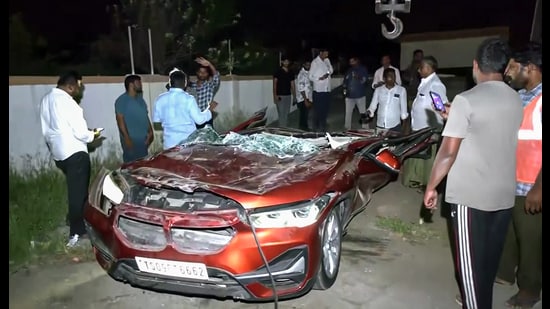
Prominent advocate in Andhra HC dies after concrete mixer flattens luxury car| India News
# AP Lawyer Dies in Highway Crush
**By Senior Correspondent | National Desk**
**April 12, 2026**
In a devastating highway tragedy on Sunday, April 12, 2026, a prominent senior advocate practicing at the Andhra Pradesh High Court was killed instantly when a speeding concrete mixer truck lost control and crushed his BMW at the Keesara toll plaza in the NTR district. Preliminary police reports indicate the heavy commercial vehicle suffered a catastrophic brake failure, leaving the driver unable to stop before plowing into the toll lane queue. This fatal incident has renewed intense scrutiny over heavy vehicle safety regulations, systemic maintenance failures, and the acute vulnerability of passenger cars waiting in toll bottlenecks across Indian highways. [Source: Hindustan Times].
## The Fatal Seconds at Keesara Toll Plaza
The morning of April 12 began as routine for travelers navigating the busy arterial stretches of the NTR district. According to eyewitness accounts and preliminary footage recovered from the toll booth’s closed-circuit television (CCTV) cameras, the senior advocate’s luxury sedan was stationary, waiting in a designated FASTag lane to clear the toll barrier.
Without warning, a fully loaded transit mixer—a heavy commercial vehicle used for transporting wet concrete—approached the plaza at an alarmingly high speed. Unable to decelerate, the truck violently rear-ended the BMW. The sheer kinetic energy and massive weight of the concrete mixer, which typically exceeds 25 to 30 tons when loaded, caused it to mount and completely flatten the passenger vehicle.
Emergency response teams, including local police units and disaster response personnel, rushed to the site. However, the extent of the structural collapse of the luxury car meant that extrication required heavy-duty gas cutters and industrial cranes. Despite the rapid deployment of these resources, the advocate was pronounced dead at the scene due to severe blunt force trauma. The truck driver reportedly sustained minor injuries and was immediately taken into police custody for interrogation and medical evaluation. [Source: Hindustan Times | Additional: Local Police Reports].
## Investigating the Mechanical Failure
Initial forensic examinations of the crash site point overwhelmingly to mechanical failure. Skid marks, or rather the lack thereof, leading up to the point of impact suggest that the truck’s braking system completely gave way.
“While a comprehensive mechanical audit by the Regional Transport Office (RTO) is pending, all preliminary indicators point toward catastrophic brake fade or complete pneumatic failure in the truck’s air brake system,” stated a senior investigative officer from the NTR district traffic police. “When a vehicle of that mass loses its braking capability on a highway approach, it essentially becomes an unguided missile. The driver claimed he pumped the brakes repeatedly, but there was no response.”
Investigators are currently seizing the maintenance logs of the construction company that owns the concrete mixer. The investigation will focus heavily on whether the vehicle had a valid fitness certificate, when its brake linings were last replaced, and whether it was carrying a payload that exceeded its gross vehicle weight rating (GVWR). Overloading is a notorious catalyst for brake failure, as it places insurmountable stress on the friction materials of heavy vehicle braking systems, particularly on downward gradients or during sudden highway deceleration.
## A Staggering Loss for the Legal Fraternity
The sudden and violent demise of the senior advocate has sent shockwaves through the legal community in Andhra Pradesh. Known for his sharp legal acumen, decades of dedicated practice, and involvement in several high-stakes constitutional and civil matters, his absence creates a profound void in the state’s judiciary circles.
Following the confirmation of his identity, the Andhra Pradesh High Court Bar Association convened an emergency condolence meeting. Several prominent lawyers and presiding judges expressed their grief, noting that the late advocate was not only a master of jurisprudence but also a mentor to countless junior lawyers navigating the complexities of the legal profession.
“We have lost a titan of the courtroom today,” remarked a senior member of the Bar Council. “His contributions to civil liberties and his dignified presence at the bench will be irreplaceable. It is deeply tragic that a life dedicated to the pursuit of justice was cut short by systemic negligence on our highways.”
As a mark of respect, several chambers suspended their afternoon proceedings, and the Bar Association is expected to pass a formal resolution demanding a high-level inquiry into the accident. The legal fraternity is also calling for stringent accountability for the transport company involved, emphasizing that civil liability and corporate negligence must be heavily penalized to set a deterrent. [Source: Additional Legal Community Press Releases].
## The Growing Menace of Heavy Vehicle Accidents
This tragic incident highlights a pervasive and lethal issue plaguing Indian highways: the frequent involvement of Heavy Commercial Vehicles (HCVs) in fatal accidents. Despite extensive modernization of highway infrastructure, the regulatory oversight of the vehicles traversing them remains highly inconsistent.
Concrete mixers and tipper trucks pose unique dangers. Because their payloads (wet concrete or loose aggregates) can shift dynamically during transit, these vehicles have high centers of gravity, making them inherently unstable during emergency maneuvers. Furthermore, the economic pressures of the construction industry often incentivize fleet operators to skip routine maintenance protocols to keep trucks on the road continuously.
**Key Risk Factors in Commercial Fleet Operations:**
* **Irregular Maintenance:** Prolonged use of worn-out brake pads, failing pneumatic valves, and bald tires.
* **Overloading:** Exceeding payload capacities, which exponentially increases stopping distances.
* **Driver Fatigue:** Commercial drivers often operate under gruelling schedules without adequate rest, reducing their reaction times in emergencies.
* **Lax Certification:** The persistent issue of fraudulent fitness certificates issued without rigorous physical inspection of the vehicle.
## Toll Plazas as High-Risk Bottlenecks
While toll plazas are necessary for revenue collection and highway maintenance funding, their physical design transforms them into high-risk crash zones. Highways are designed for high-speed, continuous travel, but toll plazas force traffic to a sudden, complete halt.
When passenger vehicles queue up in narrow, concrete-barricaded lanes, they are left with zero escape routes. If a heavy truck approaching from behind loses its brakes—as seen in the Keesara toll plaza tragedy—the cars ahead become stationary targets. The concrete dividers that separate the lanes effectively trap the smaller vehicles, preventing drivers from swerving out of the path of a runaway truck.
Highway safety engineers have long advocated for structural interventions to mitigate these risks. Proposed solutions include:
1. **Runaway Truck Ramps:** Installing sand-filled deceleration lanes before major toll plazas to safely stop runaway heavy vehicles.
2. **Segregated HCV Lanes:** Physically separating heavy commercial vehicles from passenger car lanes well in advance of the toll gates.
3. **Advance Warning Systems:** Implementing radar-based speed detection systems that trigger sirens and automated boom barriers if a vehicle approaches the plaza at an unsafe velocity, warning queuing drivers to brace or attempt evasion.
## Systemic Lapses in Fitness Certifications
The fatal crushing of the prominent advocate brings the spotlight back to the Ministry of Road Transport and Highways (MoRTH) and its ongoing battle to enforce vehicle roadworthiness. While the government has mandated the transition to Automated Testing Stations (ATS) to eliminate human intervention and corruption in issuing fitness certificates, the implementation across all districts remains patchy.
According to road safety experts, a concrete mixer operating on a national highway must undergo rigorous periodic checks of its air compressor limits, brake shoe thickness, and suspension integrity. A catastrophic brake failure is rarely a sudden event; it is almost always the culmination of weeks or months of neglected maintenance.
“Until fleet owners are held criminally liable for accidents caused by their poorly maintained vehicles, the situation on the ground will not change,” stated an independent road safety auditor monitoring the region. “We need telematics and real-time health monitoring of commercial vehicles mandated by law. A truck with failing brake pressure should not even be able to start its engine, let alone enter a national highway.” [Source: Ministry of Road Transport Policy Analysis].
## Future Outlook and Urgent Preventative Measures
The Keesara toll plaza accident is a grim reminder that world-class highway infrastructure is inherently incomplete without equally robust enforcement of vehicular safety standards. The loss of a distinguished legal mind in such a preventable manner underscores the urgent need for a multi-pronged approach to road safety.
Moving forward, regulatory bodies must accelerate the phase-out of manual fitness testing in favor of fully automated, tamper-proof diagnostics. Furthermore, the integration of Advanced Driver Assistance Systems (ADAS)—such as Automatic Emergency Braking (AEB) customized for heavy loads—must be evaluated for mandatory inclusion in all new heavy commercial vehicles sold in India.
For the victims of such tragedies, justice must extend beyond the arrest of the truck driver. It must encompass a thorough investigation into the logistical supply chain, holding corporate entities accountable for endangering public lives in the pursuit of profit.
As the Andhra Pradesh legal fraternity mourns the untimely death of one of its most respected advocates, the hope remains that this profound loss will serve as a definitive catalyst for sweeping reforms in highway safety protocols and heavy vehicle regulation.





