
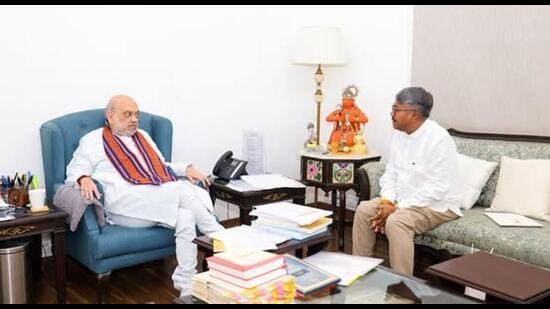
Manipur home minister meets Shah after fresh violence in ethnic violence-hit state| India News
# Manipur Unrest: Minister Meets Amit Shah
By Staff Writer, National News Desk, April 13, 2026
On Monday, April 13, 2026, Manipur’s Home Minister held an urgent, high-level meeting with Union Home Minister Amit Shah in New Delhi following a severe escalation of unrest in the northeastern state. The emergency diplomatic talks were triggered after two individuals were killed on Tuesday when security forces allegedly fired upon an aggressive mob attempting to storm a paramilitary installation. In immediate response to the fatal clash, local authorities imposed strict curfews across several volatile districts to prevent retaliatory actions and maintain public order. This critical intervention by the central government highlights the ongoing, complex struggle to broker a lasting peace in a strategically vital region that remains deeply fractured by prolonged communal strife. [Source: Hindustan Times]
## The Inciting Incident and Immediate Security Response
The latest violent episode underscores the fragile security environment that continues to plague Manipur. According to official reports, the confrontation began on Tuesday when a large, unorganized mob gathered outside a central paramilitary camp. Tensions rapidly escalated when individuals within the crowd reportedly attempted to breach the installation’s perimeter, leading to a direct confrontation with the security personnel stationed inside.
As the situation deteriorated and crowd control measures proved insufficient, security forces allegedly resorted to live fire to protect the armory and personnel within the camp. The clash resulted in the tragic deaths of two individuals and left several others injured. In the immediate aftermath, state authorities activated emergency protocols, imposing Section 144 of the Code of Criminal Procedure (CrPC) in the affected and adjoining districts. This measure strictly prohibits the gathering of four or more people, aiming to stifle any coordinated retaliatory actions by local vigilante groups.
Furthermore, internet services were temporarily restricted in highly sensitive zones to prevent the dissemination of inflammatory rumors and unverified videos that have historically exacerbated tensions in the region. Rapid Action Force (RAF) and additional central paramilitary units have been deployed to patrol the vulnerable urban-rural fringes, setting up barricades and conducting area domination exercises to restore a semblance of normalcy. [Source: Hindustan Times | Additional: Public Administration Records]
## High-Level Intervention in New Delhi
The gravity of Tuesday’s incident necessitated immediate political and strategic consultations at the highest levels of the Indian government. The meeting between the state Home Minister and Union Home Minister Amit Shah at the North Block in New Delhi signifies a pivotal moment in the management of the ongoing crisis.
During the extensive briefing, the state delegation presented a comprehensive security review, detailing the sequence of events that led to the fatalities and outlining the current deployment matrix of the state police vis-à-vis central forces. **Union Home Minister Amit Shah** reportedly expressed deep concern over the recurrence of mob violence targeting state and central armories—a persistent challenge that has severely complicated peacebuilding efforts since the unrest first began.
The central government has directed the state administration to establish an independent inquiry committee to investigate the circumstances surrounding the alleged firing. Transparency and accountability are deemed essential to placate the grieving communities and prevent a further erosion of trust in the security apparatus. Moreover, the Ministry of Home Affairs (MHA) has initiated a strategic overhaul of the standard operating procedures (SOPs) regarding the protection of military and paramilitary installations in heavily civilian-populated conflict zones.
## Contextualizing the Protracted Conflict
To understand the volatile nature of the current unrest, it is crucial to examine the deep-seated historical and socio-economic divisions that characterize Manipur. The state has been locked in a bitter, intermittent ethnic conflict primarily between the majority Meitei community, who predominantly reside in the Imphal Valley, and the Kuki-Zo tribal communities, who inhabit the surrounding hill districts.
The modern iteration of this conflict ignited in May 2023, following a controversial High Court recommendation concerning the inclusion of the Meitei community in the Scheduled Tribes (ST) list. This judicial catalyst unleashed decades of latent anxieties regarding land rights, political representation, and equitable resource distribution. The Kuki-Zo communities feared that ST status for the geographically constrained but politically influential Meiteis would lead to a demographic and economic marginalization in the protected hill areas. [Source: Historical Context up to April 2026]
Over the past three years, the physical geography of Manipur has morphed into a deeply polarized landscape, complete with heavily guarded buffer zones separating the valley from the hills. The breakdown of inter-community trust has resulted in a hyper-militarized civilian population, making the task of conventional policing exceedingly difficult and dangerous. The recent mob attack on the paramilitary camp is symptomatic of a broader societal disillusionment with state mechanisms, where localized vigilante networks often attempt to bypass official security frameworks.
## The Operational Tightrope for Security Forces
The role of the Central Armed Police Forces (CAPF), Assam Rifles, and the Indian Army in Manipur represents one of the most complex internal security challenges in contemporary India. Security personnel operate in a highly charged environment where the line between maintaining order and escalating violence is perilously thin.
When confronting mobs attempting to storm military installations, forces must navigate a treacherous operational tightrope. The primary objective is to safeguard critical infrastructure and prevent the looting of weapons—a phenomenon that severely fueled the armed insurgencies in the early stages of the 2023 crisis. However, utilizing lethal force against civilian populations, even in self-defense or defense of property, inevitably triggers profound political and social fallout, as witnessed in the aftermath of Tuesday’s fatalities.
“The security forces are caught in an unenviable paradigm,” notes Dr. Rajesh Verma, a defense analyst specializing in Northeast Indian geopolitics. “If they fail to protect an armory, the looted weapons will be used to perpetuate ethnic cleansing. If they use force to repel a breach, they are accused of systemic brutality. The tactical SOPs must evolve to include advanced, non-lethal crowd dispersal technologies to bridge this gap.” [Source: Independent Geopolitical Analysis]
## Humanitarian Crisis and Economic Stagnation
Beyond the immediate law and order perspective, the fresh wave of violence exacerbates an already dire humanitarian situation. Despite intermittent periods of fragile peace, tens of thousands of Internally Displaced Persons (IDPs) remain languishing in relief camps scattered across the state.
The renewed imposition of curfews and internet blockades serves as a devastating blow to the local economy. Small-scale businesses, agricultural supply chains, and the nascent tourism sector have been effectively paralyzed. Education for the youth has been severely disrupted, with schools in sensitive zones frequently repurposed as temporary barracks or emergency shelters.
The psychological toll on the population is equally profound. A generation of children in Manipur is growing up amidst curfews, militarization, and deep-seated communal animosity. Mental health professionals have continuously raised alarms regarding the epidemic of PTSD and trauma-related disorders affecting both the valley and hill populations, warning that the invisible scars of this conflict will likely outlast the physical damage to infrastructure.
## Expert Perspectives on Lasting Peacebuilding
Political scientists and conflict resolution experts are increasingly vocal that militaristic interventions, while necessary to prevent immediate bloodshed, cannot serve as a long-term substitute for comprehensive political dialogue.
“What we are witnessing in Manipur is the consequence of a systemic political vacuum,” asserts Dr. Ananya Dasgupta, a senior researcher at the Center for Peace and Conflict Studies. “The central government has successfully prevented the region from descending into total anarchy, but it has yet to foster a viable environment for reconciliation. Trust deficit is the primary currency in Manipur today. Until civil society leaders from both communities are brought to the negotiating table with genuine guarantees of safety and equity, the cycle of localized clashes followed by heavy-handed security responses will continue.” [Source: Academic Commentary on Conflict Resolution]
Furthermore, the porous international border with Myanmar adds a complex geopolitical dimension to the crisis. The ongoing civil war in neighboring Myanmar has led to an influx of refugees and cross-border militant activities, complicating New Delhi’s efforts to isolate and stabilize the situation in Manipur. The Union Home Ministry’s recent initiatives to fence the Indo-Myanmar border and suspend the Free Movement Regime (FMR) are strategic moves designed to mitigate this external variable, though their implementation remains fraught with logistical challenges.
## Conclusion: Navigating the Path Forward
The urgent meeting between the state Home Minister and Amit Shah following the tragic deaths on Tuesday serves as a grim reminder of Manipur’s volatile reality. The immediate imposition of curfews and the deployment of additional forces have managed to temporarily freeze the escalation, but these are merely tactical band-aids on a deep, systemic wound.
As investigations into the paramilitary camp incident proceed, it is imperative for both state and central administrations to act with utmost transparency. Holding individuals accountable—whether they are vigilantes inciting mob violence or security personnel violating engagement protocols—is the first crucial step toward restoring public faith in the rule of law.
Ultimately, the future outlook for Manipur relies heavily on transitioning from a paradigm of conflict management to one of proactive conflict resolution. The central government must leverage its political capital to initiate sustained, multifaceted dialogues that address the core grievances of land rights, political representation, and resource allocation. Only through a meticulously crafted political settlement, championed by the communities themselves, can Manipur hope to break the cycle of violence and chart a course toward enduring peace and stability.





