
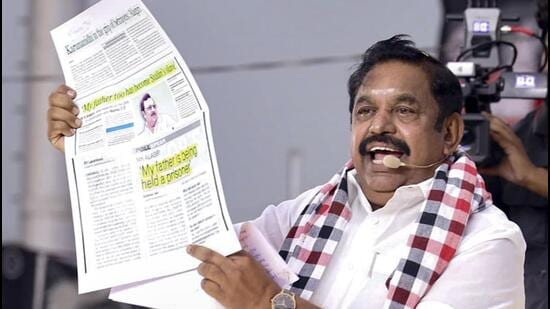
Not even 20% of 525 promises fulfilled by DMK: Palaniswami to HT| India News
# DMK failed 80% of poll promises, says EPS
**By Staff Correspondent, National Political Desk** | April 13, 2026
With Tamil Nadu gearing up for the highly anticipated 2026 state assembly elections, the political climate has intensified following a blistering critique by AIADMK General Secretary Edappadi K. Palaniswami. On Monday, April 13, 2026, Palaniswami told the Hindustan Times that the ruling Dravida Munnetra Kazhagam (DMK) government has fulfilled less than 20% of its 525 electoral promises since taking power in 2021. Accusing Chief Minister M.K. Stalin’s administration of reckless financial mismanagement, Palaniswami highlighted that the state’s historical debt has been dwarfed by aggressive recent borrowing, severely undermining Tamil Nadu’s fiscal health and jeopardizing future development.
## The Core Accusation: Unfulfilled Electoral Promises
The bedrock of the DMK’s successful 2021 election campaign was a massive, comprehensive manifesto containing **525 specific electoral promises**. These ranged from overarching infrastructural developments to hyper-local welfare schemes, designed to appeal to a broad spectrum of the Tamil Nadu electorate. However, as the government nears the end of its five-year tenure, the opposition is meticulously dismantling this record.
According to Edappadi K. Palaniswami (EPS), the gap between the ruling party’s rhetoric and its on-ground implementation is staggering. “Not even 20% of the 525 promises have been fulfilled,” Palaniswami stated in his interview, framing the current administration as one characterized by broken vows rather than actionable governance [Source: Hindustan Times RSS].
The AIADMK leader pointed out that several marquee promises remain largely unaddressed. Chief among these is the emotive issue of the National Eligibility cum Entrance Test (NEET). The DMK had campaigned heavily on the promise of securing an exemption for Tamil Nadu students from the centralized medical examination—a promise that remains legally and constitutionally stalled, much to the frustration of voters. Furthermore, promises regarding the complete waiver of educational loans, the reduction of fuel prices to specific targeted levels, and the generation of millions of private-sector jobs for local youth have reportedly fallen far short of the benchmarks set in 2021.
## Escalating Debt and Fiscal Mismanagement
Beyond the unfulfilled promises, Palaniswami directed his harshest criticism toward the state’s deteriorating macroeconomic indicators under the DMK regime. The crux of his argument centers on what he describes as unparalleled financial indiscipline.
“The state, which had accumulated a debt of ₹5 lakh crore over 73 years, has seen reckless spending over the past five years,” the AIADMK leader asserted [Source: Hindustan Times RSS]. This comparison is a potent political weapon, juxtaposing the fiscal prudence of seven decades of successive governments against the borrowing spree of the current administration.
Public finance data indicates that Tamil Nadu’s outstanding public debt has indeed surged. While the state remains one of India’s most industrialized and economically productive regions, its revenue deficit and reliance on borrowing to fund operational expenses have alarmed economists.
Dr. R. Mahadevan, a Chennai-based economist and public policy analyst, notes the underlying risks of this trajectory. “When a state borrows primarily to fund capital expenditure—such as building ports, highways, or industrial parks—the debt is considered productive. It generates future revenue. However, if borrowing is increasingly diverted to fund revenue deficits and massive welfare distributions, it creates a debt trap,” he explained. “The AIADMK’s claim touches upon a very real anxiety regarding Tamil Nadu’s debt-to-GSDP ratio, which requires immediate corrective measures to avoid fiscal stagnation.” [Additional Source: Macroeconomic State Finance Analysis].
## The “Dravidian Model” Under the Scanner
Chief Minister M.K. Stalin has consistently championed his administration’s governance framework as the “Dravidian Model”—a system designed to ensure inclusive growth, social justice, and industrial development simultaneously. However, Palaniswami’s allegations bring this model under intense scrutiny as the 2026 electoral battle lines are drawn.
The AIADMK argues that the DMK’s version of the Dravidian Model is merely a facade for “reckless spending” designed to capture short-term voter approval at the expense of long-term economic stability. By focusing heavily on direct cash transfers and subsidies without corresponding mechanisms for massive revenue generation, the opposition claims the state exchequer is bleeding.
## The DMK Government’s Defense
In the interest of journalistic neutrality, it is crucial to examine the ruling party’s counter-narrative. The DMK leadership vehemently denies the 20% fulfillment metric proposed by EPS, claiming instead that a vast majority of their crucial manifesto promises have been implemented despite severe financial constraints inherited from the previous AIADMK regime and global economic headwinds.
DMK spokespersons frequently highlight several flagship schemes that have successfully reached millions of beneficiaries:
* **Kalaignar Magalir Urimai Thittam:** The provision of ₹1,000 monthly financial assistance to eligible female heads of families, which the government points to as a massive step toward women’s economic empowerment.
* **Chief Minister’s Breakfast Scheme:** A first-of-its-kind initiative providing free, nutritious morning meals to primary school students across the state, aimed at improving attendance and nutritional standards.
* **Vidiyal Payanam:** Free bus travel for women in state-run city buses, heavily utilized by the working-class demographic.
* **Naan Mudhalvan Scheme:** A skill development initiative aimed at making college graduates highly employable in the competitive private sector.
Supporters of the ruling party argue that these initiatives are not “reckless freebies” but essential social investments that yield long-term demographic dividends. They also point out that the ₹5 lakh crore debt mentioned by EPS was largely a burden passed down by the AIADMK government prior to 2021 [Additional Source: Tamil Nadu Legislative Assembly Records].
## AIADMK’s Revival Blueprint for 2026
Palaniswami’s aggressive posturing signals a clear shift in the AIADMK’s strategy. Having successfully consolidated his absolute leadership within the party after years of internal factionalism and legal battles with O. Panneerselvam, EPS is now entirely focused on cornering the DMK.
By centering the political debate on broken promises and economic mismanagement, the AIADMK hopes to capture the anti-incumbency vote. The strategy relies heavily on appealing to the middle class, business communities, and youth who are increasingly concerned about state taxes, inflation, and employment opportunities.
Furthermore, the emphasis on the DMK’s unfulfilled promises regarding state autonomy and the NEET exemption is a calculated move to challenge the DMK’s long-standing monopoly over Tamil sub-nationalist sentiment. If the AIADMK can successfully portray the DMK as ineffective advocates for Tamil Nadu’s rights at the federal level, it could significantly alter the voting dynamics in key constituencies.
## Economic Implications of Pre-Election Spending
As Tamil Nadu edges closer to the 2026 assembly elections, the financial implications of this political war of words are profound. In an attempt to counter the AIADMK’s narrative, there is a strong likelihood that the incumbent government may announce a flurry of new schemes or rush the implementation of remaining manifesto promises.
Financial watchdogs and institutions like the Reserve Bank of India (RBI) frequently caution state governments against the proliferation of populist measures leading up to election cycles. For a state already grappling with a high debt burden, further strain on the exchequer could result in a reduction of critical capital expenditure.
“The real danger in the lead-up to the 2026 polls is that both major Dravidian parties might engage in competitive populism,” remarked senior political commentator V. Ramanathan. “While EPS is currently critiquing the DMK’s fiscal discipline, the AIADMK will also be forced to release its own manifesto soon. The challenge will be convincing voters that their promises are economically viable, unlike the DMK’s alleged 80% failure rate.” [Additional Source: Independent Political Commentary].
## Voter Sentiment and Ground Reality
Ultimately, the validity of Palaniswami’s claim—that the DMK has failed 80% of its electorate—will be judged by the voters. Ground reports suggest a mixed sentiment. While rural voters heavily rely on and appreciate schemes like the free bus travel and the monthly honorarium for women, there is palpable discontent among the urban middle class regarding infrastructure bottlenecks, rising property taxes, and electricity tariff hikes implemented over the last few years.
The opposition’s ability to weave these isolated grievances into a cohesive, statewide narrative of “reckless spending” and “broken promises” will determine the trajectory of the upcoming election campaign.
## Conclusion: The Road to 2026
Edappadi K. Palaniswami’s stark assertion that less than 20% of the DMK’s 525 promises have been fulfilled serves as the opening salvo for the 2026 Tamil Nadu Legislative Assembly elections. By highlighting the dramatic escalation in state debt and accusing the Stalin administration of reckless spending, the AIADMK is attempting to pivot the political discourse away from ideological battles and toward hard economic realities and governance metrics.
As the state transitions into full-blown campaign mode, the ruling DMK will face the dual challenge of defending its fiscal record while simultaneously satisfying an electorate accustomed to robust welfare politics. The coming months will likely witness intense statistical warfare, as both sides deploy economic data to prove their respective visions for Tamil Nadu’s future. The ultimate decision rests with the voters, who must balance the immediate relief of welfare programs against the long-term sustainability of the state’s economic health.





