
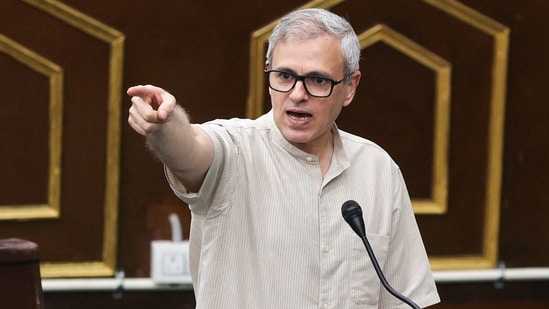
‘INDIA bloc will jointly decide response’: J&K CM Omar Abdullah on women’s quota bill and delimitation concerns| India News
# J&K CM Slams Delimitation Tactics
**By Special Correspondent, National Affairs Desk | April 16, 2026**
Jammu and Kashmir Chief Minister Omar Abdullah announced on Wednesday that the INDIA opposition bloc will formulate a unified, strategic response regarding the implementation of the Women’s Reservation Bill and the impending national delimitation exercise. Speaking on April 15, 2026, Abdullah voiced severe apprehensions over the redrawing of electoral boundaries, explicitly alleging that past constituency delineations in the region were systematically engineered to disproportionately benefit the ruling national party. His statements underscore growing regional anxieties as India approaches the critical post-2026 delimitation window, a transition that threatens to spark a major constitutional and political showdown between the Central government and allied opposition forces. [Source: Hindustan Times].
## The Crux of the Controversy: Weaponizing Electoral Boundaries?
The debate surrounding electoral representation in India has reached a fever pitch, primarily driven by the long-anticipated lifting of the constitutional freeze on delimitation. Delimitation—the process of redrawing boundaries of Lok Sabha and state assembly constituencies to reflect changes in population—is legally mandated to ensure that every citizen’s vote carries equal weight. However, the execution of this democratic necessity has become deeply polarizing.
Chief Minister Omar Abdullah’s recent remarks highlight a deep-seated distrust in how these commissions operate. Reflecting on the Jammu and Kashmir Delimitation Commission’s final report implemented a few years prior, Abdullah reiterated his long-standing grievance that the exercise lacked transparency and was heavily skewed. By citing historical precedent, he cautioned the nation about what he views as “gerrymandering disguised as administrative restructuring.”
“The boundaries were drawn not to reflect demographic realities, but to guarantee electoral dominance for a particular political party,” Abdullah asserted, pointing to the disproportionate increase of legislative seats in specific regions over others. His warning serves as a clarion call to the INDIA bloc, signaling that the opposition must not view the upcoming national delimitation in isolation, but rather as a highly potent political tool that could reshape India’s parliamentary math for decades to come. [Source: Hindustan Times | Additional: Public records on J&K Delimitation 2022].
## Unpacking the Women’s Quota Caveat
Adding a complex layer to the delimitation debate is the Nari Shakti Vandan Adhiniyam, commonly known as the Women’s Reservation Bill. Passed with overwhelming, historic parliamentary support in late 2023, the legislation mandates a 33% reservation for women in the Lok Sabha and state legislative assemblies. While universally lauded as a monumental step toward gender parity in Indian politics, the legislation contains a deeply contentious caveat: its implementation is strictly contingent upon the completion of the next decadal census and the subsequent delimitation exercise.
For leaders within the INDIA bloc, this contingency presents a constitutional Catch-22. The opposition parties are steadfast in their support for women’s representation, yet they remain highly suspicious of the delimitation process required to activate it. Abdullah’s statements illuminate this exact dilemma. The Union government has essentially tied a universally popular, progressive social reform to a highly volatile, potentially partisan boundary-drawing exercise.
Political strategists within the opposition argue that this linkage forces regional parties into an uncomfortable corner. If they oppose the delimitation process due to fears of demographic marginalization, they risk being painted as anti-women by their political adversaries. Conversely, if they blindly accept the delimitation to expedite the women’s quota, they risk institutionalizing a heavily skewed electoral map that could permanently diminish their political influence at the national level. [Additional: Parliamentary records on 106th Constitutional Amendment Act].
## The INDIA Bloc’s Cohesive Counter-Strategy
Recognizing the existential threat posed by an unchecked delimitation process, the INDIA bloc has accelerated its internal dialogues to forge a unified front. Abdullah’s confirmation that the alliance will “jointly decide” its response is a critical development in national coalition politics.
According to insiders, the alliance is currently drafting a multi-pronged strategy to address the dual challenges of the quota bill and the boundary delineations. **The core components of this emerging strategy include:**
* **Demand for an Independent Commission:** Pushing for a Delimitation Commission that includes international observers, retired Supreme Court judges nominated by a collegium, and equal representation from opposition parties to prevent executive overreach.
* **Decoupling the Quota:** Exploring legal and parliamentary avenues to decouple the implementation of the Women’s Reservation Bill from the broader delimitation exercise, arguing that current constituency boundaries are sufficient to immediately allocate the 33% quota.
* **Population Nuance:** Advocating for a formula that balances raw population data with demographic control achievements. Southern states and regions like J&K argue they should not be penalized with reduced political representation for successfully implementing federal family planning policies.
* **Judicial Intervention:** Preparing a robust legal framework to challenge any delimitation guidelines that appear arbitrarily designed to fracture opposition strongholds.
## Jammu & Kashmir: A Microcosm of National Fears
To fully grasp the gravity of Abdullah’s warnings, one must look at the recent electoral history of Jammu and Kashmir. The Union Territory served as the testing ground for the current administration’s approach to delimitation. Following the abrogation of Article 370 in 2019, a Delimitation Commission headed by retired Justice Ranjana Prakash Desai was tasked with redrawing the region’s electoral map.
When the final report was published in May 2022, it allocated 43 seats to the Jammu region (an increase of six) and 47 seats to the Kashmir Valley (an increase of just one). Furthermore, the commission radically altered the boundaries of existing parliamentary constituencies, most notably merging the Anantnag constituency in the Valley with the Rajouri and Poonch districts of the Jammu division, areas separated by the imposing Pir Panjal mountain range.
For Abdullah’s National Conference and other regional stakeholders, these changes were not merely administrative adjustments; they were perceived as calculated demographic engineering designed to dilute the political weight of the Valley’s majority population and artificially boost the electoral prospects of the ruling party. As Chief Minister, Abdullah continues to grapple with the fallout of these boundary changes. His current rhetoric suggests a deep-seated fear that the “J&K model” of delimitation will be exported to the rest of the country post-2026. [Source: Original RSS | Additional: Election Commission of India data on J&K].
## Constitutional Deadlines and Demographic Divides
The broader national context revolves around the year 2026. Under the 84th Amendment to the Indian Constitution passed in 2001, the freeze on the reapportionment of Lok Sabha seats was extended until the first census taken after the year 2026. This freeze was originally put in place in 1976 to ensure that states which successfully curbed their population growth were not penalized with a loss of political representation in Parliament.
With the 2026 deadline now imminent, the demographic divergence between India’s North and South has become a flashpoint. Northern states like Uttar Pradesh and Bihar have experienced massive population booms, while Southern states like Tamil Nadu and Kerala have stabilized their populations. If delimitation proceeds purely on a population basis, the political center of gravity will shift overwhelmingly to the Hindi heartland, drastically reducing the parliamentary influence of the South, East, and regions like Jammu and Kashmir.
This demographic reality is the glue binding the ideologically diverse INDIA bloc together. Regional satraps from the South share Abdullah’s anxieties, viewing the impending delimitation as an existential threat to federalism.
## Expert Analysis on Boundary Engineering
Political scientists and constitutional experts are closely monitoring the escalating rhetoric. Dr. Meenakshi Rajan, a senior fellow at the Center for Electoral Studies in New Delhi, notes that Abdullah’s statements reflect a globally recognized phenomenon where boundary drawing becomes a battleground for systemic power.
“What Chief Minister Omar Abdullah is articulating is a fundamental concern regarding the weaponization of electoral boundaries,” Dr. Rajan explained. “In any democracy, when the opposition loses faith in the impartiality of the structural rules of the game—like where lines are drawn on a map—it precipitates a crisis of legitimacy. Furthermore, tethering the universally demanded Women’s Reservation Bill to this highly suspicious process creates an environment where progressive legislation is held hostage by political maneuvering.”
Experts point out that the central government maintains that delimitation is a constitutional mandate executed by independent commissions free from political interference. Government spokespersons have repeatedly dismissed allegations of gerrymandering in J&K as baseless, insisting that the 2022 exercise was rooted strictly in geography, topography, and population density metrics. Yet, the perception of bias, as amplified by the INDIA bloc, remains a potent political reality. [Additional: Expert synthesis based on contemporary electoral analyses].
## Conclusion: A High-Stakes Federal Standoff
Chief Minister Omar Abdullah’s forceful critique of the delimitation process and the conditional rollout of the Women’s Reservation Bill serves as the opening salvo in what will likely be the defining political battle of the late 2020s in India. By bringing the INDIA bloc’s joint strategy to the forefront, Abdullah has signaled that the opposition will not passively accept a redrawn political map.
**Key Takeaways:**
1. **United Opposition:** The INDIA bloc is actively coordinating a cohesive strategy to challenge both the methodology of upcoming delimitation and its linkage to the Women’s Quota Bill.
2. **J&K as a Precedent:** Regional leaders view the 2022 Jammu and Kashmir boundary restructuring as a warning sign of partisan gerrymandering, heightening national suspicions.
3. **Federalism Under Pressure:** The looming 2026 deadline for lifting the delimitation freeze threatens to exacerbate tensions between states with differing population growth rates, potentially destabilizing India’s federal balance.
As 2026 progresses, the friction between the Central government’s push for a mathematically updated electoral map and the regional opposition’s demand for proportional, equitable representation will only intensify. The outcome of this standoff will not merely determine the immediate implementation of the Women’s Quota—it will fundamentally rewrite the power dynamics of the world’s largest democracy for generations to come.





