
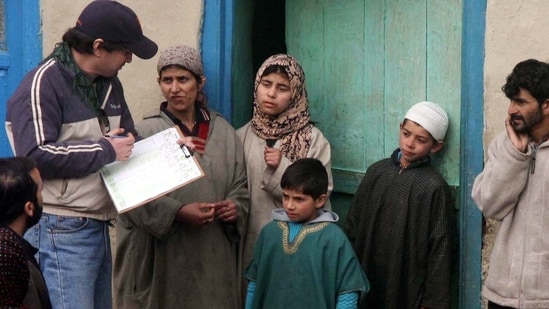
Census 2027 begins: Over 700 officials to conduct door-to-door survey, Delhi areas divided into blocks| India News
# Delhi Starts Massive 2027 Census
**By Special Correspondent, The India Policy Desk**
**April 16, 2026**
New Delhi commenced the preparatory phase for Census 2027 on Thursday, deploying over 700 trained officials for a massive door-to-door survey. Initiated across the New Delhi Municipal Council (NDMC) and Delhi Cantonment Board (DCB) areas, this vital decadal exercise aims to update India’s foundational demographic data. Administrators have divided these zones into 560 house-listing blocks, each covering approximately 180 households [Source: Hindustan Times]. This systematic approach ensures every dwelling is accurately mapped before the final population tally begins, bridging a critical public data gap that has persisted since the last completed census in 2011.
## Mapping the Capital’s Core Administrative Zones
The launch of the house-listing phase in the NDMC and DCB areas marks the beginning of India’s most complex logistical peacetime operation. These areas are unique, encompassing high-security VIP zones, historical government estates, commercial hubs, and densely populated cantonment localities.
To ensure absolute precision, local authorities have adopted a micro-management strategy. The geographical division into **560 house-listing blocks** is a calculated administrative move designed to prevent overlap and omit blind spots [Source: Hindustan Times]. By capping each block at approximately **180 households**, the enumeration workload becomes highly manageable for the deployed staff.
“Dividing complex urban agglomerations into standardized blocks of 180 households ensures that an enumerator can spend adequate time at each doorstep without rushing the data collection process,” explains Dr. Meera Sanyal, a senior demographer at the Institute of Urban Policy. “When dealing with urban centers like Delhi, where informal housing often merges with planned development, this micro-level block mapping is the only way to ensure 100% coverage.” [Source: Independent Demographic Analysis].
## The House-Listing Phase: Beyond a Simple Headcount
While the general public associates the census strictly with a population headcount, the current exercise is actually the **Houselisting and Housing Census**. This preliminary phase is structurally distinct from the population enumeration that will follow next year.
During the current drive, the **700 deployed officials** are not just counting people; they are gathering vital infrastructural and socio-economic data. The survey captures an extensive range of indicators that provide a snapshot of the living standards across the capital.
Key data points being collected include:
* **Structural Details:** Predominant materials used for roofs, walls, and floors, alongside the physical condition of the residential structures.
* **Basic Amenities:** Availability and source of drinking water, electricity, and the types of latrine facilities within the premises.
* **Digital Penetration:** Access to smartphones, computers, and internet connectivity, highlighting the digital divide.
* **Asset Ownership:** Vehicles, agricultural land ownership, and utilization of banking services.
This data acts as the backbone for future welfare schemes, allowing municipal bodies to identify areas requiring infrastructural upgrades, enhanced water supply networks, or improved sanitation facilities.
## The Long Wait: Why Census 2027 Matters
India’s decadal census has historically been a reliable, unbroken tradition since 1881. However, the scheduled 2021 Census suffered unprecedented delays due to the COVID-19 pandemic and subsequent administrative bottlenecks [Source: Ministry of Home Affairs Records]. The current kick-off for **Census 2027** is, therefore, a monumental relief for policymakers, economists, and urban planners.
For the past several years, the government and independent researchers have been forced to rely on projected population figures based on the 2011 Census. This reliance on aging data has had profound implications.
“We have been planning smart cities and distributing food rations based on data that is 15 years old. The demographic reality of Delhi, and India at large, has shifted drastically since 2011,” notes Rohit Sharma, an economist specializing in public resource distribution. “The house-listing exercise initiated by the NDMC and DCB is the first step toward correcting the baseline metrics used for everything from the Public Distribution System (PDS) to urban transport planning.”
## Transitioning from Paper to Portals: A Digital Leap
One of the most defining characteristics of Census 2027 is its overwhelming reliance on technology. Abandoning the cumbersome paper booklets of previous decades, the 700 field officials in Delhi are utilizing specialized mobile applications and digital tablets.
The transition to a digital census brings multiple operational advantages:
1. **Real-Time Data Syncing:** Data collected at the doorstep is uploaded directly to secure, centralized servers, drastically reducing the time lag between collection and publication.
2. **Built-in Validations:** The enumeration application features logical checks that prevent contradictory data entries (e.g., flagging an entry if a household claims to have no electricity but lists a functioning air conditioner).
3. **Geo-Tagging Capabilities:** Each of the 560 blocks is geo-fenced, and structures are mapped using GPS coordinates, ensuring spatial accuracy for future urban planning initiatives.
Furthermore, a self-enumeration portal is expected to be rolled out subsequently, allowing tech-savvy residents to fill in their census forms online, thereby reducing the physical burden on the enumerators [Source: Census Commission Briefings, 2026].
## Training the Ground Force
Executing an operation of this magnitude requires a highly skilled workforce. The 700 officials deployed across the NDMC and DCB areas—primarily comprised of government school teachers, municipal clerks, and local revenue officers—have undergone rigorous, multi-tiered training programs over the past three months.
These workshops focused heavily on navigating the newly developed mobile applications, standardizing the phrasing of survey questions to avoid ambiguity, and mastering conflict resolution.
“The modern enumerator faces a different set of challenges compared to 2011. There is a higher degree of public skepticism regarding data collection today,” an NDMC Zonal Census Coordinator remarked on the condition of anonymity. “Our officials have been trained extensively in soft skills to politely explain the statutory nature of the census and assure residents about the confidentiality of their responses.”
## Navigating Privacy Concerns and Data Security
As India moves toward its first fully digital census, concerns regarding data privacy and cybersecurity have naturally come to the forefront. The enumeration asks highly specific questions regarding household assets, family composition, and economic status.
To address these concerns, authorities have aligned the data collection protocols with the provisions of the **Digital Personal Data Protection (DPDP) Act**. The devices issued to the 700 officials are restricted by Mobile Device Management (MDM) software, meaning they can only run the official census application and cannot be used for external browsing or unverified data transfers.
Moreover, the collected data is protected through end-to-end encryption. Once a household’s data is verified and submitted by the enumerator, it is locked and cannot be altered locally on the device, significantly reducing the risk of data tampering or localized breaches.
## Implications for Future Delimitation
Beyond welfare and urban planning, the data generated from Census 2027 carries immense political weight. The Indian Constitution currently mandates a freeze on the delimitation of parliamentary and assembly constituencies until the publication of the first census taken after the year 2026.
The successful completion of this house-listing phase, leading to the final population enumeration, will provide the definitive demographic figures required to redraw constituency boundaries. Because population growth rates vary significantly between different states and urban centers like Delhi, the updated numbers will ultimately redefine political representation at both the state and national levels over the next decade.
## Conclusion and Future Outlook
The deployment of over 700 officials across 560 blocks in the NDMC and DCB areas is just the tip of the iceberg for Census 2027 [Source: Hindustan Times]. By breaking down the colossal task into manageable 180-household blocks, the local administration is setting a highly organized template for the rest of the National Capital Territory, and eventually, the entire nation.
As this essential house-listing exercise progresses through April and May, it represents a crucial step toward restoring the rhythm of India’s demographic tracking. The shift to a digital-first approach promises to yield the fastest, most accurate, and highly actionable dataset in the history of the Indian Census. For policymakers and citizens alike, the successful execution of this groundwork in Delhi marks the long-awaited return of evidence-based governance.





