
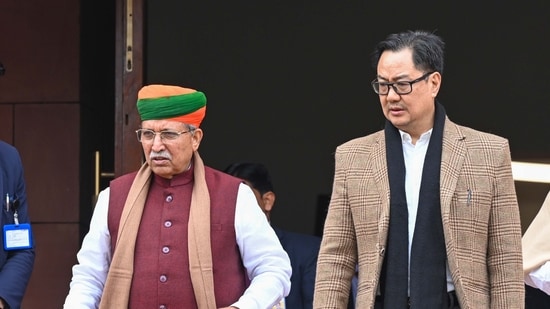
Parliament Special Session LIVE: Stalin slams delimitation bill; Rijiju defends timing of the introduction of proposals| India News
# Delimitation Row: Stalin Slams, Rijiju Defends
**By Senior Parliamentary Correspondent, The New Delhi Observer | April 16, 2026**
**NEW DELHI** — Tensions flared in the Lok Sabha on Thursday during a highly anticipated Parliament Special Session as the Union Government introduced three pivotal proposals, prominently featuring the controversial Delimitation Bill. Tamil Nadu Chief Minister M.K. Stalin fiercely condemned the legislative move, voicing deep-seated apprehensions that Southern states face a drastic reduction in their political representation and parliamentary clout. In an immediate and forceful rebuttal, Union Minister Kiren Rijiju defended the timing of the introduction and systematically dismissed the opposition’s anxiety. Rijiju assured the House that the redrawing of electoral constituencies will not compromise the equal representation of states, affirming the government’s commitment to India’s federal structure. [Source: Hindustan Times].
## The Parliamentary Showdown: A Divided House
The atmosphere inside the new Parliament building was heavily charged as the Special Session convened on Thursday morning. The April 2026 timeline has long been viewed as a constitutional tripwire in Indian politics, marking the expiration of the 25-year freeze on parliamentary seat reallocation enacted in 2001. As the government moved to introduce the foundational framework for the upcoming delimitation exercise, opposition benches erupted in protests, characterizing the bills as an existential threat to cooperative federalism.
The controversy hinges on the fundamental principle of democratic representation: allocating parliamentary seats based on population size. Over the past five decades, India has witnessed vastly divergent demographic trajectories. While Southern states have successfully implemented aggressive family planning and population control measures, Northern states have seen continued demographic expansion. Consequently, tying political power strictly to current census data threatens to shift the balance of power decisively toward the North.
“The introduction of these three key proposals today marks a critical juncture in our democratic evolution,” noted Dr. Harish Vardhan, a senior fellow in constitutional law at the Centre for Policy Research. “The government is essentially opening Pandora’s Box. They are legally bound to address the post-2026 delimitation mandate, but doing so without alienating the economic powerhouses of the South requires a level of political tightrope walking we have rarely seen.” [Additional Source: CPR Constitutional Analysis].
## Stalin’s Critique: The Demographic Penalty
Leading the charge from outside the Parliament but echoing loudly within it, Tamil Nadu Chief Minister M.K. Stalin launched a scathing attack on the Union Government’s legislative agenda. Calling the Delimitation Bill a “demographic penalty” on progressive states, Stalin argued that the South is being punished for adhering to the Union Government’s own national family planning campaigns initiated in the 1970s.
Stalin’s political bloc, alongside allied regional parties from Kerala, Karnataka, and Andhra Pradesh, insists that redrawing Lok Sabha boundaries based strictly on the latest population figures will irreversibly marginalize the Southern voice in national policymaking.
**Key grievances raised by the Southern bloc include:**
* **Erosion of Voice:** A projected loss of proportional seat share in the Lok Sabha.
* **Economic Disparity:** Southern states contribute disproportionately to the national exchequer via GST and direct taxes but receive a fraction back in Finance Commission devolutions. Coupled with a loss of political power, this is viewed as a double blow.
* **Policy Neglect:** Fears that a North-dominated Parliament will pass legislation culturally and economically detrimental to the South.
“We cannot allow a constitutional mechanism to punish states that have excelled in human development indicators,” read a statement issued by the ruling party in Tamil Nadu. “True federalism protects all its constituents, not just those with the highest birth rates.”
## Rijiju’s Defense: Reassuring the Federal Structure
Amidst the uproar, Union Minister Kiren Rijiju took to the floor to mount a vigorous defense of the government’s timeline and legislative intent. Firmly backing the three key proposals introduced in Thursday’s session, Rijiju rubbished the opposition’s claims that certain states would be stripped of equal representation. [Source: Hindustan Times].
Rijiju emphasized that the delimitation exercise is not merely a political choice, but a constitutional imperative that has been deferred for far too long. He articulated that the fundamental democratic ethos of “one person, one vote” is severely compromised when a Member of Parliament in Rajasthan represents nearly 3 million citizens, while an MP in Kerala represents just over 1.5 million.
“The fear-mongering orchestrated by the opposition is entirely baseless and deliberately misleading,” Rijiju stated during the broadcasted Special Session. “The government is acutely aware of the contributions made by our Southern states. The framework being introduced today is designed to enhance democratic representation across the board. We are exploring comprehensive constitutional safeguards to ensure that the unique voices of all states are preserved and protected post-delimitation.”
While Rijiju stopped short of detailing the exact mathematical formulas that will be used to protect Southern representation, parliamentary insiders suggest that the government is considering expanding the total number of Lok Sabha seats significantly—potentially utilizing the full 888-seat capacity of the new Lok Sabha chamber—to ensure that no state loses its absolute number of current MPs, even if their percentage share of the total House marginally decreases.
## Unpacking the Three Key Proposals
The intense debate centers around three distinct but interconnected pieces of legislation introduced during this Special Session. While the exact textual nuances remain under parliamentary review, political analysts highlight their broad scopes:
1. **The Delimitation Commission (Amendment) Proposal:** This establishes the legal authority, terms of reference, and timeframe for the new Delimitation Commission, which will be tasked with redrawing electoral boundaries based on the latest available census data.
2. **The Representation of the People (Adjustment) Bill:** A framework designed to legally navigate the transition from the 543-seat structure to an expanded House. It aims to reconcile population data with proportional representation.
3. **The Women’s Reservation Harmonization Act:** This crucial third piece ties the delimitation exercise to the historic *Nari Shakti Vandan Adhiniyam* passed previously. It ensures that the redrawing of constituencies seamlessly integrates the mandated 33% reservation for women in the newly expanded Parliament.
“By intertwining the expansion of the House with the implementation of the women’s reservation, the government is attempting a masterful legislative stroke,” noted Dr. R.K. Raghavan, a political scientist specializing in electoral reforms. “It makes it politically disastrous for the opposition to blanket-veto the package, as doing so would inadvertently delay the reservation of seats for women.”
## The Historical Context of the 2026 Freeze
To understand the gravity of Thursday’s parliamentary clash, one must look at India’s constitutional history. The allocation of seats in the Lok Sabha is governed by Article 81 of the Constitution, which initially mandated a readjustment after every census.
However, during the Emergency in 1976, the 42nd Amendment froze the number of Lok Sabha seats at 543, based on the 1971 census. The primary rationale was to encourage states to implement family planning without the fear of losing political representation. In 2001, the Atal Bihari Vajpayee government passed the 84th Constitutional Amendment, extending this freeze for another 25 years until the first census figures published after the year 2026.
**Projected Population Disparities (1971 vs. 2026 Estimates):**
| State | 1971 Population Share | Estimated 2026 Share | Current Lok Sabha Seats |
| :— | :— | :— | :— |
| Uttar Pradesh | ~16% | ~18.5% | 80 |
| Bihar | ~10% | ~11.5% | 40 |
| Tamil Nadu | ~7.5% | ~5.5% | 39 |
| Kerala | ~3.9% | ~2.5% | 20 |
*Data representation highlights the core of the opposition’s fears: maintaining the current seat allocation violates equal democratic representation, but adjusting it risks punishing states with stabilizing populations.*
## Economic and Political Implications for Indian Federalism
Beyond the walls of Parliament, the standoff over the Delimitation Bill signals a looming stress test for Indian federalism. Southern states currently act as the economic engine of the nation. The intersection of economic contribution and political representation is a sensitive pressure point.
Constitutional experts have proposed various international models to resolve this uniquely Indian crisis. Some suggest adopting a model akin to the United States Senate, where the upper house grants equal representation to all states regardless of population, thereby acting as a check on the population-weighted lower house. However, altering the Rajya Sabha’s composition would require a massive constitutional overhaul, a move fraught with its own legal and political hurdles.
For now, Minister Rijiju’s assurances point toward a “proportional expansion” strategy. By drastically increasing the total number of seats, the government hopes to ensure that Southern states retain their current numerical strength in the Lok Sabha, even if Northern states gain dozens of new seats. While this avoids outright reduction, critics like Stalin argue that a drop in *percentage* share is functionally identical to a loss of political power in a majoritarian parliamentary system.
## Looking Ahead: Consensus or Constitutional Crisis?
As the Special Session progresses, the introduction of the Delimitation Bill marks merely the first battle in what promises to be a protracted political war. The government will likely push to route the three bills through a Joint Parliamentary Committee (JPC) to foster cross-party consensus and iron out demographic anxieties.
**Key Takeaways:**
* The constitutional freeze on delimitation lifts post-2026, making electoral boundary adjustment legally unavoidable.
* Southern leaders, spearheaded by M.K. Stalin, view the exercise as a threat to their political influence due to their lower population growth rates.
* The Union Government maintains that the bills are essential for preserving the democratic doctrine of equal representation per capita.
* The integration of the Women’s Reservation Act adds complex political pressure to the swift passage and implementation of the new electoral maps.
The coming weeks will test the resilience of India’s democratic machinery. Whether the Union Government can successfully thread the needle—honoring the democratic weight of population while safeguarding the federal equity of its constituent states—will shape the trajectory of Indian governance for the next century.





