
‘Anti-national’: Opposition vows unity to defeat govt's proposal for Lok Sabha expansion| India News
# ‘Anti-National’: Fight Over Lok Sabha Expansion
By Political Correspondent, National Policy Desk, April 16, 2026
**New Delhi** — A fierce political storm has erupted in the capital this Thursday as opposition parties vowed to unite against the Union government’s imminent push to expand the Lok Sabha. Calling the move “anti-national” and detrimental to India’s federal structure, opposition leaders are mobilizing to defeat three pivotal pieces of legislation scheduled for introduction: The Delimitation Bill, 2026, The Constitution Bill, 2026, and the Union Territories Laws (Amendment) Bill, 2026. The proposed legislative overhaul aims to redraw electoral boundaries and increase the number of parliamentary seats, a move critics argue will severely penalize southern states for their historical success in population control while disproportionately empowering northern states. [Source: Hindustan Times]
## The Legislative Triad: Unpacking the 2026 Bills
The root of the current political crisis lies in the expiration of a decades-old constitutional freeze on the number of Lok Sabha seats. Since 1976, the total number of seats in the lower house of Parliament has remained capped at 543. This freeze, originally implemented during the Emergency by then-Prime Minister Indira Gandhi and later extended by the Atal Bihari Vajpayee government through the 84th Constitutional Amendment in 2001, was explicitly designed to last until the first census post-2026.
To navigate this constitutional milestone, the Union government is introducing a triad of bills:
1. **The Constitution Bill, 2026:** This bill seeks to amend Article 81 of the Constitution, lifting the numerical cap of 543 seats and establishing a new formula for state-wise parliamentary representation based on the most recent demographic data.
2. **The Delimitation Bill, 2026:** This legislation will formally establish an independent Delimitation Commission tasked with drawing the physical boundaries of the new constituencies, aiming to equalize the population size within each electoral district.
3. **The Union Territories Laws (Amendment) Bill, 2026:** A supplementary bill ensuring that representation from federally administered regions, particularly Jammu and Kashmir, and Delhi, is proportionately adjusted in accordance with the broader national restructuring.
By introducing these bills, the government argues it is simply fulfilling a constitutional mandate. However, the opposition views the timing, intent, and methodology as a calculated maneuver to permanently alter the balance of power in Indian politics. [Source: Hindustan Times | Additional: Constitutional History of India]
## The Core Conflict: The North-South Demographic Divide
The primary catalyst for the opposition’s outrage is the stark demographic divergence between India’s northern and southern states over the past fifty years. States like Kerala, Tamil Nadu, Andhra Pradesh, and Karnataka implemented rigorous family planning and progressive health policies in the 1980s and 1990s, successfully bringing their Total Fertility Rates (TFR) below the replacement level of 2.1.
Conversely, densely populated northern states, primarily Uttar Pradesh, Bihar, Madhya Pradesh, and Rajasthan, experienced prolonged periods of high population growth. Because parliamentary seats are inherently tied to population metrics—the democratic principle of “one person, one vote”—any unfreezing of the Lok Sabha allocation will mathematically transfer immense political power from the south to the north.
“If this delimitation goes through based purely on current population figures, it will be the greatest electoral injustice in the history of independent India,” states Dr. Arvind Menon, a senior political analyst specializing in federalism at the New Delhi Institute of Electoral Studies. “You are effectively telling states that invested in education, healthcare, and women’s empowerment that their reward is political marginalization.”
### Projected Shift in Lok Sabha Power Dynamics
To understand the opposition’s alarm, one must look at the projected seat distributions. While the Delimitation Commission has not yet finalized its report, independent demographic projections highlight a dramatic shift. The new Parliament building, inaugurated in 2023, was conspicuously designed to accommodate up to **888 Lok Sabha members**, signaling the government’s long-term intention to vastly expand the chamber.
| State | Current Lok Sabha Seats | Projected Seats (Based on 888 total) | Net Shift in Influence |
| :— | :— | :— | :— |
| **Uttar Pradesh** | 80 | ~143 | Massive Increase |
| **Bihar** | 40 | ~79 | Massive Increase |
| **Rajasthan** | 25 | ~50 | Significant Increase |
| **Tamil Nadu** | 39 | ~41 | Relative Decline |
| **Kerala** | 20 | ~20 | Stagnation/Decline |
| **Andhra Pradesh** | 25 | ~28 | Relative Decline |
*(Data represents independent demographic projections circulating among policy analysts as of April 2026).*
As the table illustrates, while southern states may retain their current number of seats or see a negligible increase, their *proportionate* voting power in the 888-seat house will plummet.
## ‘Anti-National’: Opposition’s Rallying Cry
The term ‘anti-national’—historically deployed by the ruling party to criticize dissenting voices—has now been co-opted by the opposition coalition. Leading the charge, opposition figures, notably Rahul Gandhi, have framed the government’s proposal as a direct assault on the cooperative federalism that binds the Indian Union together.
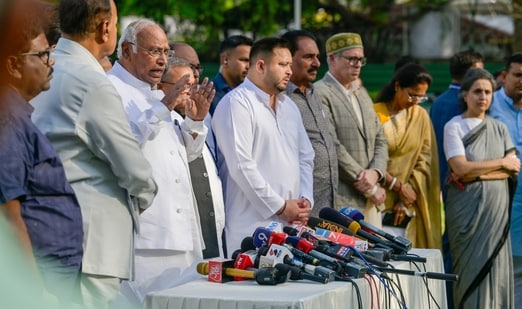
In a joint press conference on Thursday morning, representatives from an array of regional and national parties decried the bills. They argued that true nationalism involves respecting the contributions of all states. By diminishing the political voice of southern states, which contribute substantially to the national GDP and foreign exchange reserves, the government is risking deep regional alienation. [Source: Hindustan Times]
“A policy that punishes good governance and rewards demographic mismanagement is inherently anti-national,” declared a senior Congress spokesperson during the unified briefing. “We will not allow the voices of millions of citizens in the South, East, and West to be drowned out by a sheer numerical advantage manufactured in the Hindi heartland.”
The opposition is demanding that the 1971 population baseline continue to be used for the *inter-state* allocation of seats, even if *intra-state* constituency boundaries are redrawn to account for urbanization.
## The Women’s Reservation Catch-22
Adding a profound layer of complexity to this political battlefield is the implementation of the Nari Shakti Vandan Adhiniyam (Women’s Reservation Act). Passed with near-unanimous support in late 2023, the landmark legislation guarantees 33% reservation for women in the Lok Sabha and state assemblies. However, the government embedded a crucial caveat in the text of the Act: the reservation would only take effect *after* the next delimitation exercise is conducted.
By linking the two monumental shifts, the ruling government has constructed a formidable political trap for the opposition. If the opposition bloc successfully blocks the Delimitation Bill and the Constitution Bill, the government can immediately accuse them of obstructing the long-awaited Women’s Reservation.
“The coupling of delimitation with the women’s quota is a masterstroke of political engineering,” notes Dr. Sunita Rao, a professor of Constitutional Law. “The opposition is caught between alienating their regional vote banks in the South and being branded as anti-women on a national scale. Untangling these two issues will be the opposition’s greatest legislative challenge this session.” [Source: Hindustan Times | Additional: Analysis of 2023 Nari Shakti Vandan Adhiniyam]
## Government’s Stance: “One Person, One Vote”
Unfazed by the backlash, government sources maintain that the unfreezing of seats is not merely a political choice, but a democratic necessity. Since 1971, India’s population has more than doubled. Today, a Member of Parliament from states like Rajasthan or Uttar Pradesh represents up to 3 million constituents, making effective grassroots governance nearly impossible. In contrast, an MP in smaller or southern states might represent fewer than 1.5 million people.
The ruling party argues that allowing such vast discrepancies in the value of a citizen’s vote violates the fundamental democratic principle of equal representation.
“The opposition is fighting against the very tenets of democracy,” stated a Union Minister off-the-record earlier this week. “You cannot claim to protect the Constitution while simultaneously demanding that the vote of a citizen in Bihar hold only half the value of a vote of a citizen in Kerala. The 2026 limitation was a temporary freeze, not a permanent constitutional feature. It is time for India’s Parliament to accurately reflect India’s people.”
## Institutional Mechanisms and Potential Compromises
As the bills head toward the floors of the Lok Sabha and Rajya Sabha, constitutional experts are floating potential compromises to prevent a complete breakdown of federal trust.
Some policy think tanks have proposed a bicameral solution akin to the United States Congress. Under this model, the Lok Sabha would be expanded based strictly on current population figures to satisfy democratic proportionality, while the Rajya Sabha (Council of States) would be restructured to give equal representation to all states, regardless of population, thereby safeguarding federalism.
Another proposed compromise is a financial equalization model, wherein southern states concede political power in the Lok Sabha but receive statutory guarantees of a higher, fixed percentage of central tax revenues from the Finance Commission as compensation for their demographic efficiency.
However, neither the government nor the opposition has signaled a willingness to explore these middle-ground solutions as of yet. Both sides appear entrenched, preparing for a protracted legislative war.
## Conclusion: A Defining Moment for Indian Democracy
The battle over the Delimitation Bill, 2026, the Constitution Bill, 2026, and the Union Territories Laws (Amendment) Bill, 2026, is shaping up to be the most consequential political confrontation of the decade. The outcome of this legislative standoff will dictate the fundamental architecture of Indian electoral politics for the next half-century.
For the government, it is an opportunity to rectify severe representational imbalances and trigger the implementation of the historic Women’s Reservation. For the opposition, it is a desperate fight to protect regional autonomy and prevent what they see as the institutionalization of northern hegemony.
As Parliament prepares to convene to debate these explosive bills, the entire nation—particularly the southern states—watches with bated breath. The definition of Indian federalism itself hangs in the balance, and the unity the opposition has vowed to maintain will be tested against the formidable legislative machinery of the ruling party.





