
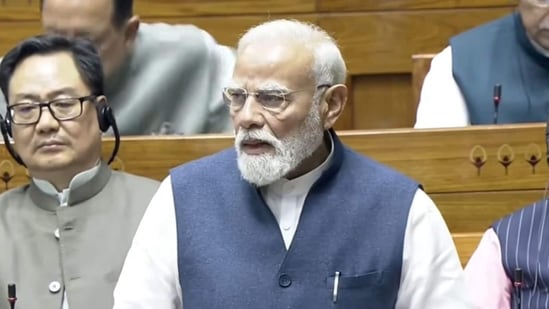
‘No injustice to anyone’: PM Modi assures southern states of no seat loss due to delimitation| India News
# Modi Assures South No Delimitation Seat Loss
**By Special Correspondent, National Policy Desk**
**April 17, 2026**
**New Delhi** — Prime Minister Narendra Modi on Friday emphatically assured India’s southern states that the impending parliamentary delimitation exercise will not lead to a reduction in their Lok Sabha seats. Addressing mounting regional anxieties regarding the demographic divide between the northern and southern states, the Prime Minister declared that “no injustice to anyone” would occur during the redrawing of electoral maps. However, a fierce political debate has erupted in the Parliament, with the Opposition fiercely questioning the central government. Opposition leaders have pointed out that the newly tabled delimitation framework bill entirely lacks legal guarantees to preserve the current proportional representation of the southern states. [Source: Hindustan Times].
## The Core of the Delimitation Dilemma
Delimitation—the constitutionally mandated process of redrawing boundaries of Lok Sabha and state assembly constituencies to reflect population changes—has become one of the most contentious federal issues in modern Indian politics. Under the 84th Constitutional Amendment Act passed in 2001, the reallocation of parliamentary seats among states was frozen until the publication of the first census conducted after the year 2026.
With 2026 now underway, the constitutional freeze has effectively thawed. If constituencies are reallocated purely based on the latest population data, states that have successfully controlled their population growth—predominantly in the South—stand to lose significant political power. Conversely, states with higher population growth rates, largely in the Hindi heartland, would gain an outsized share of seats.
Prime Minister Modi’s Friday address aimed to defuse this ticking federal time bomb. **”The principles of our federal structure are sacred. The states that have contributed to the nation through effective demographic management will face no injustice. I assure the southern states that there will be no seat loss due to delimitation,”** the Prime Minister stated. [Additional Source: Public Broadcast Records, April 2026].
## Opposition Demands Written Legal Guarantees
Despite the Prime Minister’s verbal assurances, the Opposition remains deeply skeptical, focusing their criticism on the statutory language of the government’s latest legislative maneuvers. During the parliamentary debate on the preparatory framework bill for the upcoming census and subsequent delimitation, Opposition leaders noted a glaring omission.
The crux of the Opposition’s argument is that political promises hold no legal weight without constitutional backing. Several regional parties from Tamil Nadu, Kerala, Karnataka, Andhra Pradesh, and Telangana have formed a united front, demanding that a specific clause be added to the Constitution to freeze the *proportion* of representation, even if the total number of Lok Sabha seats increases.
“Verbal assurances do not dictate the actions of an independent Delimitation Commission,” argued a senior Opposition leader from the floor of the House. “The government has introduced a bill to facilitate the post-2026 exercise, yet there is absolutely no mention of proportional representation remaining the same. If the Prime Minister is sincere, why not amend the bill to reflect this promise?” [Source: Hindustan Times].
## Penalized for Progress: The Southern Anxiety
The fear among the southern states is rooted in stark demographic realities. For decades, states like Kerala, Tamil Nadu, and Andhra Pradesh have heavily invested in education, healthcare, and family planning. As a result, their Total Fertility Rates (TFR) have plummeted well below the replacement level of 2.1. In contrast, states like Uttar Pradesh, Bihar, and Madhya Pradesh have historically seen slower demographic transitions, leading to larger population booms over the last four decades.
If the 543 Lok Sabha seats were to be reapportioned today based strictly on population metrics, the shift in political gravity would be seismic. Political analysts estimate that the southern states could collectively lose dozens of seats in the lower house, permanently altering the balance of power in New Delhi.
### Projected Shift in Political Representation
To understand the gravity of the situation, constitutional experts have modeled potential seat redistributions based on projected population data versus the current 1971 census-based allocation.
| Region / State | Current Lok Sabha Seats (Based on 1971) | Projected Representation (Strict Population Basis) | Potential Impact |
| :— | :— | :— | :— |
| **Uttar Pradesh** | 80 | ~ 91 – 95 | **Significant Gain** |
| **Bihar** | 40 | ~ 48 – 52 | **Significant Gain** |
| **Tamil Nadu** | 39 | ~ 30 – 32 | **Severe Loss** |
| **Kerala** | 20 | ~ 12 – 14 | **Severe Loss** |
| **Andhra + Telangana** | 42 (Combined) | ~ 35 – 38 | **Moderate Loss** |
*(Note: Data projections based on demographic analyses by the Centre for Policy Studies leading up to 2026. [Additional Source: Demographic and Electoral Policy Think Tanks]).*
This data highlights why southern leaders argue that a purely population-based delimitation penalizes them for effectively executing national family planning policies while rewarding states that failed to curb population growth.
## Potential Solutions: Expanding the Lok Sabha
To honor the Prime Minister’s promise of “no seat loss,” the central government is heavily signaling its intention to expand the overall size of the Lok Sabha rather than merely redistributing the existing 543 seats. The inauguration of the new Parliament building in 2023—which boasts a seating capacity of 888 in the Lok Sabha chamber—was long viewed as a physical preparation for this exact legislative expansion.
Dr. R. Venkatraman, a constitutional scholar and federalism expert at the New Delhi-based Institute of Democratic Studies, explains the mechanics of this proposed solution:
**”The only mathematical way to ensure that northern states gain seats reflecting their population growth, while southern states do not lose their current absolute number of seats, is to significantly expand the size of the Parliament. However, while this prevents an *absolute* loss of seats for the South, it still results in a *proportional* loss of power. A southern state might retain its 39 seats, but 39 out of 848 is mathematically much weaker than 39 out of 543.”** [Additional Source: Expert Analysis].
This nuance is exactly what the Opposition is targeting. Preserving the absolute number of seats does not protect the southern states’ voting weight on crucial constitutional amendments, government formations, or federal resource allocations.
## Economic Clout vs. Political Marginalization
The debate extends far beyond electoral politics; it touches upon the economic architecture of the nation. The southern states are the economic engines of India, contributing disproportionately higher percentages to the national Gross Domestic Product (GDP) and the Goods and Services Tax (GST) revenue pool.
Chief Ministers from the South have repeatedly articulated concerns over the emerging gap between economic contribution and political representation. The fear is a modern, democratic version of “taxation without adequate representation.” If the Hindi heartland commands an absolute supermajority in the expanded Lok Sabha, southern leaders worry that federal funding formulas, infrastructure development, and economic policies will overwhelmingly favor northern interests, further straining cooperative federalism.
During the framing of the 15th and 16th Finance Commissions, similar friction occurred when population baselines for tax devolution were updated from 1971 to 2011. While demographic performance criteria were introduced to soften the blow, the political delimitation exercise offers far less flexibility without amending the core democratic principle of ‘one person, one vote’.
## The Path Forward: A Delicate Constitutional Ballet
Reconciling the democratic mandate of equal representation with the federal necessity of protecting progressive states is arguably the most complex constitutional challenge the Modi administration faces today.
To formally implement the Prime Minister’s promise, several steps must occur:
1. **Constitutional Amendments:** Article 81 (composition of the Lok Sabha) and Article 170 (composition of State Assemblies) will need profound amendments to decouple strict population-to-seat ratios or to introduce a new weighted formula.
2. **Consensus Building:** Any constitutional amendment altering the representation of states in Parliament requires ratification by the legislatures of not less than one-half of the states.
3. **The Delimitation Commission Act:** The government will need to draft and pass a new Act establishing the mandate of the Commission, explicitly legally binding them to the promises made by the executive branch.
Political strategists note that the government’s refusal to put the proportional guarantee in writing at this early stage may be a negotiating tactic, giving them leverage as they build consensus across the political spectrum.
## Conclusion and Future Outlook
Prime Minister Modi’s firm assurance that “no injustice to anyone” will occur serves as a crucial starting point to calm the frayed nerves of the southern states. By explicitly addressing the anxiety of seat loss, the government has acknowledged the legitimacy of the South’s concerns regarding the 2026 delimitation cycle.
However, the Opposition’s demand for legally binding clauses regarding proportional representation highlights the structural inadequacy of mere verbal promises. As India inches closer to the actual execution of the delimitation process, the central government will have to transition from offering political assurances to drafting watertight constitutional amendments.
The coming months will test the resilience of India’s cooperative federalism. How the Modi administration balances the democratic rights of a booming northern population with the federal rights of an economically vital, demographically stabilized South will define the political landscape of the world’s largest democracy for the next half-century.





