
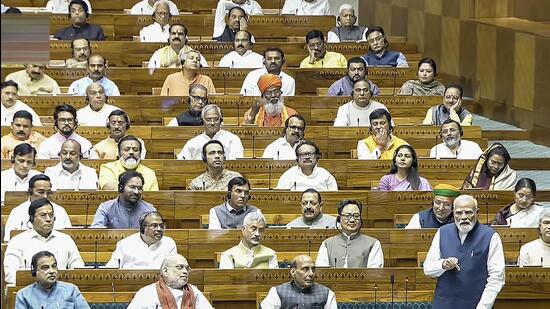
Attendance in focus as Lok Sabha gears up for voting on crucial bills| India News
# Crucial Lok Sabha Vote on 131st Bill
**By Special Correspondent, National Policy Desk**
**April 17, 2026**
**NEW DELHI** — As the Lok Sabha convenes this Friday morning, parliamentary floor managers are facing their most rigorous test of the year. The fate of the pivotal 131st Constitution Amendment Bill hangs in the balance, entirely dependent on the physical presence of Members of Parliament. Following a tepid introduction on Thursday that saw the bill clear its first hurdle with a modest count of 251-185, alarm bells have sounded across party lines. Because the legislation involves amending the Constitution, it mandates a stringent two-thirds majority of members present and voting, alongside an absolute majority of the total House. With 107 lawmakers absent during the introductory vote, attendance has shifted from a matter of routine discipline to a high-stakes numerical battle.
## The Mathematics of Article 368
Passing a constitutional amendment in the Indian Parliament is a deliberately arduous process. Under **Article 368** of the Constitution, the passage of the 131st Amendment Bill cannot rely on a simple majority. It requires two distinct numerical thresholds to be met simultaneously:
1. An absolute majority of the total membership of the House (at least **273** members out of the 543-member Lok Sabha).
2. A special majority of not less than **two-thirds** of the members present and voting.
Thursday’s introductory phase served as a harsh reality check for the treasury benches. The bill was introduced with **251 votes in favor and 185 against**, bringing the total number of voting members to 436 [Source: Hindustan Times].
If these exact attendance numbers were to replicate during the final passage, the bill would fail spectacularly. To pass with 436 members present, the ruling alliance would need 291 votes (two-thirds of 436) and would still fall short of the 273 absolute majority threshold since they currently only demonstrated the backing of 251 MPs.
### Parliamentary Arithmetic at a Glance
| Metric | Number | Implication for the 131st Amendment |
| :— | :— | :— |
| **Total Lok Sabha Strength** | 543 | Baseline for all constitutional calculations. |
| **Absolute Majority Target** | 273 | The minimum affirmative votes required, regardless of absences. |
| **Thursday’s “Ayes”** | 251 | Currently 22 votes short of the absolute majority baseline. |
| **Thursday’s “Noes”** | 185 | Demonstrates strong, unified opposition bench strength. |
| **Total Absentees** | 107 | The critical swing block that floor managers must mobilize today. |
This stark arithmetic underscores why attendance is dominating the discourse in the corridors of Parliament. The ruling party must bridge a critical gap, ensuring that nearly all its absent members and coalition allies are marshaled into the lower house before the electronic voting system is activated.
## Three-Line Whips and Floor Management
In response to Thursday’s close shave, both the ruling coalition and the opposition bloc have escalated their parliamentary enforcement mechanisms. Major political parties have issued draconian **three-line whips**—the strictest directive a party can issue to its MPs, compelling them to be present in the House and vote in accordance with the party leadership’s instructions.
Defying a three-line whip can lead to severe consequences, including disqualification under the Anti-Defection Law (Tenth Schedule of the Constitution). However, a whip cannot magically cure physical impossibilities such as severe health emergencies or grounded flights due to weather disruptions.
“Floor management for a constitutional amendment is a logistical nightmare,” notes Dr. Meenakshi Sundaram, a senior political analyst and fellow at the Institute for Parliamentary Studies. “It is not just about political loyalty; it is about physical logistics. Ensuring that 300-plus individuals from varying geographical locations, some with age-related health issues, are sitting in their designated seats at a specific hour requires military-level coordination.” [Additional Source: Political Analysis Expert Commentary]
The Ministry of Parliamentary Affairs has reportedly set up a dedicated control room to track the real-time location of MPs. Lawmakers who were traveling abroad on official parliamentary committee assignments have been hurriedly recalled, while regional allies have been urged to suspend state-level campaigns to rush to New Delhi.
## Contextualizing the Stakes: The Delimitation Deadline of 2026
The urgency surrounding the 131st Constitution Amendment Bill is deeply tied to the calendar year. The year 2026 represents a historic constitutional juncture for India. Under the 84th Amendment Act passed in 2001, the readjustment (delimitation) of parliamentary constituencies was frozen until the publication of the first census figures after the year 2026.
With 2026 now a reality, the Parliament is faced with the monumental task of addressing this expiring freeze. The 131st Amendment seeks to navigate this complex federal minefield, potentially restructuring electoral representations or extending the freeze to maintain regional demographic parity between the northern and southern states.
Given the profound implications of this bill on the future of India’s electoral map, it is considered one of the most “crucial bills” of the decade [Source: Hindustan Times]. This weight is precisely why the opposition has galvanized 185 members to resist the legislation at its mere introduction phase, signaling a protracted ideological and procedural battle.
“The 131st Amendment goes to the very heart of India’s federal structure and democratic representation,” says senior constitutional lawyer, Alok Verma. “If the government fails to secure the numbers today due to sheer absenteeism, it will not just be a legislative embarrassment; it will trigger a constitutional vacuum regarding the delimitation timeline.”
## The Opposition’s Counter-Strategy
While the treasury benches are focused on maximizing attendance, the opposition’s strategy relies on holding the line. By rallying 185 MPs to vote against the introduction of the bill, the opposition has demonstrated unexpected cohesion.
Their objective is mathematical sabotage: if the opposition can maintain or slightly increase its attendance to around 200 members, the total number of MPs present and voting will rise. As the denominator increases, the two-thirds requirement for the ruling party becomes steeper.
For instance, if the opposition brings 200 MPs and the ruling party manages to bring 300 MPs (totaling 500 members present), the two-thirds requirement jumps to **334**. In this scenario, even with 300 members voting in favor (which easily clears the 273 absolute majority mark), the bill would still fail because it lacks the special two-thirds majority of those present and voting.
Consequently, the opposition is meticulously ensuring that no MP from their bloc abstains or walks out. Historically, walkouts have been a common form of protest in the Indian Parliament, but a walkout in this context would actually help the ruling party by lowering the total number of “present and voting” members, thereby reducing the two-thirds threshold. The mandate for the opposition is clear: stay in the House, press the red button, and force the government to overcome the harshest possible mathematical barrier.
## Implications for National Policy and the Rajya Sabha
The outcome of today’s vote in the Lok Sabha will set a definitive tone for the remainder of the parliamentary session. If the ruling coalition manages to scrape through and pass the 131st Amendment, the battle will shift to the Rajya Sabha (Upper House), where the government’s arithmetic has historically been more precarious. Constitutional amendments must pass through both Houses independently with the exact same special majority; there is no provision for a joint sitting to resolve deadlocks on constitutional bills.
Conversely, if the bill falls through today due to a failure to meet the Article 368 requirements, it will be a historic setback. The government would be forced to prorogue the session, re-strategize, and potentially re-introduce a modified version of the bill in a subsequent session, significantly delaying vital electoral reforms.
Furthermore, a failure to pass the bill could rattle financial markets and political stability, as it would expose vulnerabilities in the ruling coalition’s ability to drive through structural reforms. It would empower regional parties, who have been vocal about their apprehensions regarding electoral restructuring, giving them immense bargaining power ahead of the upcoming state assembly elections.
## Conclusion: The Countdown Begins
As the digital clocks in the Lok Sabha chambers tick closer to the voting hour, all eyes are on the entry gates of the Parliament building. The Thursday tally of **251-185** was the warning shot; Friday is the final showdown [Source: Hindustan Times].
The passage of the 131st Constitution Amendment Bill is no longer merely a debate on policy, federalism, or constitutional law—it has been distilled into a high-stakes test of political logistics and physical presence. Whether it is through chartered flights, postponed surgeries, or canceled international tours, the directive to India’s lawmakers is absolute. In the theater of parliamentary democracy, before one can vote, one must simply show up. The next few hours will determine if the treasury benches have the discipline required to rewrite the nation’s constitutional map.





