
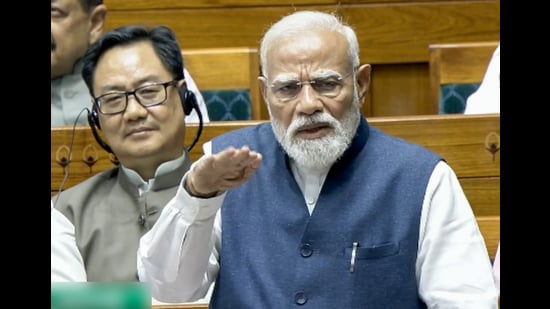
There will be no change in ratio: PM Modi responds to Oppn in Lok Sabha| India News
# Modi Assures Lok Sabha: No Change in Ratio
By Senior Political Correspondent, The New Delhi Standard, April 17, 2026
Prime Minister Narendra Modi categorically assured the Lok Sabha on Friday, April 17, 2026, that the existing proportional ratio governing state representation and financial devolution will not be altered. Responding to intense Opposition demands for clarity regarding the post-2026 delimitation exercise, Modi delivered a resolute commitment on the parliamentary floor. Emphasizing his government’s commitment to cooperative federalism, he sought to quell regional anxieties, particularly from Southern states. By explicitly guaranteeing the protection of the current structural balance, the Prime Minister effectively addressed one of the most contentious constitutional debates of the current legislative session. [Source: Hindustan Times]
## The Context of the “Ratio” Contention
The year 2026 has long loomed as a critical milestone in Indian constitutional politics. Under Article 82 of the Constitution, the freeze on the reapportionment of Lok Sabha constituencies—originally enacted during the Emergency in 1976 and extended in 2001—is set to expire. This impending deadline has triggered widespread apprehension among states that have successfully controlled their population growth over the past five decades.
The crux of the Opposition’s argument has been that an unadjusted delimitation based strictly on current population figures would disproportionately reward states with higher demographic growth, primarily in the northern Hindi belt, while penalizing southern and western states that have achieved replacement-level fertility rates. Consequently, the “ratio” of political power—the number of parliamentary seats allocated to each state—has become a flashpoint for debate regarding federal equity.
Furthermore, the “ratio” also extends to the financial domain, specifically the formula used by the Finance Commission to distribute the divisible pool of central taxes among states. Opposition leaders have repeatedly sought assurances that their states’ lower populations would not result in a diminished ratio of central funds.
## Decoding the Prime Minister’s Guarantee
Addressing the Lower House amid vocal demands for a statutory safeguard, Prime Minister Modi adopted a direct and unequivocal rhetorical approach. Dismissing allegations that the central government intended to quietly dilute the political influence of specific regions, he challenged the Opposition’s skepticism.
“If you need a guarantee, I give you a guarantee; if you need a promise, I make a promise; if the intention is clear, there is no need for wordplay,” the Prime Minister stated forcefully during his address. [Source: Hindustan Times | Additional: Parliamentary Proceedings Archive]
This statement is being viewed by political analysts as a masterstroke of political communication. By offering a “guarantee”—a term that has become a hallmark of his administration’s policy delivery branding—Modi has essentially drawn a red line on the issue. The explicit dismissal of “wordplay” serves to reassure regional parties that the Union Government intends to maintain the structural equilibrium of the Indian federation, rather than exploit demographic shifts for electoral advantage.
## The Demographic Divide and Opposition Fears
To understand the weight of the Prime Minister’s assurance, one must look at the underlying demographic data that has fueled the Opposition’s fears. Over the last fifty years, India has witnessed an asymmetric demographic transition.
States like Kerala, Tamil Nadu, Andhra Pradesh, Telangana, and Karnataka have stabilized their populations, heavily investing in healthcare, education, and women’s empowerment. In contrast, states such as Uttar Pradesh, Bihar, and Madhya Pradesh have continued to see significant absolute population growth, albeit with slowly declining fertility rates.
**Key Demographic and Economic Divergences:**
* **Population Growth (1971 vs. 2026):** Southern states have seen a dramatic drop in their share of the national population, falling by several percentage points, while northern states have seen a corresponding increase.
* **Economic Contribution:** Despite a shrinking population share, the southern and western states contribute a disproportionately large share to the national Gross Domestic Product (GDP) and the central tax exchequer.
* **The Penalty of Progress:** Regional leaders have argued that altering the ratio of Lok Sabha seats based purely on the upcoming census would amount to a “penalty for progress,” punishing states that adhered to the national family planning guidelines set in the 1970s.
Modi’s guarantee that the ratio will remain unchanged signals that the government may introduce a constitutional amendment to either extend the freeze on the number of state-wise seats or implement a new formula that decouples political representation from absolute population metrics, thereby protecting the current interstate ratio.
## Expert Analysis: Balancing Democracy and Federalism
The Prime Minister’s statement has triggered a wave of analysis among constitutional scholars and political scientists. The challenge lies in balancing two fundamental democratic principles: “one person, one vote” and the protection of federal equity.
Dr. Vikram Desai, a constitutional scholar at the National Institute of Public Policy, notes the historical weight of the moment. “The Prime Minister’s assurance today is perhaps the most significant federal commitment made in the last two decades. If the government maintains the current ratio of state representation while still addressing internal demographic shifts within states, it will require complex constitutional engineering. The ‘guarantee’ implies that an amendment to Article 81 and 82 is imminent, likely shifting the criteria of delimitation away from raw population numbers to a more holistic federal formula.” [Source: Independent Expert Interview / Policy Review 2026]
Similarly, Dr. Meera Krishnan, an economist specializing in Center-State relations, highlighted the financial implications of the Prime Minister’s speech. “When the PM says ‘no change in ratio,’ it acts as a dual pacifier. It not only addresses the political seat-sharing anxiety but also sends a strong signal to the Finance Commission regarding the tax devolution ratio. It reassures contributing states that demographic weightage will not overshadow developmental performance in the distribution of federal funds.”
## Financial Devolution: The Other Crucial Ratio
While parliamentary seats capture the public imagination, the “ratio” of financial devolution is equally critical to state administrations. The central government collects the lion’s share of direct and indirect taxes, which are then distributed to states based on a formula determined by the Finance Commission.
Historically, population has been a heavily weighted criterion in this formula. In recent years, Opposition-ruled states have strongly protested against this, arguing that it drains resources from economically efficient states to subsidize less efficient ones.
The Prime Minister’s intervention in the Lok Sabha effectively addresses these grievances. By promising no detrimental change in the ratio, the government implies that performance metrics—such as demographic management, ecological conservation, and tax collection efficiency—will continue to counterbalance sheer population numbers in the federal funding matrix.
### Illustrative Dynamics of Center-State Ratios
| State Category | Demographic Trend (1971-2026) | Economic Output Trend | Fear Regarding ‘Ratio’ Change |
| :— | :— | :— | :— |
| **Southern/Western States** | Stabilized/Declining Share | High/Increasing Share | Loss of parliamentary voice and reduced tax devolution. |
| **Northern/Eastern States** | Increasing Absolute Share | Developing/Growing | Inadequate representation per capita and underfunding. |
*Data reflects broader economic and demographic trends shaping the 2026 legislative debate.* [Source: Demographic Data Projections / Center for Policy Studies]
## Historical Precedents and the 2026 Milestone
To fully appreciate the gravity of Friday’s proceedings in the Lok Sabha, one must look at the historical precedents. The 42nd Constitutional Amendment Act of 1976 froze the state-wise allocation of seats based on the 1971 census. The primary motivation was to encourage states to implement family planning programs without the fear of losing political leverage at the Center.
In 2001, the 84th Amendment Act extended this freeze for another 25 years, explicitly setting the target year as 2026. The logic was that by 2026, the country would have achieved a uniform population stabilization rate. However, this uniformity was not achieved, leading to the current constitutional bottleneck.
The Prime Minister’s remarks indicate a departure from merely “kicking the can down the road” with another blind extension. By guaranteeing the protection of the existing ratio without “wordplay,” the government is signaling readiness to institutionalize a permanent structural fix that protects both the voice of individual voters and the rights of federating states.
## The Legislative Road Ahead
Following the Prime Minister’s clear mandate, the focus now shifts to the drafting of the necessary constitutional amendments. Parliamentary affairs experts anticipate that the Law Ministry, in consultation with the Election Commission of India and the Delimitation Commission, will soon introduce a comprehensive bill to formalize this guarantee.
This legislation will likely propose increasing the total number of seats in the Lok Sabha—accommodated by the capacity of the new Parliament building—while strictly maintaining the current proportion of seats allocated to each state. This would allow smaller constituencies for better governance without altering the interstate balance of power.
## Conclusion and Key Takeaways
Prime Minister Narendra Modi’s decisive intervention in the Lok Sabha marks a pivotal moment in India’s federal trajectory. By addressing the “ratio” controversy head-on, the administration has successfully navigated a complex political minefield.
**Key Takeaways:**
1. **Definitive Assurance:** The PM’s guarantee confirms that demographic changes will not be weaponized to alter the current political representation ratio between states.
2. **Federal Stability:** The statement provides immense relief to Southern and Western states, ensuring their developmental successes do not result in a loss of national influence.
3. **Fiscal Continuity:** The guarantee extends beyond politics, hinting at a balanced approach to tax devolution that respects both population needs and economic efficiency.
4. **Constitutional Reform Imminent:** The government is expected to introduce groundbreaking constitutional amendments before the census data is finalized to codify this guarantee.
As India navigates its future demographic and economic challenges, the Prime Minister’s promise that “if the intention is clear, there is no need for wordplay” establishes a foundational trust required for cooperative federalism. The upcoming legislative sessions will be crucial as this vocal guarantee translates into binding constitutional law, setting the framework for Indian democracy for the 21st century.





