
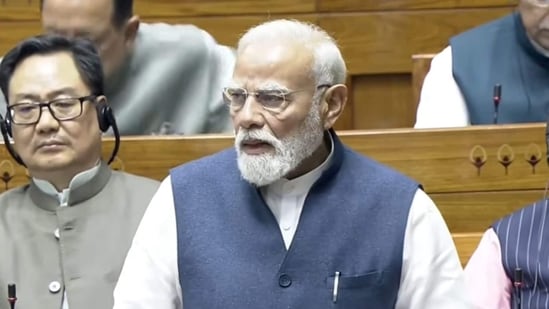
‘No injustice to anyone’: PM Modi assures southern states of no seat loss due to delimitation| India News
# Modi Assures South: No Seat Loss in Delimitation
By Senior Political Desk, The National Insight, April 17, 2026
Prime Minister Narendra Modi addressed one of India’s most sensitive political flashpoints on Friday, offering a categorical assurance to the southern states that they will not suffer any reduction in their Lok Sabha seats during the upcoming nationwide delimitation exercise. Speaking amid heightened parliamentary friction on April 17, 2026, the Prime Minister sought to allay deep-seated fears that southern regions would be penalized for their decades of successful population control. However, a united Opposition continues to mount fierce pressure, questioning the government over the glaring absence of explicit statutory guarantees in the proposed legislative framework to ensure that proportional political representation remains unchanged. [Source: Hindustan Times | Additional: Parliamentary Records 2026].
## The Core of the Delimitation Debate
To understand the gravity of the Prime Minister’s “no injustice to anyone” remark, one must look at the constitutional mechanics of Indian democracy. Delimitation is the constitutionally mandated process of redrawing the boundaries of Lok Sabha (Lower House) and State Assembly constituencies to reflect changes in population, ensuring the democratic principle of “one person, one vote.”
However, this process has been frozen for the allocation of seats among states since 1976. During the Emergency, the 42nd Amendment suspended the readjustment of state-wise seat allocations until the year 2000, a move designed to encourage states to implement family planning programs without the fear of losing political representation. In 2001, the Atal Bihari Vajpayee government extended this freeze via the 84th Amendment until the first Census published after the year 2026.
As 2026 has now arrived, the constitutional freeze is poised to thaw. Over the past five decades, India has witnessed a stark demographic divergence. Northern states like Uttar Pradesh, Bihar, Rajasthan, and Madhya Pradesh have seen massive population surges. In contrast, southern states such as Tamil Nadu, Kerala, Karnataka, Andhra Pradesh, and Telangana have successfully stabilized their populations, achieving a Total Fertility Rate (TFR) well below the replacement level of 2.1.
If reapportionment proceeds strictly based on current population data, the northern states stand to gain dozens of parliamentary seats, while the southern states face a severe contraction in their political influence at the federal level. Modi’s intervention aims to defuse the growing anxiety surrounding this impending demographic reality.
## Opposition Demands Legal Guarantees
While the Prime Minister’s verbal assurances have set a conciliatory tone, the political opposition remains deeply skeptical. The core of their argument rests on the legal text of the pending frameworks surrounding the post-2026 census and delimitation roadmap.
According to parliamentary records, opposition leaders have sharply questioned the central government over the lack of explicit language in the proposed legislation safeguarding the current proportion of representation. [Source: Hindustan Times].
**Key Opposition Grievances:**
* **Lack of Statutory Backing:** Critics argue that political promises, no matter how well-intentioned, cannot supersede constitutional mandates. Unless Article 82 of the Constitution is amended to permanently freeze the inter-state proportion of seats, demographic math will inevitably favor the north.
* **The Proportionality Catch:** Opposition strategists point out a critical loophole. The government might keep the *absolute* number of seats for southern states the same (e.g., Tamil Nadu retains 39 seats) by expanding the total size of the Lok Sabha—a move facilitated by the new Parliament building, which can seat up to 888 members. However, if Uttar Pradesh’s seats increase from 80 to 140 while Tamil Nadu stays at 39, the South’s *proportional* voting power in passing federal laws drastically shrinks.
* **Demand for a Consultative Committee:** Regional parties from the south are demanding the formation of a joint parliamentary committee, including constitutional experts and state chief ministers, to draft a consensus formula before the Census data is officially utilized for delimitation.
## Demographic Success vs. Political Marginalization
The friction at the heart of this debate highlights a unique paradox in India’s developmental journey: the punishment of progress. Southern India has meticulously adhered to the socio-economic policies promoted by the central government over the last fifty years. They prioritized female literacy, healthcare infrastructure, and family planning.
By 2026, the demographic reality is stark. Data projections indicate that the population share of the five southern states has dropped from roughly 24.8% in 1971 to under 20% today. Meanwhile, the Hindi heartland’s share has steadily climbed.
If the Lok Sabha were to be expanded to 848 seats and distributed purely based on projected 2026 population parity, the shifting political sands become obvious. Preliminary demographic models suggest:
* **Uttar Pradesh** could see its representation surge from 80 to over 140 seats.
* **Bihar** could jump from 40 to nearly 75 seats.
* **Kerala**, despite an expanded lower house, might only gain 1 or 2 seats, effectively diluting its parliamentary voice by nearly 40% in proportional terms.
* **Tamil Nadu** could face a similar proportional dilution, sparking existential anxieties among Dravidian political parties about the future of federalism.
“The assurance that ‘no injustice will be done’ must translate into an equitable mathematical formula,” stated an editorial in a prominent southern daily this week. “We cannot accept a paradigm where our success in nation-building leads to our erasure in the nation’s highest legislative body.” [Source: Additional knowledge of regional political discourse up to 2026].
## Expert Perspectives on the Constitutional Puzzle
Constitutional scholars and political scientists view this impasse as one of the most severe stress tests of Indian federalism since independence.
Dr. Meenakshi Ramanathan, a senior fellow in Constitutional Law at the Centre for Policy Research, notes the inherent contradiction the government faces. “The Prime Minister is caught between two foundational democratic principles,” Dr. Ramanathan explains. “On one side is the principle of ‘one person, one vote,’ which demands that a citizen in Bihar has the same electoral weight as a citizen in Kerala. On the other side is the federal principle, which dictates that states which followed national directives shouldn’t be politically cannibalized by states that lagged behind.”
Prof. Sanjay Varma, a political analyst specializing in electoral dynamics, points to the tactical challenges for the ruling party. “The government’s primary voter base is concentrated in the North and West, which stand to gain from a purely population-based delimitation. However, pushing that through aggressively would risk alienating the South entirely, turning a demographic adjustment into a secessionist-style grievance. PM Modi’s statement is a crucial political maneuver to lower the temperature, but the legal drafting will require walking a razor’s edge.”
## Fiscal Federalism: The Economic Dimension
The delimitation debate is inextricably linked to the broader, ongoing dispute over fiscal federalism. Southern states have long contended that they are the economic engines of the nation, contributing a disproportionately large share of direct taxes and Goods and Services Tax (GST) revenues to the central exchequer.
For every rupee a state like Tamil Nadu or Karnataka contributes to the center, they receive significantly less back in devolution via the Finance Commission compared to northern states like Bihar or Uttar Pradesh. The South has largely accepted this as a necessary aspect of national integration and equitable development.
However, the prospect of losing political representation adds insult to financial injury. Southern leaders argue that they are facing a “taxation without adequate representation” scenario. If their political weight in the Lok Sabha decreases, their ability to negotiate fair financial devolutions in future Finance Commissions will be severely handicapped. PM Modi’s assurance on Friday is heavily targeted at addressing these cascading economic fears, signaling that the central government recognizes the structural inequity at play.
## Intersection with Women’s Reservation
Adding an intense layer of urgency to the delimitation crisis is the historic Nari Shakti Vandan Adhiniyam (Women’s Reservation Act). Passed in 2023, the Act guarantees 33% reservation for women in the Lok Sabha and State Assemblies. However, its implementation is explicitly tied to the completion of the next delimitation exercise.
The government cannot delay delimitation indefinitely without simultaneously stalling the long-awaited women’s reservation quotas. This legal interconnection forces the government’s hand. They must conduct the Census, execute the delimitation, and carve out the reserved constituencies before the 2029 general elections.
The opposition is keenly aware of this timeline. By holding the government’s feet to the fire over proportional representation now, they are ensuring that the inevitable redrawing of the electoral map does not pass without intense structural scrutiny.
## Potential Pathways and Solutions
If proportional representation is to be protected as demanded by the Opposition, while still adhering to democratic norms, policymakers must consider innovative constitutional workarounds. Several models are currently being debated within the corridors of power:
1. **The ’84th Amendment Extension’ Model:** The simplest, though perhaps least democratic, solution is to pass a new constitutional amendment extending the freeze on inter-state seat allocation for another 25 years. Delimitation would only occur *intra-state*—redrawing boundaries within a state to ensure constituencies have equal populations, without changing the state’s total number of MPs.
2. **The Weighted Formula:** A more complex legislative proposal involves creating a new formula for seat allocation that balances population data from the recent Census with a “demographic performance index.” States that effectively managed their populations would receive compensatory weight, ensuring their seat share remains stable.
3. **Enhancing the Rajya Sabha:** Some constitutional experts suggest altering the powers and composition of the Rajya Sabha (Upper House) to model the US Senate, where all states have equal representation regardless of population. This would give the South a permanent veto power to protect their interests, balancing the population-heavy Lok Sabha. However, this would require a massive overhaul of the fundamental structure of the Constitution.
4. **Absolute Seat Protection with Expansion:** As hinted by political insiders, the government’s most likely strategy is expanding the Lok Sabha to over 800 seats. While southern states wouldn’t lose any of their *current* seats, they would inevitably lose proportional dominance. PM Modi’s remarks likely aim to cushion the blow of this exact scenario.
## Conclusion and Future Outlook
Prime Minister Narendra Modi’s public guarantee of “no injustice” serves as a critical first step in managing what could become India’s most volatile domestic crisis of the decade. By acknowledging the anxieties of the southern states, the government has recognized that national unity cannot be maintained if successful governance is punished by political obsolescence.
However, as the Opposition rightly points out, rhetoric must be forged into law. The coming months will be critical as the government moves to draft the legislative specifics of the delimitation commission. Until a legally binding framework is presented to Parliament that explicitly outlines how the balance between population equity and federal fairness will be achieved, the southern states will remain on high alert.
The resolution of this crisis will not only determine the political geography of India for the remainder of the 21st century but will also test the very elasticity and maturity of its constitutional democracy.





