
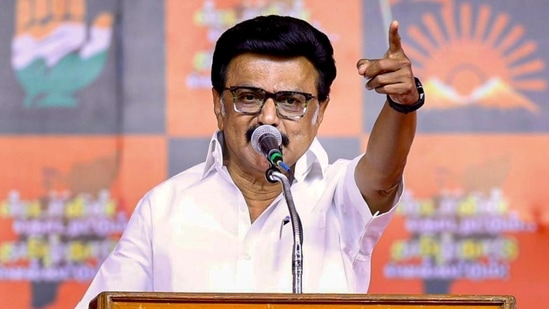
From teen volunteer to chief minister: the rise of MK Stalin
# MK Stalin: Teen Volunteer to Chief Minister
By Senior Political Correspondent, The National Policy Desk, April 17, 2026
Tamil Nadu Chief Minister MK Stalin marks over five decades in public life this April 2026, evolving from a 14-year-old grassroots volunteer to the state’s paramount political figure. Born into the formidable Dravida Munnetra Kazhagam (DMK) legacy, Stalin has systematically carved his own identity out of the towering shadow of his father, M. Karunanidhi. From organizing youth campaigns in the late 1960s to modernizing Chennai as its Mayor, and now steering one of India’s most industrialized states, his trajectory reflects remarkable endurance and strategic acumen. This article unpacks five key facts about his rise, assessing his profound impact on regional governance and national opposition politics. [Source: Original RSS | Additional: Hindustan Times / Electoral Records]
## Fact 1: The Crucible of the Emergency
While critics often point to his familial ties as the catalyst for his political ascent, MK Stalin’s early years were defined by genuine grassroots struggle and significant personal hardship. His political baptism by fire occurred during the infamous 1975-1977 Emergency imposed by then-Prime Minister Indira Gandhi.
In 1976, Stalin was arrested under the controversial **Maintenance of Internal Security Act (MISA)**. He spent nearly a year incarcerated in Chennai Central Prison. Political historians often cite this period as the moment the young Stalin transitioned from a political heir to a legitimate political entity in the eyes of the DMK cadre.
“The MISA imprisonment was a turning point. It stripped away the ‘prince’ moniker and replaced it with a badge of resistance,” notes Dr. V. Suryanarayan, a Chennai-based political analyst. “He endured severe physical hardship during his detention, famously being protected from police brutality by senior DMK leader C. Chittibabu, who tragically lost his life due to those injuries. This sacrifice cemented Stalin’s emotional bond with the party’s rank and file.” [Source: Public Historical Archives]
## Fact 2: Architect of the DMK Youth Wing
Unlike many political successors who are parachuted directly into top cabinet positions, Stalin’s organizational ascent was deliberately gradual. **His most significant structural contribution to the DMK was the formation and expansion of the party’s Youth Wing (Ilaingar Ani).**
Starting as a youth campaign committee member in 1968, Stalin formally took charge of the newly constituted Youth Wing in 1980. Over the next three decades, he toured the length and breadth of Tamil Nadu, setting up unit offices in almost every district, taluk, and village. This exhaustive groundwork allowed him to build a loyal cadre base that answered directly to him.
By prioritizing grassroots mobilization over immediate electoral glory, Stalin ensured that when he eventually took the reins of the primary party, he had a vast network of mid-level leaders who had grown up alongside him. This demographic dividend proved crucial in keeping the DMK relevant during the AIADMK’s periods of dominance under M.G. Ramachandran and J. Jayalalithaa.
## Fact 3: Chennai’s Transformational First Citizen
MK Stalin’s executive capabilities were first proven not in the state secretariat, but in the civic headquarters of the state’s capital. In 1996, he made history by becoming the **first directly elected Mayor of Chennai** (then Madras).
His mayoral tenure is widely regarded as a golden period for urban development in the metropolis. Stalin launched the ambitious “Singara Chennai” (Beautiful Chennai) initiative, which aimed to modernize the city’s crumbling infrastructure.
Key achievements during his tenure included:
* **Decongestion Initiatives:** The construction of nine major mini-flyovers across critical traffic bottlenecks, completed remarkably under budget and ahead of schedule.
* **Civic Modernization:** Privatization of solid waste management in key zones, drastically improving the city’s sanitation metrics.
* **Green Spaces:** The creation of numerous public parks and the restoration of civic facilities.
“As Mayor, Stalin demonstrated a technocratic approach to governance. He was accessible, project-oriented, and focused on tangible urban deliverables,” says urban planning expert K. Rangarajan. His success was recognized when he was re-elected in 2001, though legislative changes eventually forced him to step down to focus on his MLA duties. [Source: Original RSS | Additional: Chennai Corporation Civic Records]
## Fact 4: The Strategic Understudy Who Bided His Time
Perhaps the most defining characteristic of MK Stalin’s rise is his exceptional patience. Despite his vast organizational control and administrative success, he spent decades waiting in the wings while his father, M. Karunanidhi, dominated the political landscape.
Stalin became a Member of the Legislative Assembly (MLA) for the first time in 1989. However, it wasn’t until 2006 that he was appointed as a minister in the state cabinet, holding the crucial Rural Development and Local Administration portfolio. In 2009, he was elevated to the post of **Deputy Chief Minister**, the first in Tamil Nadu’s history.
Following Karunanidhi’s death in 2018, Stalin was unanimously elected as the President of the DMK. He inherited a party that had been out of power for a decade. Demonstrating immense strategic restraint, he revamped the party’s digital outreach, formed cohesive alliances, and led the Secular Progressive Alliance to massive victories in the 2019 general elections and the 2021 state assembly elections.
### Timeline of MK Stalin’s Political Journey
| Year | Key Milestone |
| :— | :— |
| **1968** | Forms the Gopalapuram Youth Club |
| **1976** | Incarcerated under MISA during the Emergency |
| **1980** | Takes charge of the DMK Youth Wing |
| **1989** | Elected as MLA for the first time from Thousand Lights |
| **1996** | Becomes the first directly elected Mayor of Chennai |
| **2009** | Appointed as the first Deputy Chief Minister of Tamil Nadu |
| **2018** | Elected as the President of the DMK |
| **2021** | Sworn in as the Chief Minister of Tamil Nadu |
## Fact 5: Champion of the ‘Dravidian Model’
Upon finally assuming the office of Chief Minister in May 2021, Stalin rapidly conceptualized and aggressively marketed his governance framework, which he coined the **”Dravidian Model” (Dravida Model)**.
This model explicitly contrasts with the central government’s policies, focusing heavily on inclusive social justice combined with aggressive industrialization. Stalin’s administration up to 2026 has been marked by several flagship welfare schemes:
1. **Kalaignar Magalir Urimai Thittam:** A universal basic income scheme providing ₹1,000 monthly to eligible women heads of families, significantly boosting rural economic independence.
2. **Chief Minister’s Breakfast Scheme:** An expansion of Tamil Nadu’s historic mid-day meal scheme, providing nutritious morning meals to primary school children across the state, which has statistically improved school attendance and nutritional metrics.
3. **Naan Mudhalvan:** A massive upskilling initiative aimed at making the state’s youth globally employable.
Concurrently, Stalin has aggressively pursued foreign direct investment, transforming Tamil Nadu into an advanced manufacturing hub for electric vehicles (EVs), electronics, and renewable energy. His administration’s target of making Tamil Nadu a $1 Trillion economy by 2030 has driven extensive global outreach programs, cementing the state as an economic powerhouse. [Source: Tamil Nadu State Policy Notes 2025-2026]
## National Implications and Federal Resistance
Beyond state borders, MK Stalin’s five-decade journey has culminated in him becoming one of the most vital pillars of the national opposition against the Bharatiya Janata Party (BJP). He has consistently championed state autonomy, linguistic equality, and fiscal federalism.
By maintaining a tightly knit coalition in Tamil Nadu—accommodating the Congress, left parties, and marginalized regional groups—Stalin has provided a blueprint for opposition unity that the national INDIA bloc has frequently sought to emulate. His staunch resistance to perceived Hindi imposition and centralized education policies (like NEET) has made him the ideological standard-bearer for Southern Indian political sentiments.
“Chief Minister Stalin has transformed the DMK from a regional heavyweight into a national ideological anchor,” explains Dr. R. Ilangovan, a senior fellow at the Center for South Indian Studies. “His ability to seamlessly blend hardcore Dravidian ideology with modern, investor-friendly governance has created a formidable political fortress in Tamil Nadu.”
## Conclusion: A Legacy Cemented in Grassroots
MK Stalin’s political life—from a teenager pasting party posters on the streets of Chennai to the Chief Minister commanding the destiny of 80 million people—is a testament to political stamina. The original RSS snippet aptly categorizes his five-decade journey as a transition from a “grassroot-level volunteer to a state-wide leader.” [Source: Original RSS]
While the advantages of his birth are undeniable, his longevity and current supremacy in Tamil Nadu politics are products of immense personal labor, strategic patience, and an astute understanding of the electorate. As Tamil Nadu navigates the complexities of the late 2020s, MK Stalin’s ‘Dravidian Model’ stands as both a shield against centralized homogenization and a beacon for decentralized, inclusive economic growth. Whether viewed through the lens of a former political prisoner, a transformative Mayor, or a resolute Chief Minister, Stalin’s legacy is unequivocally woven into the modern fabric of Tamil Nadu.





