
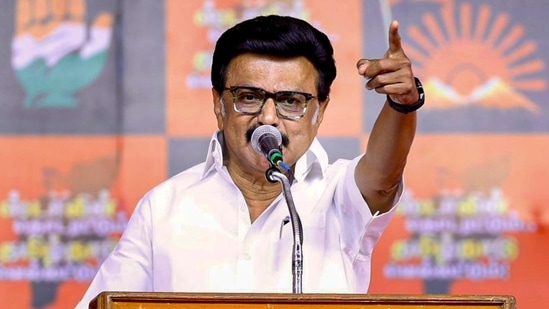
From teen volunteer to chief minister: the rise of MK Stalin
# MK Stalin’s Rise to Power: 5 Key Facts
**By Senior Political Correspondent, National Desk | April 17, 2026**
Muthuvel Karunanidhi Stalin, the current Chief Minister of Tamil Nadu, has navigated a remarkable political journey spanning over five decades. On Friday, as political analysts evaluate the landscape ahead of the upcoming state assembly elections, his trajectory from a grassroots teenage volunteer to a formidable state-wide leader remains a focal point of Dravidian politics. Having transformed the Dravida Munnetra Kazhagam (DMK) into a modern electoral juggernaut, Stalin has successfully institutionalized his “Dravidian Model” of governance. This article explores five key facts defining his meteoric rise, examining how early struggles, imprisonment, and administrative milestones shaped Tamil Nadu’s chief executive. [Source: Hindustan Times | Additional: Historical political archives].
## 1. The Genesis: From Teenage Volunteer to Youth Wing Pioneer
While being the son of M. Karunanidhi—one of India’s most iconic political stalwarts—certainly provided proximity to power, Stalin’s entry into politics was distinctly grassroots. At the tender age of 14, while his peers were focused on academics and recreation, Stalin initiated the **Gopalapuram Youth Club**. Alongside his neighborhood friends, he organized local campaigns and community service initiatives, laying the foundational brick of his political career during the critical 1967 elections, which saw the DMK capture power in Tamil Nadu for the first time.
His early work culminated in the formation of the DMK Youth Wing in 1980. For decades, Stalin served as its secretary, traveling to every corner of Tamil Nadu to recruit young cadres and build a loyal base. This on-the-ground engagement was critical. It differentiated him from parachute politicians who rely solely on dynastic legacy.
“MK Stalin’s formative years were not spent comfortably in the corridors of power, but in the dusty streets of Chennai organizing the youth,” notes Dr. S. Ramanathan, a veteran political scientist specializing in South Indian politics. “By building the youth wing from scratch, he created a parallel organizational structure that remained fiercely loyal to him, eventually becoming the backbone of the mainstream party.”
## 2. The Crucible: The Emergency and MISA Incarceration
Perhaps no single event forged Stalin’s political credibility more than his imprisonment during the 1975-1977 National Emergency. At a time when civil liberties were suspended across India, the DMK government in Tamil Nadu strongly opposed the central mandate, leading to the dismissal of the state government.
In 1976, Stalin was arrested under the draconian **Maintenance of Internal Security Act (MISA)**. His incarceration in the Central Prison, Chennai, was a harrowing experience. Historical accounts and party lore detail the physical hardships and abuse he endured while detained. Another prominent DMK leader, C. Chittibabu, tragically lost his life due to injuries sustained while allegedly protecting Stalin from police brutality inside the prison.
This period was a baptism by fire. The MISA arrest effectively silenced internal party critics who viewed him merely as the patriarch’s son. He emerged from prison not as a privileged heir, but as a recognized political martyr who had bled for the party’s democratic ideals. This sacrifice remains a central pillar of his political narrative, frequently referenced during election campaigns to underscore his lifelong commitment to democratic values. [Source: Historical political archives].
## 3. Executive Proving Ground: The First Directly Elected Mayor of Chennai
Before leading the state, Stalin had to prove his administrative mettle in the state’s capital. In 1996, he achieved a historic milestone by becoming the **first directly elected Mayor of Chennai**. His tenure was marked by rapid urbanization efforts and a modernization drive that significantly altered the city’s infrastructure.
He introduced the ambitious **”Singara Chennai” (Beautiful Chennai)** initiative. Under this banner, the city saw a massive overhaul of its civic infrastructure. Key achievements during his mayoral tenure included:
* **Infrastructure Boom:** The construction of nine major flyovers to decongest Chennai’s notoriously gridlocked traffic.
* **Civic Improvements:** Upgrades to waste management systems, public parks, and sanitation facilities.
* **Modernization:** Streamlining the Chennai Corporation’s grievance redressal systems.
His performance as Mayor was widely lauded, earning him the moniker “Thalapathy” (Commander). It showcased his ability to execute large-scale public projects, transforming his image from a street-corner agitator and youth organizer to a capable, pragmatic administrator. He was re-elected in 2001, though he later stepped down due to the enactment of a “one-man, one-post” law by the rival AIADMK government.
## 4. The Long Apprenticeship: Stepping Out of the Patriarch’s Shadow
Despite his successes, Stalin endured one of the longest political apprenticeships in modern Indian history. Governing in the shadow of a towering figure like M. Karunanidhi required immense patience and political maneuvering. He slowly climbed the state hierarchy, serving as the Minister for Rural Development and Local Administration in 2006, and later being elevated to **Deputy Chief Minister in 2009**.
However, the definitive transition of power within the DMK was a gradual, highly scrutinized process. As Karunanidhi’s health declined, Stalin was appointed the Working President of the DMK in 2017. Following his father’s passing in 2018, he was unanimously elected as the Party President.
The pressure was immense. Critics questioned whether Stalin could hold the party together and match his father’s electoral alchemy. He answered these doubts emphatically by forging a formidable Secular Progressive Alliance. Stalin led the DMK-led coalition to a sweeping victory in the 2019 Lok Sabha elections, almost wiping out the opposition in Tamil Nadu, and subsequently secured a decisive mandate in the 2021 State Assembly elections, officially ending a decade of AIADMK rule.
“Stalin’s greatest political achievement was keeping the DMK united post-Karunanidhi,” explains independent political analyst Meera Chandran. “He meticulously marginalized internal dissent, modernized the party’s campaign machinery, and built alliances that were mathematically unbeatable.”
## 5. The Chief Minister: Championing the ‘Dravidian Model’
Sworn in as the Chief Minister in May 2021 amidst the devastating second wave of the COVID-19 pandemic, Stalin faced an immediate trial by fire. His calm, inclusive approach to crisis management—including forming bipartisan advisory committees—won him widespread praise across the political spectrum.
Over the past five years, up to the current landscape in 2026, his governance has been anchored in what he terms the **’Dravidian Model’**—an ideological framework emphasizing inclusive growth, social justice, women’s empowerment, and rapid industrialization.
Key hallmarks of his administration include:
* **Kalaignar Magalir Urimai Thittam:** A landmark universal basic income scheme providing ₹1,000 monthly to over a crore eligible women, significantly boosting rural household economies.
* **Pudhumai Penn and Tamil Pudhalvan:** Financial assistance schemes encouraging female and male students from government schools to pursue higher education.
* **Economic Ambition:** Setting an aggressive target to make Tamil Nadu a $1 Trillion economy by 2030, supported by relentless foreign direct investment (FDI) campaigns and global investors’ meets.
* **Social Justice:** Passing legislative resolutions to maintain state autonomy, particularly opposing standardized national exams like NEET, which the state argues disadvantages rural and marginalized students. [Source: State Legislative Records].
By blending robust welfarism with aggressive capitalist growth, Stalin has attempted to create a distinct governance model that stands in sharp contrast to national paradigms, securing his position as a crucial ideological counterweight in Indian politics.
## Analysis and Future Outlook for Tamil Nadu
As Tamil Nadu edges closer to the state assembly elections in the coming months of 2026, MK Stalin’s legacy and future strategy are under the microscope. His journey from a teenage volunteer to a regional titan has fortified his resilience, but the challenges ahead remain substantial.
He currently balances the demands of managing massive state debt with fulfilling expansive welfare promises. Furthermore, the political landscape is evolving. The opposition, including an aggressive push by the Bharatiya Janata Party (BJP) to gain a foothold in the Dravidian heartland, requires Stalin to continually reinvent his strategies. There is also the internal dynamic of succession planning, with his son, Udhayanidhi Stalin, taking on increasingly prominent roles within the cabinet and the party.
At the national level, Stalin’s role within the broader opposition framework (the INDIA bloc) has cemented him as a kingmaker and a vocal defender of federalism and states’ rights. He has adeptly positioned Tamil Nadu as a progressive, industrialized state that contributes heavily to the national exchequer while demanding fair fiscal devolution.
## Conclusion
MK Stalin’s political biography is not merely a tale of dynastic succession, but one of rigorous endurance, calculated patience, and administrative evolution. The five key facts of his rise—his grassroots youth wing origins, his suffering during the Emergency, his transformative stint as Chennai’s Mayor, his patient consolidation of party power, and his current stewardship of the ‘Dravidian Model’—paint a picture of a leader deeply entrenched in the socio-political fabric of his state.
As 2026 unfolds, whether Stalin can secure a consecutive mandate will depend on his ability to sustain his economic promises while fending off emerging political rivals. Nevertheless, his fifty-year journey ensures that his impact on Tamil Nadu’s development and India’s federal discourse will be studied for generations to come.





