
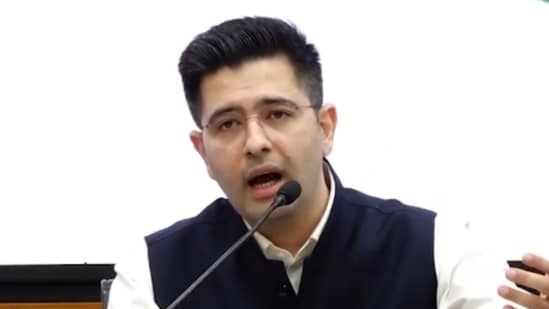
Raghav Chadha news LIVE updates: Raghav Chadha quits AAP, says 6 other MPs joining BJP to retain Rajya Sabha membership| India News
# Chadha Quits AAP; Joins BJP With 6 RS MPs
**By Political Desk, National Affairs | April 24, 2026**
On Friday, April 24, 2026, the Aam Aadmi Party (AAP) suffered an unprecedented political earthquake as senior leader and Rajya Sabha Member of Parliament Raghav Chadha resigned from the party to formally merge its Upper House faction with the Bharatiya Janata Party (BJP). Orchestrating a meticulously planned exit in New Delhi, Chadha announced that seven of AAP’s ten Rajya Sabha MPs have crossed over to the ruling BJP. This mass defection, satisfying the two-thirds majority required to bypass the anti-defection law, guarantees the lawmakers retain their parliamentary memberships. The strategic maneuver drastically alters the power dynamics within the Upper House, cripples AAP’s national footprint, and hands the BJP a critical legislative advantage heading into the next parliamentary session.
## The Anatomy of the Defection
The political corridors of New Delhi were left stunned when Raghav Chadha, traditionally viewed as a core loyalist of the AAP high command and a key architect of the party’s Punjab victory, addressed a press conference announcing his departure. He was not alone. The defection encompasses a total of seven AAP Members of Parliament from the Upper House.
According to primary reports, prominent figures joining Chadha in this merger include former international cricketer Harbhajan Singh and Lovely Professional University chancellor Ashok Mittal, both of whom were nominated to the Rajya Sabha from Punjab by AAP [Source: Hindustan Times].
**Key Facts of the Merger:**
* **Total AAP Rajya Sabha MPs:** 10
* **Number of Defecting MPs:** 7
* **Threshold Required for Legal Merger (2/3rd):** 6.6 (Effectively 7 MPs)
* **Primary Motivation Cited:** “Developmental politics” and alignment with national interests.
By securing the exact number of MPs required, Chadha has effectively executed a “legislative merger” rather than a standard defection. In his address, Chadha remarked that the defecting group represents the “real voice of the mandate” and stated that the Aam Aadmi Party had deviated from its foundational anti-corruption ethos, becoming mired in administrative paralysis and confrontational politics.
## Navigating the Tenth Schedule: A Legal Masterstroke
To understand the mechanics of this move, one must examine the Tenth Schedule of the Indian Constitution, colloquially known as the anti-defection law. Enacted to curb political opportunism, the law stipulates that any elected member who voluntarily gives up the membership of their political party is subject to disqualification.
However, Paragraph 4 of the Tenth Schedule provides a critical exemption: if two-thirds of the members of a legislative party agree to merge with another political party, they are protected from disqualification [Source: Constitutional Law Archive].
Dr. Ananya Sharma, a constitutional law expert and senior fellow at the Institute for Democratic Studies, explains the legality of Friday’s events:
*”The anti-defection law recognizes a split only if it meets the two-thirds threshold and culminates in a merger with an existing party or the formation of a new one. By rallying exactly seven out of ten MPs, Raghav Chadha has legally insulated his faction. The Rajya Sabha Chairman is constitutionally bound to recognize this as a valid merger of the AAP legislative party into the BJP, leaving the original AAP with virtually no legal recourse to demand their disqualification.”*
This strategy mirrors past political realignments, such as the 2019 incident when four out of six Telugu Desam Party (TDP) Rajya Sabha MPs merged with the BJP.
## AAP’s Compounding Crises and Leadership Vacuum
The mass exodus led by Chadha did not occur in a vacuum; it is the culmination of years of mounting internal and external pressures on the Aam Aadmi Party. Over the past three years, AAP has been besieged by investigations from central law enforcement agencies, including the Enforcement Directorate (ED) and the Central Bureau of Investigation (CBI).
With top-tier leaders facing prolonged legal battles and incarcerations related to the Delhi excise policy case and other administrative controversies, the party’s second-rung leadership found itself operating in a volatile, high-risk environment.
Political analysts note that Chadha, who has spent much of the last year navigating his own political and legal challenges, likely viewed the BJP merger as a mechanism for political survival. During the press briefing, Chadha subtly alluded to these institutional struggles, stating, *”We entered politics to build schools, hospitals, and secure India’s future. Over the last two years, our energies have been entirely consumed by fighting court cases and engaging in vindictive politics. The people of Punjab and Delhi deserve representatives who can work seamlessly with the central government to bring actual development.”* [Source: Hindustan Times Live Updates].
## Strategic Implications for the BJP
For the Bharatiya Janata Party, absorbing seven AAP MPs is a monumental legislative and psychological victory. The Rajya Sabha has historically been the sole legislative arena where the BJP-led National Democratic Alliance (NDA) has occasionally struggled to command an absolute majority, forcing it to rely on friendly opposition parties to pass contentious constitutional amendments.
The addition of these seven MPs drastically bolsters the NDA’s arithmetic in the Upper House. Furthermore, it serves as a massive psychological blow to the opposition INDIA bloc, projecting an image of inevitability and dominance for the ruling party.
**Status of AAP Rajya Sabha Defections (As of April 2026):**
| MP Name | Original Party | Merged Party | Representing State | Reason for Exemption |
| :— | :— | :— | :— | :— |
| Raghav Chadha | AAP | BJP | Punjab | 2/3rd Majority Merger |
| Harbhajan Singh | AAP | BJP | Punjab | 2/3rd Majority Merger |
| Ashok Mittal | AAP | BJP | Punjab | 2/3rd Majority Merger |
| *[Four Others]* | AAP | BJP | Punjab/Delhi | 2/3rd Majority Merger |
*Table: Data derived from the April 24, 2026, legislative realignment.*
Beyond the numbers, this merger provides the BJP with high-profile faces in Punjab—a state where the party has historically struggled to establish a dominant grassroots presence, particularly following the agrarian protests earlier in the decade. Leaders like Harbhajan Singh carry significant cultural cachet, while Raghav Chadha offers youthful, articulate representation that the BJP can leverage in upcoming state elections.
## AAP’s Retaliation: Accusations of ‘Operation Lotus’
The reaction from the remnants of the Aam Aadmi Party has been swift and vitriolic. Senior AAP leaders have decried the development as the darkest day for Indian democracy, accusing the BJP of utilizing central agencies to blackmail and coerce their parliamentarians.
AAP spokespersons immediately invoked the term “Operation Lotus”—a moniker frequently used by opposition parties to describe the BJP’s alleged tactics of toppling state governments and poaching elected representatives through a mix of intimidation and financial inducement.
“This is not a merger; it is a hostile takeover orchestrated at gunpoint by the Enforcement Directorate,” declared a senior AAP cabinet minister in Delhi. “Raghav Chadha and the others have betrayed the mandate of the people of Punjab. The voters elected them because they stood against the BJP’s dictatorial policies. History will not forgive this capitulation.”
Despite the fierce rhetoric, AAP’s legal options remain severely limited. The party has indicated it will file an urgent petition before the Chairman of the Rajya Sabha and subsequently approach the Supreme Court of India, arguing that the legislative party cannot merge without a corresponding resolution from the party’s organizational structure. However, historical precedent heavily favors the defectors in cases where the two-thirds legislative threshold is demonstrably met.
## Ripples in Punjab Politics
The epicenter of this shockwave is undoubtedly Punjab. In 2022, AAP swept the Punjab assembly elections, subsequently nominating a full slate of seven candidates to the Rajya Sabha. The fact that a majority of these very nominees have now abandoned the party raises severe questions about the internal stability of Chief Minister Bhagwant Mann’s government.
While the defection is restricted to the Rajya Sabha and does not directly threaten the survival of the AAP government in the Punjab state assembly, it acts as a massive vote of no-confidence from the party’s own elites. It signals to the electorate and local MLAs that the party’s central leadership is rapidly losing its grip.
Local political commentators suggest that the BJP will use these new acquisitions to mount a fierce campaign against the Mann administration, citing governance failures, agricultural distress, and a deteriorating law-and-order situation. The defected MPs, deeply familiar with AAP’s internal electoral machinery in Punjab, will prove to be formidable assets for the BJP’s regional strategy.
## Future Outlook
As the dust settles on Friday’s dramatic events, the political landscape of India leading up to the next electoral cycles has been irrevocably altered. Raghav Chadha’s transition from a founding pillar of the Aam Aadmi Party to a BJP parliamentarian highlights the fluid, often ruthless nature of Indian politics where ideological lines frequently blur in the face of political pragmatism and legal pressures.
For the BJP, the acquisition is a masterstroke in realpolitik—securing crucial parliamentary numbers while dismantling a vocal opposition rival from the inside. For AAP, the departure of 70% of its Rajya Sabha strength is an existential crisis that will force the party to fundamentally reassess its survival strategy. Whether this defection is an isolated parliamentary maneuver or the first domino in a broader collapse of AAP’s legislative footprint remains the most critical question in Indian politics today.





