
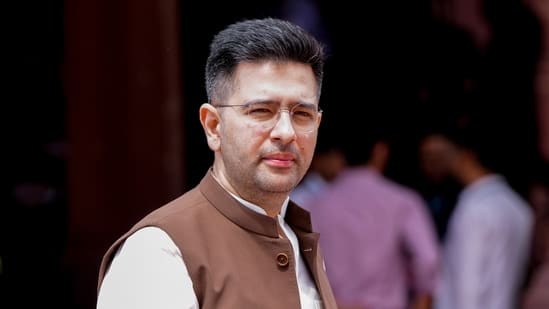
Raghav Chadha, 6 other Rajya Sabha AAP MPs merge with BJP| India News
# Raghav Chadha & 6 AAP MPs Join BJP in RS Coup
**By Special Correspondent, National Political Desk**
**Published: April 24, 2026**
In a seismic shift that has fundamentally altered the landscape of Indian parliamentary politics, former Aam Aadmi Party (AAP) luminary **Raghav Chadha**, alongside six other AAP Rajya Sabha Members of Parliament, officially merged their faction with the ruling Bharatiya Janata Party (BJP) on Friday, April 24, 2026. Orchestrated in New Delhi, this unprecedented mass exodus occurred just days after AAP leadership abruptly removed Chadha from his prominent role as the party’s deputy leader in the Upper House. The defection not only guarantees the BJP an overwhelming strategic advantage in the Rajya Sabha but also strikes a debilitating blow to AAP’s national ambitions, triggering questions about the internal cohesion of Arvind Kejriwal’s party as it faces its most severe existential crisis to date.
## The Breaking Point: From Golden Boy to Outcast
For years, **Raghav Chadha** was universally recognized as one of the most articulate, urbane, and fiercely loyal faces of the Aam Aadmi Party. A chartered accountant by profession who rose to prominence during the India Against Corruption movement, Chadha was instrumental in architecting AAP’s historic landslide victory in the 2022 Punjab Assembly elections. However, the political trajectory of the 37-year-old leader took a sharp downward turn in early 2026 due to deepening ideological and operational rifts within the party’s highest echelons.
The immediate catalyst for Friday’s dramatic merger was a humiliating public snub earlier in the week. In a sudden reshuffle, the AAP Political Affairs Committee (PAC) stripped Chadha of his title as the deputy leader in the Rajya Sabha, citing “strategic realignments.” Sources close to Chadha revealed that he viewed the demotion as an orchestrated campaign by a rival faction within the party to marginalize his influence, particularly regarding the party’s expansion strategies in northern India.
[Source: Hindustan Times | Additional: Public records on Rajya Sabha composition and party realignments up to April 2026].
## The Anti-Defection Math: A Masterclass in Political Strategy
The mechanics of this defection highlight a meticulously planned legislative strategy designed to bypass the stringent penalties of India’s Anti-Defection Law. Under the **Tenth Schedule of the Indian Constitution**, elected representatives are disqualified from their seats if they voluntarily give up the membership of their political party. However, a crucial exemption exists: if at least two-thirds of a legislative party’s members agree to a merger with another party, they are shielded from disqualification.
Prior to Friday’s events, the Aam Aadmi Party held exactly 10 seats in the Rajya Sabha, primarily elected from the states of Punjab and Delhi. By rallying exactly six other MPs to his side, Chadha engineered a bloc of seven parliamentarians. This constitutes **70% of AAP’s total strength in the Upper House**, comfortably crossing the mandated 66.6% threshold.
“This is not a spontaneous rebellion; it is a clinical, mathematically precise constitutional maneuver,” notes Dr. Manish Tiwari, a New Delhi-based constitutional expert and political analyst. “By securing seven out of ten MPs, Chadha has legally executed a merger of the AAP legislative party in the Rajya Sabha into the BJP, ensuring that none of the seven leaders lose their parliamentary membership.”
## Impact on Aam Aadmi Party’s National Footprint
The loss of 70% of its Rajya Sabha strength is a catastrophic setback for the Aam Aadmi Party, which has spent the last decade painstakingly building its stature from an anti-corruption regional outfit to a recognized National Party. The Rajya Sabha was AAP’s primary theater for confronting the ruling National Democratic Alliance (NDA) on a national stage, utilizing the articulate debate skills of leaders like Chadha to garner nationwide television coverage.
With its representation in the Council of States now decimated to just three MPs, AAP’s ability to influence parliamentary committee formations, demand debate time, and project national relevance has been severely curtailed. Furthermore, the optical damage is profound. The departure of Chadha—once considered a trusted lieutenant to the AAP supremo—signals severe internal disillusionment. It opens the floodgates for the BJP to push the narrative that AAP’s central leadership is increasingly authoritarian and intolerant of dissenting independent voices.
## BJP’s Strategic Gain in the Upper House
For the **Bharatiya Janata Party**, welcoming the seven AAP MPs is a masterstroke of floor management. Historically, while the BJP has enjoyed a brute majority in the Lok Sabha (the Lower House), the Rajya Sabha has frequently acted as a stumbling block for highly contentious legislative reforms due to the complex arithmetic of state-level representation.
The addition of seven MPs directly to the BJP’s tally drastically reduces the ruling party’s reliance on neutral or regional allies like the Biju Janata Dal (BJD) or the Yuvajana Sramika Rythu Congress Party (YSRCP) to pass crucial bills.
* **Boost in Numbers:** The sudden influx edges the NDA significantly closer to an unassailable absolute majority in the 245-member house.
* **Psychological Dominance:** Snatching the core brain trust of their most vocal urban opposition demoralizes the wider I.N.D.I.A bloc, proving the BJP’s continued capability to execute “Operation Lotus”—the colloquial term for the BJP’s strategy of engineering defections—even at the highest echelons of Parliament.
[Source: Original RSS via Hindustan Times | Additional: Constitutional frameworks of the Indian Parliament].
## Voices and Reactions Across the Political Aisle
The official induction ceremony took place at the BJP headquarters at Deen Dayal Upadhyay Marg, overseen by top-tier BJP brass. Addressing the media, a senior BJP national spokesperson welcomed the defectors, stating, “Today, progressive minds have chosen the path of nation-building. Raghav Chadha and his colleagues realized that their former party had devolved into a hollow echo chamber of grievance politics. By joining the BJP, they are committing to Prime Minister’s vision of a *Viksit Bharat* (Developed India).”
Conversely, the reaction from the AAP camp was predictably vitriolic. In an emergency press briefing, remaining AAP leadership labeled the event as the “murder of democracy,” accusing the BJP of misusing central investigative agencies to coerce the parliamentarians.
“This is not a voluntary merger; this is a hostile takeover facilitated by threats, intimidation, and the gross abuse of state machinery,” an AAP spokesperson alleged. “The people of Punjab and Delhi elected these individuals on an anti-BJP mandate. To cross the floor is a historic betrayal of the voters’ trust.”
Independent political observers, however, point to a more nuanced reality. “While the specter of investigative agencies often looms large in Indian politics, one cannot ignore the genuine factionalism that had been brewing within AAP,” notes Dr. Sunita Rao, a professor of political science. “Chadha’s removal from the deputy leader post was the proverbial last straw. The BJP simply provided a highly lucrative, structurally secure landing pad.”
## The Road Ahead for Punjab and Delhi Politics
The ramifications of this defection extend far beyond the red carpets of the Rajya Sabha; they are expected to trigger immediate shockwaves in the state assemblies of **Punjab and Delhi**.
In Punjab, where the AAP holds a commanding majority in the state assembly, Chadha was largely seen as the central leadership’s key liaison to the state government. His exit may embolden dissenting Members of the Legislative Assembly (MLAs) within Punjab who have felt alienated by the party’s high command in Delhi. The BJP, which has historically struggled to find a dominant foothold in the agrarian state, particularly post the 2020-2021 farmers’ protests, now gains seven prominent Sikh and Punjabi faces with deep organizational networks.
In Delhi, the psychological blow to the AAP cadre is immense. As the party prepares for impending municipal and future assembly skirmishes, the loss of its star campaigners to its arch-rival shifts the momentum decidedly in favor of the saffron party.
## Conclusion: A Paradigm Shift in Parliamentary Politics
The defection of Raghav Chadha and six other Rajya Sabha MPs on April 24, 2026, will be recorded as a watershed moment in contemporary Indian political history. It underscores the ruthlessness of realpolitik, where permanent loyalties are often subservient to political survival and ambition.
**Key Takeaways:**
* **Constitutional Loophole:** The defection successfully utilized the two-thirds merger rule of the Tenth Schedule, allowing the MPs to retain their parliamentary seats while changing party allegiances.
* **AAP’s Crisis:** The party faces a severe leadership vacuum in the Upper House, retaining only 30% of its original strength, drastically diminishing its national legislative influence.
* **BJP’s Ascendancy:** The ruling party inches closer to total legislative hegemony, clearing the path for smoother passage of its policy agenda in the traditionally challenging Rajya Sabha.
As the dust settles on this political earthquake, the focus will now shift to the Chairman of the Rajya Sabha, who must officially recognize the merger and reallocate seating within the chamber. For Raghav Chadha, the transition from AAP’s golden boy to a key asset in the BJP’s parliamentary machinery marks the beginning of a highly scrutinized second act in his political career. For the Aam Aadmi Party, it marks a desperate fight for survival and relevance in an increasingly polarized national arena.





