‘Grave betrayal against 700 million women’: BJP trains guns at opposition after 131st Amendment bill fails| India News
# Women’s Bill Fails: BJP Slams Opposition
**NEW DELHI, April 18, 2026** — A fierce political firestorm erupted in Parliament on Saturday after the 131st Constitution Amendment Bill failed to secure the requisite special majority, effectively halting the implementation of a nationwide electoral delimitation exercise and the linked women’s reservation quota. The ruling Bharatiya Janata Party (BJP) launched a scathing attack on opposition parties, labeling the legislative defeat a “grave betrayal against 700 million women.” Opposition leaders, however, defended their coordinated vote, arguing that the government’s approach to delimitation threatened the political representation of Southern states. This dramatic parliamentary collapse sets the stage for a bitter electoral showdown.
## The Legislative Deadlock in Parliament
The 131st Amendment Bill was brought to the floor with the ambitious mandate of formalizing the operational framework for the upcoming Delimitation Commission, whose work is fundamentally tied to the rollout of the 33% reservation for women in the Lok Sabha and State Legislative Assemblies. Because it involved an amendment to the Constitution impacting federal representation, the bill required a special majority—two-thirds of the members present and voting, alongside an absolute majority of the total membership of the House.
Despite the government’s intense floor management and eleventh-hour negotiations, a unified opposition bloc managed to prevent the bill’s passage. The defeat, notably, halts the progress of the linked delimitation exercise, which had been a key flashpoint between the government and the opposition for the past several years [Source: Hindustan Times].
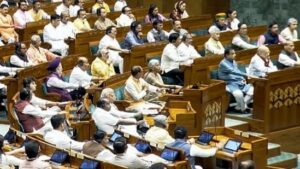
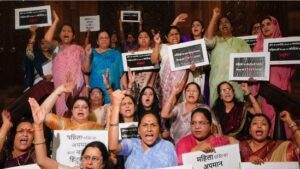
The rejection of the bill represents a rare and significant legislative roadblock for the ruling administration. Parliamentary proceedings were adjourned amidst chaotic scenes, with members from the treasury benches holding placards demanding accountability from the opposition for stalling women’s political empowerment.
## BJP’s Narrative: A “Grave Betrayal”
In the immediate aftermath of the bill’s collapse, the BJP launched an aggressive nationwide communications campaign. Senior government ministers and party spokespersons convened emergency press briefings, framing the opposition’s legislative maneuvering as an anti-women agenda.
“Today will be remembered as a dark day in our parliamentary democracy. By voting against this amendment, the opposition has committed a grave betrayal against 700 million women in India,” a senior BJP spokesperson stated during a televised address. The ruling party argues that the opposition is using the complexities of the delimitation process as a convenient smokescreen to block the long-pending implementation of women’s reservation.
The government maintains that the 106th Amendment Act (Nari Shakti Vandan Adhiniyam), passed to much fanfare in 2023, clearly stipulated that the 33% quota for women could only be implemented *after* a new census and the subsequent redrawing of constituency boundaries. By paralyzing the 131st Amendment, the BJP claims, the opposition has intentionally paralyzed the quota itself.
## The Opposition’s Defense: The Delimitation Dilemma
The opposition has vehemently pushed back against the BJP’s characterization of the vote. For regional parties and the principal opposition bloc, the primary contention is not the empowerment of women, but the mechanics of the delimitation exercise that the bill sought to set into motion.
Delimitation is the constitutional process of redrawing boundaries for Lok Sabha and state assembly seats to represent changes in population. However, this process has been frozen since 1976 (and further extended by the 84th Amendment in 2001) precisely because population-based seat allocation disproportionately penalizes states that have successfully implemented family planning policies.
Opposition leaders contend that the 131st Amendment did not provide adequate constitutional safeguards for Southern states—such as Tamil Nadu, Kerala, Andhra Pradesh, and Karnataka—which have significantly lower population growth rates compared to Northern states like Uttar Pradesh and Bihar.
“We are entirely in favor of the women’s reservation quota, but we will not allow the government to use the noble cause of women’s empowerment as a Trojan horse to marginalize the political voice of South India,” an opposition floor leader told reporters outside Parliament. “Delimitation without demographic safeguards is a direct assault on the federal structure of our Constitution.”
## The North-South Demographic Divide
To understand the severity of this parliamentary clash, one must look at the demographic shifts that have occurred since the last functional delimitation based on the 1971 census. Over the past five decades, India’s population has surged, but the growth has been deeply asymmetrical.
According to demographic projections from the Ministry of Statistics and independent think tanks, a pure population-based reallocation of Lok Sabha seats would dramatically shift the balance of power toward the Hindi-speaking belt.
**Projected Impact of Unfettered Delimitation on Key States:**
| State | Current Lok Sabha Seats | Projected Seats (Post-Delimitation) | Shift |
| :— | :— | :— | :— |
| Uttar Pradesh | 80 | 143 | +63 |
| Bihar | 40 | 79 | +39 |
| Tamil Nadu | 39 | 33 | -6 |
| Kerala | 20 | 12 | -8 |
| Andhra Pradesh & Telangana | 42 | 34 | -8 |
*[Additional Source: Demographic Projections based on National Population Commission Data]*
This stark disparity is the crux of the current political paralysis. The opposition demands a hybrid model of delimitation—one that preserves the current proportional weight of the states in the Lok Sabha while internally redrawing boundaries to accommodate the women’s quota. The government, conversely, has pushed for a comprehensive national delimitation based on the latest census data, arguing in favor of the democratic principle of “one person, one vote, one value.”
## Expert Analysis: The Constitutional Crisis
Constitutional scholars and political scientists suggest that the failure of the 131st Amendment Bill introduces a profound period of legal and legislative uncertainty. The lifting of the delimitation freeze, originally slated for the first census post-2026 under Article 82 of the Constitution, now hangs in the balance.
Dr. Meera Vasudevan, a political scientist at the Center for Democratic Studies, notes that the intertwining of these two monumental issues was bound to result in a deadlock. “By linking the universally popular Nari Shakti Vandan Adhiniyam (Women’s Reservation Act) to the deeply divisive issue of interstate delimitation, the government created an all-or-nothing scenario,” Dr. Vasudevan explained. “The failure of this bill means both initiatives are now in legislative purgatory. The BJP gains a potent campaign narrative that the opposition is anti-women, while the regional parties can claim they successfully defended federalism.”
Rajesh Narayanan, a constitutional law expert, highlighted the temporal pressure. “The freeze on delimitation ends this year, 2026. Without a constitutional amendment defining the terms of reference for a new Delimitation Commission—especially regarding how to handle the North-South population skew—the Election Commission cannot practically move forward. Furthermore, the 33% quota for women remains unimplemented on the ground, trapped behind this bureaucratic and political wall.”
## Potential Paths Forward
The immediate future of the women’s reservation and the delimitation exercise remains murky. Several potential scenarios could unfold in the coming months as political parties strategize ahead of the next electoral cycle:
1. **A Decoupling Amendment:** The government could theoretically introduce a new bill that decouples women’s reservation from the delimitation process. This would involve applying the 33% quota to the existing 543 Lok Sabha seats. However, logistically determining which seats to reserve without a formal delimitation commission remains a complex hurdle.
2. **Consensus on Federal Safeguards:** The government may seek to negotiate with opposition parties by introducing a revised delimitation bill that guarantees a “floor” for state representation, ensuring no state loses its current number of Lok Sabha seats regardless of population shifts.
3. **Judicial Intervention:** With the 2026 deadline for lifting the delimitation freeze now an active reality, public interest litigations may be filed in the Supreme Court of India, seeking judicial directions on how the government and the Election Commission should proceed under Article 82.
## Conclusion: A High-Stakes Political Chess Match
The dramatic failure of the 131st Amendment Bill on Saturday is far more than a routine parliamentary defeat; it is a manifestation of India’s deepest demographic and federal fault lines. For the BJP, the narrative is clear: the opposition has obstructed a historic milestone for gender parity. For the opposition, the vote was a necessary defense against a demographic centralization of power.
As both sides retreat to consolidate their political messaging, the reality is that the 700 million women referenced by the ruling party must wait even longer for their guaranteed 33% representation in the halls of power. The standoff over the 131st Amendment has ensured that the intertwined issues of delimitation, federalism, and women’s empowerment will dominate India’s political discourse for the foreseeable future. How the political establishment navigates this complex constitutional maze will determine not just the makeup of the next Parliament, but the fundamental balance of power within the Indian republic.
***
**By Political Desk, India Policy Review, April 18, 2026**