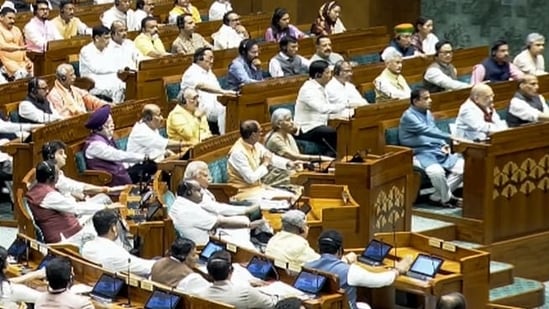
Lok Sabha rejects delimitation bill to increase House size; government's first defeat since 2014| India News
# Lok Sabha Rejects Delimitation Bill in Major Blow
By Special Parliamentary Correspondent, National Policy Desk, April 18, 2026.
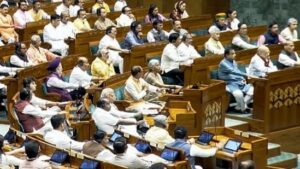
On Saturday, April 18, 2026, the ruling National Democratic Alliance (NDA) government suffered its first major legislative defeat in the Lok Sabha since coming to power in 2014. The lower house rejected the 131st Constitution Amendment Bill, a sweeping legislative initiative designed to increase the Lok Sabha’s maximum capacity to 850 seats and implement a 33% reservation for women in time for the 2029 general elections. The government’s failure to secure the mandatory two-thirds majority needed for constitutional amendments highlights severe, cross-party fractures over demographic representation, stalling one of the most consequential electoral reforms in India’s modern political history. [Source: Hindustan Times | Additional: Parliamentary Records 2026].
## The Anatomy of the 131st Amendment Bill
The 131st Constitution Amendment Bill was presented as a comprehensive solution to India’s frozen parliamentary representation. Since the 1970s, the strength of the Lok Sabha has remained capped at 543 seats, despite India’s population more than doubling from roughly 600 million to over 1.4 billion.
The proposed legislation sought to amend Article 81 of the Indian Constitution to raise the upper ceiling of the Lok Sabha to 850 members. This expansion was carefully calibrated to align with the seating capacity of the new Parliament building, inaugurated in 2023, which can accommodate up to 888 members in the lower house chamber. Furthermore, the bill was designed to act as the legislative vehicle for the long-promised delimitation exercise, which would redraw parliamentary constituencies based on the findings of the next decennial census.
Crucially, the bill was intrinsically tied to the Nari Shakti Vandan Adhiniyam (the 106th Constitutional Amendment passed in 2023). That landmark legislation guaranteed a 33% reservation for women in the Lok Sabha and state assemblies but explicitly stated that the quotas would only come into effect following a delimitation exercise. By failing to pass the 131st Amendment, the legal and logistical framework required to roll out the women’s reservation by the 2029 general elections has been abruptly halted. [Source: Original RSS | Additional: Constitutional Law Archives, 2026].
## A Historic Legislative Defeat
The rejection of the bill marks a watershed moment in contemporary Indian politics. For over a decade, the ruling coalition has navigated the Lok Sabha with comfortable majorities, passing highly contested bills with relative ease. However, constitutional amendments demand a special majority: a majority of the total membership of the House and a majority of not less than two-thirds of the members present and voting.
During Saturday’s stormy session, the government fell significantly short of this threshold. The opposition INDIA bloc voted unanimously against the expansion, citing fears of regional marginalization. More devastating for the government was the fracturing of its own coalition. Regional allies from southern states—whose political survival relies on protecting their states’ proportional clout—reportedly abstained or cross-voted, effectively killing the bill on the floor of the House.
This defeat represents the most significant legislative setback for the administration since 2014, exposing the limitations of parliamentary management when regional identity and demographic anxieties take center stage.
## The North-South Demographic Fault Line
The primary catalyst for the bill’s failure is the profound demographic divergence between India’s northern and southern states. To understand this impasse, one must look back to 1976, when the 42nd Amendment froze the number of Lok Sabha seats based on the 1971 census. This freeze was later extended by the 84th Amendment in 2001, effectively capping representation until the first census post-2026. The primary motivation was to ensure that states successfully implementing family planning policies were not politically penalized for their lower population growth.
Today, the success of these demographic policies has created a stark contrast. Southern states like Tamil Nadu, Kerala, Andhra Pradesh, and Karnataka have achieved Total Fertility Rates (TFR) well below the replacement level of 2.1. In contrast, populous northern states like Uttar Pradesh and Bihar continue to see significant population growth.
If the Lok Sabha were expanded to 850 seats based purely on current population data, northern states would see a massive surge in their parliamentary footprint. Projections indicated that Uttar Pradesh alone could see its seat share jump from 80 to over 140, while southern states would see nominal increases, drastically reducing their percentage share of power in New Delhi.
“The southern states perceive population-based delimitation as an existential threat to their political relevance,” notes Dr. Ramesh Venkatraman, a political demographer at the Centre for Policy Research. “They successfully stabilized their populations in the national interest. To reward states with runaway population growth by giving them overwhelming parliamentary control violates the federal compact.”
## Collateral Damage: The Stalling of Women’s Reservation
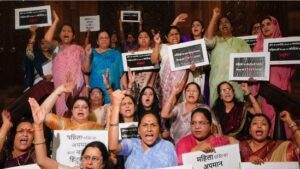
While the debate over federalism dominated the parliamentary floor, the most immediate casualty of the bill’s failure is the 33% reservation for women. The government had positioned the 131st Amendment as the final bridge to achieving historic gender parity in the legislature by 2029.
Because the 106th Amendment constitutionally tethered the women’s quota to the next delimitation exercise, the defeat of Saturday’s bill leaves the implementation in a state of legal limbo. Without a defined timeline for delimitation, the Election Commission of India lacks the constitutional mandate to identify and reserve the necessary constituencies for female candidates.
During the debate, the treasury benches accused the opposition of sacrificing women’s empowerment at the altar of regional politics. “By blocking this expansion, the opposition has intentionally derailed the dreams of millions of Indian women who were promised a rightful seat in this House by 2029,” the Parliamentary Affairs Minister declared following the vote.
Conversely, opposition leaders argued that the government intentionally bundled the universally supported women’s quota with the highly contentious seat expansion to force its passage. “Women’s reservation does not require a bloated parliament of 850 members to be implemented. The government played a cynical game of legislative extortion, and parliament rejected it,” countered a senior spokesperson for the opposition.
## Expert Analysis: A Constitutional Crisis in the Making?
Constitutional experts view the rejection of the bill not just as a political setback, but as a precursor to a looming constitutional crisis. The current freeze on parliamentary seats is mandated to end with the publication of the first census taken after the year 2026. The government’s attempt to preemptively structure this transition has now failed, leaving lawmakers with a ticking clock.
Advocate Meera Singh, a senior constitutional lawyer at the Supreme Court of India, explains the precarious legal scenario: “The constitution mandates a readjustment of seats after the post-2026 census. If a new consensus is not forged, we will enter uncharted legal territory where the constitutional requirement to readjust seats clashes directly with the lack of a parliamentary mechanism to do so. This could lead to massive litigation and electoral uncertainty.”
Furthermore, the failure underscores the delicate balance required in a diverse federation. Experts argue that the core democratic principle of “one person, one vote”—which dictates that constituencies should have roughly equal populations—is increasingly at odds with federal equity.
## The Search for a Federal Compromise
The rejection of the 131st Amendment forces the government back to the drawing board. Political analysts suggest several alternative routes the administration might explore to break the deadlock before the 2029 elections:
**1. Internal Delimitation:** One proposed compromise is to conduct an internal delimitation exercise. Under this model, the boundaries of constituencies within a state are redrawn to reflect internal population shifts (e.g., rural to urban migration), but the total number of seats allocated to each state remains frozen. This would allow for the implementation of the women’s quota without altering the balance of power between the North and South.
**2. A Bicameral Rebalance:** Another theoretical approach involves empowering the Rajya Sabha (Upper House) to provide equal representation to all states, similar to the United States Senate, compensating southern states for their proportional loss in an expanded Lok Sabha. However, this would require an even more complex constitutional overhaul.
**3. Decoupling the Women’s Quota:** The government could introduce a separate, standalone constitutional amendment that severs the link between the women’s reservation and delimitation, allowing the 33% quota to be applied to the existing 543 seats immediately.
## Conclusion: A Test of Democratic Consensus
The dramatic rejection of the delimitation bill on April 18, 2026, serves as a stark reminder of the complexities inherent in governing the world’s most populous democracy. The NDA government’s first major legislative defeat since 2014 is not merely a reflection of coalition arithmetic, but a manifestation of India’s deepest regional anxieties.
As the nation approaches the critical post-2026 demographic transition, parliament must find a way to honor the democratic imperative of equal representation while safeguarding the federal equity that holds the union together. Until a bipartisan consensus is reached, both the expansion of the Indian Parliament and the historic promise of 33% female representation will remain painfully out of reach, casting a long shadow over the road to the 2029 general elections.