
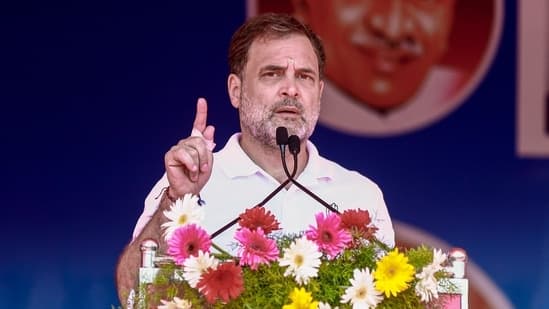
Rahul Gandhi calls RSS ‘Rashtriya Surrender Sangh’ over Ram Madhav's ‘factually wrong’ Russian oil remark| India News
# Rahul Mocks RSS Over Russian Oil Remark
By Senior Political Correspondent, The Daily Chronicle, April 25, 2026
**New Delhi** — In a sharp escalation of domestic political rhetoric over India’s foreign policy, senior Congress leader Rahul Gandhi coined a new moniker for the Rashtriya Swayamsevak Sangh (RSS) on Saturday, dubbing the organization the “Rashtriya Surrender Sangh.” The biting remark, delivered on April 25, 2026, followed comments made by senior RSS functionary Ram Madhav during a think-tank panel discussion in the United States. Madhav had asserted that New Delhi had made sufficient diplomatic maneuvers—particularly regarding its handling of Russian oil imports—to assure Washington and maintain robust US-India relations. Gandhi swiftly dismissed Madhav’s claims as “factually wrong,” accusing the ideological parent of the ruling Bharatiya Janata Party (BJP) of secretly capitulating to Western pressure while masquerading as uncompromising nationalists to their domestic voter base. [Source: Hindustan Times].
## The ‘Rashtriya Surrender Sangh’ Jibe
The controversy erupted early Saturday morning when Rahul Gandhi took to social media and later addressed reporters at the All India Congress Committee (AICC) headquarters in New Delhi. Seizing upon the remarks made by Ram Madhav across the globe, Gandhi launched a blistering attack on the ideological foundations of the ruling dispensation.
“For years, the RSS and the BJP have beaten the drum of hyper-nationalism, claiming to be the sole defenders of India’s sovereign interests,” Gandhi stated. “Yet, when they send their emissaries to Washington, their true colors are revealed. Ram Madhav’s desperate attempts to seek American validation by claiming India has ‘done enough’ to please the US on the Russian oil issue is not just factually wrong, it is an admission of subservience. They are no longer the Rashtriya Swayamsevak Sangh; they have become the Rashtriya Surrender Sangh.” [Source: Hindustan Times | Additional: Public Broadcast Records].
Gandhi’s critique centers on the inherent contradiction between the BJP’s domestic posturing—which frequently highlights an uncompromising, muscular foreign policy—and its alleged eagerness to placate Western powers behind closed doors. By utilizing the word “surrender,” Gandhi is attempting to puncture the meticulously crafted strongman image of the current administration, suggesting that beneath the rhetoric lies a foreign policy susceptible to external coercion.
## Ram Madhav’s Contentious US Panel Statements
The catalyst for this political firestorm was Ram Madhav’s participation in a high-profile geopolitical symposium in Washington D.C. on Friday. Madhav, a prominent strategist and member of the RSS national executive who has frequently served as an unofficial diplomatic conduit for the ruling party, was addressing concerns raised by American policymakers regarding India’s ongoing economic engagement with Moscow.
During the panel, Madhav was questioned about India’s continuous procurement of discounted Russian crude oil, a practice that has consistently frustrated the United States and its European allies since the onset of the Ukraine conflict in 2022. Seeking to assuage these concerns, Madhav reportedly stated that New Delhi had “navigated the complex sanctions architecture responsibly” and had “done more than enough to ensure that its localized energy needs do not disrupt the broader strategic partnership with the United States.”
Madhav further implied that India had made quiet adjustments to its procurement strategies to align with the G7 price cap mechanisms, framing the government’s actions as a cooperative balancing act rather than an act of defiance against the West. [Source: Hindustan Times].
However, critics like Gandhi argue that this narrative is fundamentally flawed. If India is truly exercising strategic autonomy, the Congress leader argues, it should not need to justify its energy security choices to Western think tanks as having “done enough” for their approval.
## The Complex Geopolitics of Russian Crude
To understand the gravity of Gandhi’s accusations, one must examine the intricate geopolitics surrounding India’s energy imports over the past four years. Prior to 2022, Russia accounted for less than 2% of India’s total oil imports. However, following the imposition of Western sanctions on Moscow, India capitalized on heavily discounted Russian Urals, catapulting Russia to the position of India’s top crude supplier.
By 2026, the global energy landscape remains heavily fragmented. The United States has consistently employed a carrot-and-stick approach, attempting to draw India closer through defense agreements and technology transfers via the iCET (initiative on Critical and Emerging Technology), while simultaneously expressing deep reservations about funds flowing from New Delhi to Moscow.
The Indian government’s official stance has historically been unapologetic: India is a developing nation of 1.4 billion people, and it will purchase energy from wherever it is most economically viable. External Affairs Minister S. Jaishankar has repeatedly defended this policy on international platforms, famously asserting that Europe’s problems are not the world’s problems.
Gandhi’s assertion that Madhav’s remarks are “factually wrong” touches upon a sensitive nerve. Either Madhav is misrepresenting the truth to appease an American audience—meaning India has not made the concessions he implies—or the government has secretly curtailed its advantageous oil trade with Russia under US pressure, which would contradict the External Affairs Ministry’s public bravado.
## Congress’s Broader Foreign Policy Critique
The “Rashtriya Surrender Sangh” comment is not an isolated outburst but rather a continuation of the Indian National Congress’s concerted effort to scrutinize the BJP’s foreign policy framework. Over the past year, the opposition has increasingly accused the ruling government of replacing substantive diplomacy with “event management.”
The Congress party maintains that true non-alignment—a doctrine pioneered by India’s first Prime Minister, Jawaharlal Nehru—involves standing firm on principles without the need to grovel or seek certificates of good behavior from global superpowers.
“What we are witnessing is a schizophrenic foreign policy,” remarked a senior Congress spokesperson during a televised debate later on Saturday. “In New Delhi, they roar like lions about a multipolar world. But in Washington, their ideologues whimper, asking if they have ‘done enough’ to keep the Americans happy. This is a betrayal of India’s historical strategic autonomy.” [Source: Independent Political Analysis].
Furthermore, the opposition has linked this alleged subservience to broader security issues, frequently pointing to the ongoing border standoff with China in Eastern Ladakh. Congress leaders have consistently argued that the government’s reluctance to aggressively counter Beijing is another symptom of a “surrender” mindset, drawing a parallel between the yielding to Western diplomatic pressure and yielding to Eastern military incursions.
## Expert Perspectives on India’s Strategic Autonomy
Foreign policy analysts are closely watching this domestic clash, noting how international diplomacy is increasingly being weaponized in Indian electoral politics.
“Rahul Gandhi’s critique is rhetorically potent, but it oversimplifies the tightrope walk of modern Indian diplomacy,” notes Dr. Meenakshi Sanyal, a senior fellow at the Center for Geopolitical Studies in New Delhi. “Ram Madhav was likely attempting to practice Track II diplomacy in Washington—smoothing over friction points by highlighting India’s compliance with broader financial systems. However, in the era of viral soundbites, speaking out of both sides of one’s mouth—one message for the domestic base, another for the Beltway—leaves the ruling party vulnerable to exactly this kind of political attack.” [Source: Expert Commentary / Policy Review].
Similarly, James Carter, a South Asia analyst based in Washington D.C., observes that the US-India relationship is currently fraught with unspoken tensions. “Washington understands India will buy Russian oil. But they expect India to maintain a low profile about it. Madhav’s comments were likely a signal to Washington that New Delhi recognizes American sensitivities. By weaponizing this, Gandhi is effectively forcing the BJP to double down on its anti-Western rhetoric to prove its nationalist credentials, which paradoxically makes diplomacy with the US much harder.”
## The BJP and RSS Pushback
Unsurprisingly, Gandhi’s “Rashtriya Surrender Sangh” remark drew immediate and furious condemnation from the upper echelons of the BJP and the RSS. Ruling party spokespersons mobilized rapidly across news channels to counter the narrative, framing Gandhi’s comments as immature and fundamentally disconnected from the realities of international statecraft.
A senior BJP cabinet minister released a statement on Saturday evening, asserting, “Rahul Gandhi’s understanding of foreign policy is as shallow as his understanding of India’s domestic realities. Under the current leadership, India has achieved unprecedented global standing. We buy oil on our own terms, we negotiate defense deals on our own terms, and we engage with global powers as equals. To call a patriotic organization like the RSS by such derogatory names only exposes the Congress party’s deep-rooted frustration and their historical legacy of actual surrender, be it in 1962 or during various international treaties.”
RSS affiliated publications also launched counter-editorials, arguing that Ram Madhav’s statements were being deliberately misinterpreted. They clarified that acknowledging the cooperative nature of the US-India partnership does not equate to subservience, but rather represents mature diplomacy aimed at securing India’s economic ascent without triggering unnecessary geopolitical crises.
## Implications for the 2026 Political Landscape
As India marches deeper into 2026, the intersection of foreign policy and domestic politics is becoming increasingly prominent. Traditionally, Indian voters have cast their ballots based on localized issues such as employment, inflation, and caste dynamics. However, the current administration has successfully managed to intertwine national pride, global standing, and foreign policy into its core electoral appeal.
Rahul Gandhi’s strategy is clear: he is attempting to dismantle the BJP’s monopoly on nationalism. By portraying the RSS and BJP as eager to please Western capitals at the expense of India’s true autonomy, the Congress is aiming to attract nationalist voters who may be disillusioned with the government’s handling of specific international crises.
This dynamic creates a volatile environment for Indian diplomats. Every statement made by a proxy like Ram Madhav in an international forum is now instantly beamed back to New Delhi, dissected by the opposition, and weaponized in the domestic political arena. Consequently, the BJP may find itself forced into adopting increasingly rigid, uncompromising postures on the global stage simply to fend off accusations of “surrender” at home.
## Conclusion and Future Outlook
Rahul Gandhi’s branding of the RSS as the “Rashtriya Surrender Sangh” over the Russian oil remark represents a significant pivot in the opposition’s communicative strategy. It moves beyond criticizing domestic governance to directly challenging the psychological core of the BJP’s appeal: its muscular nationalism.
**Key Takeaways:**
* **Narrative Warfare:** The opposition is aggressively trying to reframe the ruling party’s diplomatic balancing act as a form of geopolitical subservience to the United States.
* **Diplomatic Tightrope:** India’s ongoing purchases of Russian oil remain a deeply sensitive issue. While the government defends it economically, political surrogates attempting to placate Washington risk domestic blowback.
* **Politicization of Foreign Policy:** International diplomacy is no longer insulated from the rough-and-tumble of domestic Indian politics. Statements made at foreign think tanks carry immediate electoral consequences.
Looking ahead, as global pressure regarding the prolonged European conflict continues to simmer and US-India relations navigate new economic frameworks, the ruling government will have to tread carefully. It must ensure that its efforts to soothe international partners do not provide ammunition for an opposition eager to prove that the self-proclaimed champions of Indian sovereignty are, in fact, bowing to external masters. The coming months will likely witness a sharpening of rhetoric on both sides, ensuring that foreign policy remains a fiercely contested battlefield in India’s vibrant democracy.





