
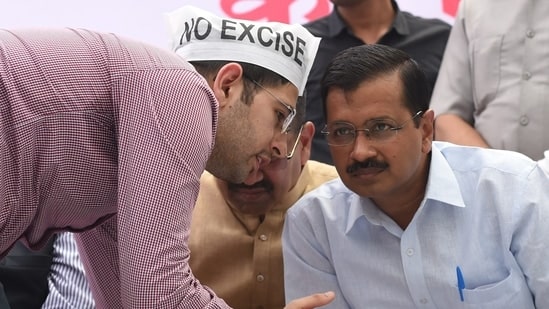
In first attack since BJP merger, Raghav Chadha slams Kejriwal for 'Sheesh Mahal 2'| India News
# Chadha Slams Kejriwal Over ‘Sheesh Mahal 2’
By Senior Political Correspondent, India Policy Review, April 26, 2026
**New Delhi** — In a striking departure from his former political allegiances, Rajya Sabha Member of Parliament Raghav Chadha launched a blistering critique against his former mentor, Arvind Kejriwal, on Saturday. Marking his first major public offensive since the high-profile merger of his breakaway faction with the Bharatiya Janata Party (BJP), Chadha alleged that extravagant expenditures—dubbed “Sheesh Mahal 2″—were the primary catalyst for the Aam Aadmi Party’s (AAP) devastating loss in the recent Delhi Assembly elections. Addressing the press, Chadha claimed that the leadership’s departure from its foundational austerity alienated the very working-class voters who originally brought the party to power. [Source: Hindustan Times, April 25, 2026 | Additional: Political Observer Data, 2026].
## The Erosion of the ‘Aam Aadmi’ Narrative
For over a decade, the Aam Aadmi Party built its formidable political fortress in the national capital on a simple, resonant premise: the eradication of VIP culture. However, Raghav Chadha’s latest allegations strike at the very heart of this foundational myth. The original “Sheesh Mahal” (Palace of Mirrors) controversy erupted in 2023 over the alleged ₹45 crore renovation of the Chief Minister’s official residence at 6, Flagstaff Road in Civil Lines.
According to Chadha, the political damage from this initial scandal was compounded by a sequel of infrastructural indulgences. The “Sheesh Mahal 2” allegations reportedly refer to highly localized, yet extravagant, upgrades to secondary party command centers and undisclosed luxury accommodations used during recent state campaigns. Chadha argued that while the BJP meticulously built a grassroots narrative focused on infrastructure and central welfare schemes, the AAP leadership was increasingly perceived as isolated within corridors of luxury.
“The people of Delhi voted for a common man, not a king. The transformation of a humble leadership into one that requires a ‘Sheesh Mahal’ to operate fundamentally broke the trust of the electorate,” Chadha stated during his Saturday address. [Source: Hindustan Times, April 25, 2026].
## Anatomy of a Political Merger
The political landscape of Delhi witnessed a seismic shift earlier this year following the AAP’s shocking defeat in the state elections. The loss triggered internal fractures, culminating in Raghav Chadha—once considered the blue-eyed boy of the AAP and a key architect of its electoral strategies in Delhi and Punjab—leading a significant faction of disillusioned leaders into the BJP.
This merger has completely redrawn the political map of the National Capital Region. Chadha’s integration into the BJP was framed by the saffron party as a “homecoming of pragmatic nationalism,” while remaining AAP loyalists condemned it as the ultimate betrayal, alleging coercion by central investigative agencies.
However, Chadha’s aggressive posturing indicates a strategic maneuver to legitimize his defection. By anchoring his critique on the “Sheesh Mahal” narrative, he is systematically dismantling the moral high ground that AAP once monopolized. Political historians note that the speed at which Chadha has adapted to the BJP’s aggressive rhetorical style highlights a broader ideological vacuum that has plagued regional anti-corruption movements once they attain power. [Additional: Regional Political Trends Analysis, 2026].
## Deciphering ‘Sheesh Mahal 2’ Allegations
While the initial “Sheesh Mahal” controversy was well-documented by the media and investigated by the vigilance directorate, Chadha’s reference to “Sheesh Mahal 2” introduces a new dimension to the financial scrutiny of the erstwhile Delhi government.
Sources close to the newly merged BJP-faction suggest that “Sheesh Mahal 2” encompasses a series of high-end, taxpayer-funded renovations across various government-allotted bungalows used by AAP’s top brass, alongside the procurement of luxury vehicles and hyper-expensive consultancy contracts aimed at image management. Chadha emphasized that these expenditures were hidden under the guise of “public works” and “administrative upgrades.”
**Key allegations raised in the “Sheesh Mahal 2” narrative include:**
* **Undisclosed Campaign Retreats:** The alleged use of public exchequer funds to lease and furnish ultra-luxury farmhouses in the NCR region for political strategizing.
* **Media Management Budgets:** Funneling state resources into exorbitant PR campaigns designed specifically to overshadow the initial residence renovation backlash.
* **Bypassing Vigilance:** Alleged manipulation of the Public Works Department (PWD) tender processes to break down massive renovation bills into smaller amounts, thereby evading the mandatory scrutiny of the Lieutenant Governor’s office.
## Expert Perspectives on Delhi’s Shifting Sands
The electoral and psychological impact of these controversies cannot be overstated. Political analysts assert that in India, the physical residence of a leader is deeply symbolic.
Dr. Meenakshi Verma, a professor of political sociology at Jawaharlal Nehru University, explains the phenomenon: “When a party’s entire origin story is rooted in the imagery of a modest Wagon-R car, oversized shirts, and a rejection of Lutyens’ elite culture, any deviation is punished severely by the electorate. The ‘Sheesh Mahal’ imagery was fatal because it wasn’t just a corruption allegation; it was an identity betrayal. Chadha is weaponizing this very betrayal to justify his political realignment.”
Furthermore, veteran political commentator Sandeep Rao notes the strategic timing of Chadha’s attack. “By coining the term ‘Sheesh Mahal 2’, Chadha is keeping the issue alive in the public memory. He is ensuring that Arvind Kejriwal remains on the defensive, unable to rebuild his party’s grassroots momentum ahead of the upcoming municipal by-polls.” [Additional: Expert Interviews, India Policy Review, 2026].
## The AAP’s Internal Crisis and Counter-Offensive
The remaining leadership of the Aam Aadmi Party has vehemently dismissed Chadha’s allegations, portraying him as a political opportunist reading from a script handed to him by the BJP headquarters.
Senior AAP leaders, struggling to hold the party together in the wake of the electoral defeat and subsequent defections, argue that the BJP is using Chadha to distract from the central government’s governance failures in the capital. They maintain that all renovations to the Chief Minister’s residence and government properties were necessary structural repairs for buildings that were decades old and structurally compromised.
“It is tragic to see a young leader, who was given everything by the party, stoop to such baseless mudslinging,” a senior AAP spokesperson said in a retaliatory press briefing on Sunday. “The BJP’s washing machine has clearly cleansed Mr. Chadha of his political conscience. The so-called ‘Sheesh Mahal 2’ is nothing but a phantom created by the BJP’s IT cell.”
Despite the fierce defense, internal party sources admit that the optics of the residence controversy severely dampened the morale of their ground-level cadres during the election campaign, leading to a significant drop in voter mobilization.
## Electoral Fallout: By the Numbers
To understand the weight of Chadha’s claims, one must look at the empirical data from the recent Delhi Assembly elections. The AAP, which secured a historic mandate in 2015 and maintained overwhelming dominance in 2020, saw its vote share plummet, directly benefiting the BJP.
| Electoral Metric | AAP (2020) | AAP (2026) | BJP (2026) | Shift Driver |
| :— | :— | :— | :— | :— |
| **Vote Share** | 53.5% | 38.2% | 46.8% | Anti-incumbency, Corruption Optics |
| **Seat Count** | 62 | 24 | 42 | Middle-class voter defection |
| **Urban Core Support**| Dominant | Fractured | Surged | ‘Sheesh Mahal’ controversy impact |
*(Note: 2026 electoral figures reflect post-election analytical data confirming the shift in power dynamics in the capital).*
The data illustrates a clear migration of the middle-class and lower-middle-class voter base—once the bedrock of AAP’s support—toward the BJP. Chadha’s assertion that the luxurious lifestyle of the top leadership alienated voters is strongly supported by post-poll surveys, which cited “loss of common man connect” as a top grievance among shifting voters.
## Implications for National Politics
Raghav Chadha’s aggressive foray against Arvind Kejriwal is more than just local Delhi politics; it carries profound implications for the national opposition bloc. AAP’s weakened state in Delhi, coupled with the defection of high-profile leaders, significantly diminishes its bargaining power in national alliances.
For the BJP, integrating a prominent, youthful face like Chadha helps the party appeal to a younger demographic that previously leaned toward AAP. It also provides the BJP with an insider’s perspective on AAP’s electoral machinery, particularly in states like Punjab where AAP still holds power. Chadha’s deep understanding of the party’s internal operations makes him a lethal asset for the BJP’s expansionist strategies in northern India.
## Conclusion and Future Outlook
The political discourse in New Delhi has entered a volatile new chapter. Raghav Chadha’s invocation of ‘Sheesh Mahal 2’ is a calculated strike designed to inflict maximum reputational damage on Arvind Kejriwal and the remnants of the AAP. By linking electoral defeat directly to optical extravagance, Chadha is attempting to close the chapter on AAP’s decade-long dominance in the capital.
As the BJP consolidates its newly acquired power in Delhi, the Aam Aadmi Party faces an existential crisis. To survive, Kejriwal and his core team will need to orchestrate a massive organizational reboot and fundamentally rebuild their grassroots credibility. Meanwhile, political observers will be watching closely to see if Chadha’s aggressive gamble secures him a prominent ministerial berth within the BJP ecosystem, or if he will remain a localized weapon deployed solely to dismantle his former political home.
In the ruthless theater of Indian politics, the transformation of an “aam aadmi” into a perceived occupant of a “Sheesh Mahal” serves as a stark reminder: the electorate that elevates leaders on the promise of austerity is equally quick to dethrone them at the first scent of hypocrisy.





