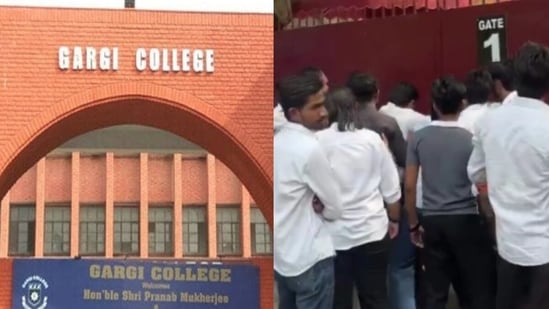
DUSU chief Aryan Maan, ABVP workers forcibly enter DU's Gargi College; AAP questions ‘sanskaar’| India News
# DUSU Chief Storms Gargi College; AAP Hits Back
By Staff Correspondent, The National Brief, April 19, 2026
On April 19, 2026, **Delhi University Students’ Union (DUSU) President Aryan Maan**, alongside several members of the **Akhil Bharatiya Vidyarthi Parishad (ABVP)**, allegedly forced their way into the premises of **Gargi College**, a premier women’s institution affiliated with Delhi University. The incident occurred when the student leaders were explicitly denied entry by college security staff. Guarding the gates, personnel cited stringent institutional protocols which mandate that male visitors are only permitted after rigorous verification and strictly on specific occasions. The forcible breach of the college gates has triggered a massive political and administrative uproar. The **Aam Aadmi Party (AAP)** swiftly condemned the breach, publicly questioning the ‘sanskaar’ (cultural values) of the ABVP members and reigniting debates over women’s safety and male entitlement in campus politics.
## The Confrontation at the Gates
The standoff began early Sunday when DUSU chief Aryan Maan and a contingent of ABVP workers arrived at the gates of Gargi College in South Delhi. According to eyewitnesses and preliminary reports, the delegation intended to enter the campus to interact with students and discuss union-related grievances. However, Gargi College maintains strict access control policies regarding non-student visitors, particularly men.
Security guards stationed at the main entrance intercepted the group, explaining that under the college’s standard operating procedures, male visitors cannot enter the campus without prior administrative clearance, an official appointment, or during specific open-house events. Despite being informed of these rules, the DUSU delegation reportedly bypassed the security cordon. Video footage circulated on social media appears to show union workers pushing past the guards, arguing that their status as elected university representatives granted them unrestricted access to all colleges under the Delhi University umbrella. [Source: Hindustan Times | Additional: Verified social media footage and campus reports].
The forcible entry caused immediate panic and disruption among the students present on campus. College authorities were forced to intervene to de-escalate the situation, eventually escorting the unauthorized group off the premises, but not before the breach had compromised the college’s secure environment.
## Historical Context: Why Gargi’s Rules are Ironclad
To understand the severity of the college administration’s reaction, one must look back at the traumatic history of security breaches at Gargi College. The strict rules regarding male entry are not arbitrary; they are the direct result of a highly publicized and deeply disturbing incident that took place in February 2020.
During the college’s annual cultural festival, ‘Reverie’, hundreds of unauthorized men broke through the college gates, overwhelmed the security staff, and sexually harassed, groped, and stalked the female students. The 2020 incident sparked nationwide outrage, leading to widespread protests, police investigations, and a complete overhaul of security protocols across all women’s colleges at Delhi University.
**Key Security Upgrades Since 2020:**
* **Mandatory ID Checks:** Barcoded identification for all entering students.
* **Restricted Male Entry:** Complete ban on male visitors without prior written permission from the Principal’s office.
* **Police Deployment:** Increased presence of Delhi Police personnel outside campus boundaries during student body events.
* **CCTV Surveillance:** Enhanced monitoring of all entry and exit points.
By forcibly breaching the gates in 2026, the DUSU chief and his supporters not only violated administrative rules but also reopened deep institutional wounds, triggering immense anxiety among a student body that treats the campus as a strictly safeguarded sanctuary. [Source: Public records on DU security policies].
## AAP’s Fierce Backlash and Political Fallout
The political ramifications of the incident were immediate. The Aam Aadmi Party (AAP), whose student wing—the Chhatra Yuva Sangharsh Samiti (CYSS)—has long been a rival of the RSS-affiliated ABVP, launched a scathing attack on the DUSU leadership.
AAP spokespersons convened a press briefing, heavily criticizing the ABVP for its blatant disregard for women’s safety. The party strategically utilized the concept of ‘sanskaar’—a term often invoked by right-wing organizations to denote traditional cultural values and respect.
“Is this the ‘sanskaar’ that the ABVP teaches its leaders? To storm into a women’s college, intimidate female students, and push past security guards?” an AAP spokesperson stated. “Gargi College is a safe space for young women. Breaking into it forcibly is not an act of student leadership; it is an act of hooliganism and deeply patriarchal entitlement.”
The political discourse surrounding the event highlights the ongoing ideological battle within Delhi University. By questioning the ‘sanskaar’ of the DUSU chief, AAP has attempted to highlight a perceived hypocrisy, contrasting the ABVP’s ideological claims of respecting traditional values with the aggressive physical actions of its members on a women’s campus.
## ABVP’s Stance: Mandate vs. Autonomy
While the ABVP has faced severe backlash, sources close to the DUSU leadership argue that the incident is being politicized and misrepresented. The core of their defense hinges on the jurisdictional authority of the Delhi University Students’ Union.
Aryan Maan, as the elected President of DUSU, theoretically holds a mandate to represent all students enrolled in the university, which includes the students of Gargi College. Supporters of the DUSU chief argue that student leaders must have the ability to access college campuses to address grievances, inspect facilities, and interact with their constituents. They claim that college administrations often use “security protocols” as a convenient shield to block union activities and silence student mobilization.
However, university administrators and legal experts draw a sharp distinction between a mandate for representation and the right to trespass. The autonomous rights of individual college administrations to set their own security protocols legally supersede the operational desires of the student union. Even if a DUSU leader wishes to interact with students, protocol dictates that an official request must be filed, a venue approved, and security clearances obtained. Bypassing this process removes the defense of legitimate union activity. [Source: Hindustan Times | Additional: DU Proctorial Guidelines].
## A Systemic Issue: Security at DU Women’s Colleges
The incident at Gargi College is not an isolated phenomenon. Over the past several years, the friction between external male actors and the security perimeters of women’s colleges has been a persistent fault line in Delhi University.
| College | Year of Major Breach | Incident Context | Administrative Response |
| :— | :— | :— | :— |
| **Gargi College** | 2020 | Cultural Fest (‘Reverie’) | Complete ban on unverified male entry; increased police liaison. |
| **Miranda House** | 2022 | Diwali Mela | Men climbed walls and gates; led to strict capacity limits and entry bans. |
| **Indraprastha College (IPCW)** | 2023 | Annual Fest (‘Shruti’) | Forced entry led to stampede and harassment; triggered DU-wide fest guidelines. |
These recurring breaches underscore a systemic vulnerability. Despite detailed guidelines issued by the DU Proctor’s office following the IPCW incident in 2023, the enforcement of these rules frequently collapses when confronted by organized groups, large crowds, or, in this recent case, powerful student politicians.
## Expert Perspectives on Campus Safety
The intersection of student politics and campus security requires a delicate balance. Dr. Meenakshi Sharma, an independent higher education policy analyst, notes that the aggressive nature of student politics in India often directly conflicts with the institutional requirements for safe educational spaces.
“What we witnessed at Gargi College is a classic manifestation of patriarchal entitlement masked as political duty,” says Dr. Sharma. “When an elected student leader decides that his right to campaign or ‘interact’ is more important than the established security protocols of a women’s college, it sends a dangerous message. It signals to the broader student body that rules are merely suggestions for those in power. Institutions must safeguard their autonomy, especially when it concerns the physical safety of female students.”
Furthermore, legal experts emphasize that under the Delhi University Act and related statutes, the Principal of a constituent college holds ultimate authority over the physical premises of that institution. The DUSU constitution does not grant its office bearers immunity from trespassing laws or institutional access rules.
## Broader Implications for Student Elections
As the academic year progresses, this incident is expected to become a flashpoint in upcoming student elections. AAP’s student wing and other opposition groups, such as the National Students’ Union of India (NSUI) and the All India Students’ Association (AISA), will likely weaponize this breach to target the ABVP’s governance record.
Women’s safety has consistently been a pivotal electoral issue at Delhi University. A significant portion of the voting demographic consists of female students whose primary concern remains secure campus environments. By alienating this demographic through forcible entries and aggressive posturing, the incumbent DUSU leadership may face severe electoral backlash.
Conversely, the ABVP may attempt to frame the narrative around “administrative overreach,” arguing that college principals are increasingly utilizing security as a pretext to isolate students from union activities. However, navigating this argument without appearing insensitive to the legitimate trauma and safety concerns of female students will require a highly nuanced political strategy—one that the physical breaching of gates severely undermines.
## Conclusion and Future Outlook
The forcible entry of DUSU chief Aryan Maan and ABVP workers into Gargi College is a stark reminder of the ongoing tensions between aggressive student politics and the fundamental right to safety on educational campuses. While student unions play a vital democratic role in university life, their operations cannot supersede the established security protocols designed to protect vulnerable student populations.
The Aam Aadmi Party’s sharp critique regarding the ‘sanskaar’ of the perpetrators highlights the deep political divides characterizing Delhi University. Moving forward, the onus lies heavily on the Delhi University administration and the Proctor’s office to take decisive action. A failure to hold powerful student leaders accountable for breaching a women’s college will set a dangerous precedent, potentially emboldening future violations.
For Gargi College students, the event is a chilling echo of past traumas. As investigations proceed, the university community watches closely to see whether institutional integrity and women’s safety will be prioritized over political clout. Ensuring that campuses remain safe sanctuaries for education, free from political intimidation and patriarchal entitlement, must remain the uncompromising priority for all stakeholders involved.