# Indian Ships Attacked in Strait of Hormuz
By Maritime News Desk, Sentinel Standard, April 19, 2026
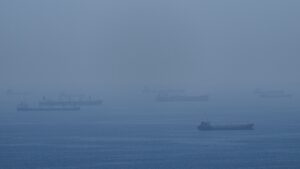
On Sunday, April 19, 2026, two Indian commercial ships—the **Sanmar Herald** and the **Jag Arnav**—were forced to abruptly halt their transit through the Strait of Hormuz after reportedly coming under fire from fast attack boats belonging to Iran’s Islamic Revolutionary Guard Corps (IRGC). The unprecedented morning ambush involved small-arms fire and an “unknown projectile” launched toward the merchant vessels. Fortunately, no major casualties were reported. Both captains swiftly executed evasive maneuvers and turned back to safer waters. This sudden escalation in one of the world’s most critical maritime chokepoints has sent immediate shockwaves through global energy markets, raising urgent questions regarding international shipping security. [Source: Hindustan Times].
## The Incident: Anatomy of a High-Seas Ambush
The timeline of the attack reveals a highly coordinated harassment effort within international shipping lanes. At approximately 05:30 local time, as the two vessels were navigating the inbound traffic separation scheme of the Strait of Hormuz, they were approached by multiple armed speedboats. Maritime tracking data confirms that the boats operated in a classic “swarm” formation, a well-documented tactical maneuver frequently utilized by the IRGC Navy (IRGCN) in the Persian Gulf.
According to initial distress calls relayed to regional maritime coordination centers, the gunboats closed the distance to less than a nautical mile before initiating warning shots. The situation rapidly escalated when an “unknown projectile” was fired in the direction of the **Sanmar Herald**. While it remains unclear whether the projectile was a small drone, a rocket-propelled grenade, or a warning flare, the threat level was deemed critically high.
In adherence to Best Management Practices (BMP5) for maritime security, the masters of both the **Sanmar Herald** and the **Jag Arnav** made the immediate tactical decision to abort their transit. They reversed course, heading back toward the Gulf of Oman to await naval escort and further instructions from their respective shipping companies. [Source: Hindustan Times | Additional: Regional Maritime Security Reports].
## The Vessels Involved: Sanmar Herald and Jag Arnav
To understand the economic and diplomatic gravity of this incident, it is essential to look at the profiles of the targeted ships. Both vessels represent vital cogs in the regional supply chain and India’s maritime trade network.
* **Jag Arnav:** Operated by Great Eastern Shipping, India’s largest private sector shipping company, vessels bearing the “Jag” prefix are a common sight in global maritime trade. The *Jag Arnav* is a heavy-duty commercial carrier actively engaged in bulk transport. Its presence in the Strait of Hormuz underscores India’s heavy reliance on the region for commodity imports.
* **Sanmar Herald:** Part of the Sanmar Shipping fleet, this vessel is typically involved in the transport of critical liquid bulk or chemical payloads. Any physical damage to a vessel of this classification carries the terrifying secondary risk of environmental catastrophe through hazardous spills.
**”The targeting of these specific vessels is a stark reminder of the vulnerabilities inherent in commercial shipping,”** notes Dr. Alistair Vance, Lead Analyst at the Center for Naval Intelligence in London. **”These are not military assets; they are slow-moving, minimally armed merchant ships carrying the economic lifeblood of nations. Forcing them to turn back disrupts supply chains that are already stretched dangerously thin in 2026.”**
## Decoding the Threat: IRGC Tactics and ‘Unknown Projectiles’
The involvement of the IRGC brings a complex geopolitical dimension to the incident. Historically, the IRGCN operates parallel to the traditional Iranian Navy, focusing extensively on asymmetric warfare. Their fast-attack craft (FAC) and fast inshore attack craft (FIAC) are heavily armed with heavy machine guns, multi-barrel rocket launchers, and anti-ship missiles.
The mention of an “unknown projectile” is the most concerning element of the Hindustan Times’ initial report. By early 2026, maritime security dynamics have fundamentally shifted due to the proliferation of loitering munitions (often referred to as “kamikaze drones”) and lightweight anti-ship missiles.
If the projectile was a drone, it aligns with a broader pattern of maritime harassment observed over the last three years in the Red Sea and the Gulf of Oman. Such weapons allow state and non-state actors to project power and intimidate international shipping with plausible deniability. Analysts are currently reviewing satellite telemetry and radar signatures to determine the exact nature of the weapon fired at the Indian vessels. [Source: Additional Open-Source Maritime Intelligence].
## Simmering Tensions: The Geopolitical Context of 2026
The attack does not exist in a vacuum. By April 2026, the Middle East’s geopolitical landscape remains highly volatile. The Strait of Hormuz—a narrow 21-mile-wide channel between Iran and Oman—is a critical artery for the global economy. Approximately 20% of the world’s global oil consumption transits through this chokepoint daily.
This incident occurs against a backdrop of complex regional negotiations, shifting alliances, and ongoing low-intensity conflicts. Harassment of shipping in the Strait is frequently utilized as a geopolitical lever. When diplomatic pressures mount, or regional sanctions are tightened, the maritime domain often becomes the theater for “gray zone” warfare—aggressive actions that remain just below the threshold of conventional armed conflict.
**”What we are witnessing is the instrumentalization of maritime chokepoints,”** explains Priya Desai, a Senior Fellow in Middle Eastern Studies at the Global Policy Institute. **”By intimidating Indian-flagged vessels, regional actors can send a message not just to New Delhi, but to the broader international community about who holds the keys to the world’s energy supply. It is a high-stakes game of diplomatic chicken.”**
## India’s Diplomatic and Military Response
For India, the safety of its merchant fleet in the Persian Gulf is a matter of paramount national interest. India imports over 80% of its crude oil, with a vast majority originating from the Middle East and transiting the Strait of Hormuz.
Following the April 19 incident, the Indian government has reportedly activated rapid response protocols. While the Ministry of External Affairs is expected to lodge formal diplomatic inquiries regarding the harassment, the Indian Navy’s role will be heavily scrutinized in the coming days.
Since the launch of *Operation Sankalp* in 2019, the Indian Navy has maintained a persistent presence in the Gulf region, deploying stealth frigates and destroyers to reassure and escort Indian-flagged merchant vessels. In the wake of the attacks on the **Sanmar Herald** and **Jag Arnav**, it is highly probable that the Indian Navy will increase its operational footprint, deploying additional P-8I maritime patrol aircraft and surface combatants to the Gulf of Oman to provide a protective umbrella for its commercial fleet. [Source: Historical Indian Defense Posture / Additional Analysis].
## Economic Fallout: Freight Rates and Energy Markets
Any disruption in the Strait of Hormuz triggers immediate economic consequences. The forced turnaround of the two Indian ships represents a tangible delay in supply chains, but the broader psychological impact on the shipping market is far more profound.
### Immediate Market Impacts
1. **War Risk Insurance Premiums:** Following the reports of IRGC gunboats firing projectiles, maritime insurance syndicates based in London and globally are likely to reassess the threat level in the Persian Gulf. War risk premiums, which are charged as a percentage of the ship’s hull value, could see sharp overnight spikes. This increased cost is inevitably passed down the supply chain to consumers.
2. **Oil Price Volatility:** Although neither the *Sanmar Herald* nor the *Jag Arnav* were reported as destroyed, the mere threat of a Strait closure causes market panic. Brent Crude futures historically jump between 2% to 4% on news of live-fire incidents in the Hormuz channel.
3. **Vessel Rerouting and Delays:** Merchant ships currently anchored in the UAE, Saudi Arabia, and Iraq may delay their outbound transits, awaiting naval escorts or clearer security guarantees. This leads to port congestion and a tightening of global shipping tonnage.
| **Economic Indicator** | **Pre-Incident Status (April 18)** | **Post-Incident Projection (April 20)** |
| :— | :— | :— |
| **War Risk Insurance** | Baseline (Standard Gulf Transit) | Expected to rise by 0.5% – 1.0% |
| **Global Oil Prices** | Stable / Demand-driven | Short-term spike projected |
| **Transit Delays** | Standard Schedule | 24-48 hour holds expected |
## Navigating the Future: Security Measures and Outlook
The live-fire harassment of the **Sanmar Herald** and **Jag Arnav** serves as a critical inflection point for global maritime security in 2026. While the vessels survived the encounter and successfully retreated to safe waters, the incident lays bare the persistent vulnerabilities of global maritime commerce.
Moving forward, the international shipping community faces a difficult balancing act. Commercial operators cannot afford prolonged transit suspensions, yet the physical safety of crews and multibillion-dollar cargoes cannot be compromised. This paradigm will likely accelerate several key industry trends:
* **Enhanced Escort Operations:** We can expect to see a reinforcement of international naval coalitions, such as the International Maritime Security Construct (IMSC), alongside independent national deployments by nations like India, China, and South Korea.
* **Technological Defenses:** Commercial vessels may increasingly adopt passive defense technologies, including advanced drone-jamming equipment and reinforced safe rooms (citadels) to protect crew members during high-seas confrontations.
* **Diplomatic De-escalation:** The onus will fall heavily on diplomatic backchannels to prevent an isolated incident from spiraling into a broader regional conflict.
As authorities continue to investigate the precise nature of the “unknown projectile” and the exact motives behind the IRGC gunboats’ aggressive maneuvers, the global community watches with bated breath. The safe passage of vessels like the **Sanmar Herald** and **Jag Arnav** is not merely a matter of corporate logistics; it is the fundamental prerequisite for global economic stability. Until robust security guarantees are re-established in the Strait of Hormuz, the waters of the Middle East will remain fraught with peril, echoing the delicate balance of power in an increasingly multipolar world.