
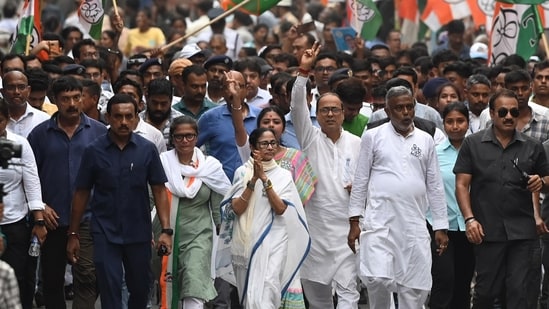
Jadavpur: Bengal's high-voltage seat where legacy, lawfare and ideologies collide
# Jadavpur: Bengal’s Ultimate Political Clash
By Staff Reporter, Political Desk | April 28, 2026
As West Bengal plunges into the crucial 2026 assembly elections, the Jadavpur constituency has once again emerged as the epicenter of a fierce, multi-cornered political battle. Historically renowned as a bellwether seat, Jadavpur will witness a dramatic collision of the ruling Trinamool Congress (TMC), the resurgent Left-Congress alliance, and the Bharatiya Janata Party (BJP) this May. Driven by deep-seated ideological divides, intense legal battles, and the towering legacies of former political titans, this urban stronghold encapsulates the broader socio-political struggle defining modern Bengal. For voters and analysts alike, whoever commands Jadavpur invariably dictates the political narrative of the state.
[Source: Hindustan Times | Additional: Election Commission of India Archives]
## The Weight of History and Political Legacy
Jadavpur is not merely a constituency; it is a living museum of West Bengal’s volatile political evolution. Once represented by former Chief Minister and CPI(M) stalwart Buddhadeb Bhattacharjee, the seat carries immense symbolic weight. Bhattacharjee’s tenure as the local representative was synonymous with the Left Front’s unyielding grip on the state’s urban intelligentsia and working-class refugee populations.
However, Jadavpur has long been a graveyard for political complacency. It was here in 1984 that a young Mamata Banerjee earned the moniker of “giant killer” by defeating veteran CPI(M) leader Somnath Chatterjee in the Lok Sabha polls. Decades later, in the historic 2011 assembly elections, Bhattacharjee himself was defeated by TMC’s Manish Gupta, signaling the definitive end of the 34-year-old Left regime in Bengal.
Today, the ghosts of these electoral earthquakes hover over the 2026 campaign. The CPI(M) is desperate to reclaim the legacy of Bhattacharjee, framing their current campaign around his vision of industrialization and intellectual freedom. Conversely, the TMC continuously invokes Banerjee’s historic 1984 triumph to remind voters of their roots in grassroots resistance.
“Jadavpur is the barometer of Bengal’s political mood,” notes Dr. Ayan Mukhopadhyay, a Kolkata-based political sociologist. “When Jadavpur shifts its allegiance, the rest of the state eventually follows. The legacy of Buddhadeb Babu and Mamata Banerjee’s early struggles makes this seat a matter of supreme prestige.”
## An Ideological Battleground: From Campuses to Streets
At the heart of the constituency lies Jadavpur University (JU), an institution recognized globally for its academic rigor and deeply entrenched leftist activism. The university campus frequently serves as a microcosm of the ideological wars fought across the state.
In recent years, the ideological landscape of the constituency has fractured. The traditional Leftist hegemony, championed by student unions and veteran intellectuals, is under severe pressure. The TMC has effectively mobilized its welfare-centric, sub-nationalist ideology, appealing directly to the working-class neighborhoods and newly developed suburban pockets surrounding the core urban center.
Meanwhile, the BJP has aggressively attempted to penetrate this historically impenetrable fortress. By championing a narrative of cultural nationalism and prioritizing national integration over regional exceptionalism, the BJP aims to consolidate the urban middle-class and upper-middle-class voters who have grown disillusioned with local administrative stagnation. The collision of these three distinct worldviews—Marxist-Leninist ideology, regional populism, and Hindutva-infused nationalism—creates an electrifying, and often combustible, electoral environment.
[Source: Hindustan Times | Additional: State Political Discourse Analysis 2026]
## Lawfare: The New Weapon of Electoral Politics
What distinctly separates the 2026 battle for Jadavpur from previous elections is the pervasive element of “lawfare”—the strategic use of legal proceedings to damage political opponents and shape public perception. Over the past three years, West Bengal has witnessed a flurry of Public Interest Litigations (PILs), Central Bureau of Investigation (CBI) probes, and Enforcement Directorate (ED) raids, many of which have directly or indirectly touched the political machineries operating in Jadavpur.
The judicial interventions regarding the state’s teachers’ recruitment controversies, municipal corruption allegations, and campus security protocols at local universities have heavily influenced voter sentiment. Opposition parties, particularly the BJP and the CPI(M), have weaponized these court rulings in their campaign rallies, accusing the ruling TMC of institutional decay.
In response, the TMC has launched its own legal counter-offensives, accusing central agencies of partisan witch-hunts designed to destabilize a democratically elected state government. This relentless legal warfare has transformed standard campaign rhetoric into highly technical debates about constitutional overreach, federalism, and judicial integrity.
“Elections in Jadavpur are no longer just fought in street corners and rally grounds; they are being fought in the corridors of the Calcutta High Court,” explains legal analyst and advocate Ruma Dasgupta. “Voters are highly literate here. They are reading court affidavits, following judicial bench decisions, and making electoral choices based on which party they believe is on the right side of the law.”
## Demographic Shifts and Changing Voter Sentiments
To understand the complexity of the Jadavpur seat in 2026, one must examine its rapidly evolving demographics. Historically, the area was settled by thousands of refugees fleeing East Pakistan (now Bangladesh) during the 1947 partition and the 1971 Liberation War. For decades, these refugee colonies formed the impregnable bedrock of the Left Front’s support, bound by promises of land rights and social security.
However, rapid urbanization and gentrification have drastically altered the constituency’s landscape. The old refugee colonies now sit adjacent to gleaming high-rises, luxury residential complexes, and modern commercial hubs. This geographical transformation has brought in a new demographic: young IT professionals, corporate executives, and affluent business families.
**Key Demographic Segments in Jadavpur (2026 Estimates):**
* **The Old Guard:** Retired professionals, veteran trade unionists, and early settlers who lean heavily toward ideological voting (historically Left, recently divided).
* **The Urban Youth:** University students and gig-economy workers who prioritize employment, campus politics, and progressive social issues.
* **The New Middle Class:** Corporate employees residing in high-rises who vote largely on infrastructure, law and order, and national economic policies.
* **The Working Class:** Domestic workers, street vendors, and transport workers who are the primary beneficiaries of the state government’s direct cash transfer and welfare schemes.
This demographic fragmentation means that no single issue dominates the electorate. While a family in a traditional neighborhood might vote based on legacy and ideological loyalty, a voter in a newly built condominium might base their decision purely on municipal governance, traffic management, and anti-corruption measures.
[Source: Hindustan Times | Additional: West Bengal Demographic Research Data]
## The 2026 Campaign Strategies
As April 2026 draws to a close, the campaign strategies of the three major factions have crystallized, reflecting the high-stakes nature of the Jadavpur contest.
**The Trinamool Congress (TMC)** is relying heavily on its vast array of social welfare programs, such as *Lakshmir Bhandar* (a basic income scheme for women) and *Swasthya Sathi* (health insurance). Their campaign in Jadavpur emphasizes the protection of Bengali sub-national identity against what they term as “outsider” interference by the central government. Local TMC leadership has also undertaken massive door-to-door campaigns to counteract the negative optics generated by the ongoing legal probes.
**The Left-Congress Alliance**, sensing a revival among the urban youth, is leaning heavily into an anti-corruption and pro-employment narrative. By fielding younger, highly educated candidates—many with roots in Jadavpur University’s student politics—the CPI(M) hopes to shed its antiquated image. They are framing 2026 as a moral crusade to restore Bengal’s intellectual and administrative dignity.
**The Bharatiya Janata Party (BJP)** is running a high-voltage campaign focused entirely on “double-engine government” economics and zero tolerance for political violence. The BJP is aggressively targeting the new middle-class residents of Jadavpur, promising infrastructure overhauls, the eradication of local extortion syndicates, and rapid industrialization aligned with central government initiatives.
## Implications for West Bengal’s Future
The outcome of the Jadavpur race will serve as a critical indicator for the broader trajectory of West Bengal politics over the next half-decade. If the TMC manages to retain the seat amidst anti-incumbency pressures and intense legal scrutiny, it will validate the enduring power of Mamata Banerjee’s welfare-driven electoral machine.
Conversely, a victory for the Left-Congress alliance would signal a monumental political renaissance, proving that ideological politics and anti-corruption platforms still resonate powerfully with the Bengali urban voter. Should the BJP pull off a surprise victory, it would mark a historic ideological breach in one of India’s most famously left-leaning constituencies, signaling a seismic demographic and cultural shift in Kolkata’s political fabric.
## Conclusion: A Constituency on the Edge
Jadavpur in 2026 is much more than a battle for a single legislative seat; it is a profound clash of narratives. The constituency remains a theater where the legacy of past chief ministers collides with modern legal battles, and where traditional leftist ideologies clash against modern regionalism and right-wing nationalism.
As voters prepare to cast their ballots, they are not just choosing a representative; they are deciding the philosophical and administrative direction of West Bengal. With its unique blend of intellectual history, changing demographics, and high-voltage campaigning, Jadavpur has once again cemented its status as the ultimate crucible of Indian democracy. Whatever the verdict, the echoes of the Jadavpur election will resonate far beyond the borders of Kolkata.





