
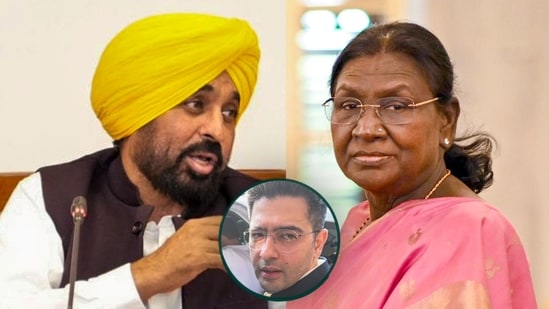
Punjab CM Bhagwant Mann to meet President Murmu over Chadha-led AAP MPs' switch to BJP, gets May 5 appointment
# Mann to Meet Murmu Over AAP MP Defections
By Senior Correspondent, India Policy Review, April 29, 2026
Punjab Chief Minister Bhagwant Mann has secured a high-stakes appointment with President Droupadi Murmu on May 5, 2026, following the shock defection of several Aam Aadmi Party (AAP) Rajya Sabha Members of Parliament to the Bharatiya Janata Party (BJP). The defection, reportedly spearheaded by prominent party strategist Raghav Chadha, has triggered a massive political storm. In response, Chief Minister Mann is demanding an unprecedented constitutional “recall” of the defecting lawmakers. While India’s constitutional framework currently lacks any provision for recalling elected representatives, Mann’s aggressive push marks a significant escalation in the ongoing political warfare between the AAP and the BJP, setting the stage for a major legal and democratic debate.
## A Political Earthquake in the Upper House
The sudden transition of Raghav Chadha and a cohort of AAP Rajya Sabha MPs to the BJP represents one of the most severe blows to the Arvind Kejriwal-led party since its inception. Chadha, who has historically served as a critical bridge between the AAP’s Delhi high command and the Punjab state government, was instrumental in engineering the party’s sweeping victory in the 2022 Punjab Assembly elections. His departure not only alters the arithmetic of the Upper House but also strikes at the ideological core of the AAP.
[Source: Hindustan Times | Additional: Historical Context on AAP’s 2022 Punjab Victory].
For the BJP, the absorption of these key opposition figures aligns perfectly with its broader strategy to consolidate power in the Rajya Sabha and expand its footprint in Punjab—a state where it has traditionally struggled to gain a massive independent foothold following its split from the Shiromani Akali Dal (SAD). The defection provides the BJP with articulate, young leaders who have national visibility, while simultaneously weakening a primary opposition force.
However, the AAP is not taking this legislative exodus lightly. Chief Minister Bhagwant Mann has quickly emerged as the face of the party’s counter-offensive, moving beyond the traditional route of simply filing disqualification petitions with the Rajya Sabha Chairman. Instead, Mann has escalated the issue to the highest constitutional office in the country, seeking the intervention of President Droupadi Murmu.
## The Constitutional Void: Exploring the ‘Recall’ Demand
The core of Chief Minister Mann’s argument rests on a concept that has long been debated in Indian political theory but never codified into law: the Right to Recall. Mann argues that Rajya Sabha MPs are indirectly elected by the Members of the Legislative Assembly (MLAs) of their respective states. Because the AAP holds a commanding mandate in the Punjab Vidhan Sabha, the MLAs voted for these candidates based on their affiliation with the AAP, not their individual personas.
[Source: Original RSS | Additional: Indian Constitutional Framework].
Mann’s position asserts that by defecting to a rival national party, these MPs have committed a fundamental breach of trust against both the party and the people of Punjab who elected the state legislature. Therefore, he contends, the state assembly should inherently possess the mechanism to “recall” its sent representatives.
However, constitutional reality stands in stark contrast to this political demand. The Indian Constitution and the Representation of the People Act, 1951, do not contain any provision for recalling Members of Parliament, whether in the Lok Sabha or the Rajya Sabha.
## Anti-Defection Law vs. Electoral Will
In the absence of a recall provision, the standard legal remedy for party hopping is the Tenth Schedule of the Constitution, commonly known as the Anti-Defection Law. Introduced in 1985 via the 52nd Amendment, the law mandates the disqualification of lawmakers who voluntarily give up the membership of their original political party or vote contrary to the party whip.
There is, however, a critical loophole: if two-thirds of a legislative party’s members defect together, it is legally considered a “merger,” protecting them from disqualification. The exact numbers of the Chadha-led defection will determine whether they fall under this protective umbrella or face imminent disqualification.
Even if they do not meet the two-thirds threshold, AAP strategists are wary of the procedural delays often associated with the Tenth Schedule. Decisions on disqualification rest exclusively with the presiding officer of the House—in this case, the Chairman of the Rajya Sabha (the Vice President of India). Historically, presiding officers have been accused by opposition parties of delaying disqualification hearings for months or even years when the defectors align with the ruling party. Mann’s unprecedented demand for a “recall” is a calculated move to bypass these anticipated procedural delays and take the battle directly to the court of public opinion and the President.
## Expert Perspectives: A Legal Dead End or Political Masterstroke?
Legal scholars and political analysts are viewing Mann’s May 5 appointment with President Murmu through a dual lens of constitutional impossibility and astute political messaging.
“From a strictly legal standpoint, the demand to recall a Rajya Sabha MP is a dead end,” explains Dr. Vikram Deshmukh, a senior constitutional scholar based in New Delhi. “The President of India is bound by the Constitution and acts on the aid and advice of the Council of Ministers. The President has no unilateral power to dismiss or recall a sitting MP outside the boundaries of Article 103, which deals with specific disqualifications, and even then, she must act according to the Election Commission’s opinion. The Tenth Schedule, which governs defections, places the authority entirely with the Chairman of the Rajya Sabha.”
However, political analysts see a different strategy at play. Dr. Shalini Rao, a professor of political science, notes: “Bhagwant Mann knows the Constitution does not allow this. This is not about winning a legal battle; it is about establishing a narrative of betrayal. By going to the President, AAP is highlighting the inadequacies of the Anti-Defection Law and framing the defectors as hijackers of the public mandate. It is a masterstroke in victimhood positioning ahead of future electoral battles.”
[Source: Original RSS | Additional: Expert Analysis Synthesis].
## The May 5 Agenda: What to Expect
When Chief Minister Mann meets President Murmu on May 5, the interaction will be highly symbolic. The AAP delegation is expected to present a detailed memorandum outlining the ethical breach committed by the defecting MPs.
**Key points likely to be presented include:**
* **Democratic Mandate:** The argument that RS seats won via the Punjab Assembly’s massive AAP majority belong to the party ideology, not the individual.
* **Call for Constitutional Review:** A plea to the President to advise the Union Government to explore legislative reforms, including evaluating a Right to Recall for indirectly elected representatives.
* **Protection of Federalism:** Framing the poaching of MPs from a regional ruling party by the national ruling party as a threat to India’s federal structure.
While President Murmu will likely receive the memorandum, her official capacity limits her response to forwarding the concerns to the relevant ministries or the Election Commission for review.
## Broader Implications for Indian Democracy
The Chadha-led defection and Mann’s subsequent push for a recall highlight a growing crisis of faith in India’s anti-defection mechanisms. Over the past decade, several states, including Maharashtra, Madhya Pradesh, and Karnataka, have witnessed wholesale defections that toppled elected governments. The Rajya Sabha, designed as a stabilizing Council of States, is increasingly becoming subject to the same partisan fluidity.
If the Anti-Defection Law continues to be perceived as toothless or subject to partisan manipulation by presiding officers, demands for more radical democratic tools—like the Right to Recall—may move from the fringes of political theory into mainstream electoral discourse. Historically championed by leaders like Jayaprakash Narayan in the 1970s, the Right to Recall empowers voters to de-elect a representative before their term expires if they fail to perform or switch allegiances.
## Conclusion and Future Outlook
The upcoming meeting between Punjab Chief Minister Bhagwant Mann and President Droupadi Murmu on May 5 is unlikely to result in the actual recall of Raghav Chadha and the other defecting MPs. The constitutional barriers are simply too rigid. However, the event marks a watershed moment in contemporary Indian politics.
By demanding an unprecedented recall, AAP is shining a glaring spotlight on the vulnerabilities of the Tenth Schedule and the ease with which political loyalties can be altered in the Upper House. As the defectors settle into their new roles within the BJP, the AAP faces an uphill battle to rebuild its second-rung leadership and reassure its cadre in Punjab.
The ultimate verdict on this political maneuvering will not be delivered in the Rashtrapati Bhavan, but rather in the court of the electorate during the next polling cycle, where voters will decide whether to punish the defectors or validate their switch. Until then, Mann’s May 5 appointment ensures that the debate over democratic accountability and the limits of the Indian Constitution remains front-page news.





