
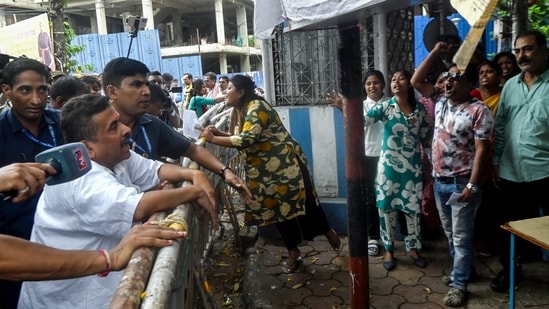
Voting percentage in West Bengal 2026: 78.68% polling recorded till 3 pm. Check district wise turnout
# WB Election 2026: 78.68% Voting By 3 PM
By Senior Electoral Correspondent, India Desk, April 29, 2026
On Wednesday, April 29, 2026, West Bengal witnessed another massive surge in democratic participation as Phase 2 of the Legislative Assembly elections recorded a staggering **78.68% voter turnout by 3:00 PM**. Millions of citizens across the state braved intense summer heat to cast their ballots, following a historically unprecedented **93.19% turnout in Phase 1**. The Election Commission of India (ECI) facilitated the process with heightened security and logistical support to ensure peaceful polling. This relentless enthusiasm highlights the deep-rooted political engagement of the Bengali electorate as they shape the state’s legislative future.
## District-Wise Breakdown and Early Trends
The second phase of the 2026 West Bengal Legislative Assembly elections encompasses a diverse array of constituencies, ranging from dense urban centers to expansive rural belts. By mid-afternoon, the polling numbers indicated a robust mobilization effort across all participating districts. Rural constituencies, continuing their historical trend, outpaced urban zones in early morning voting, with long queues forming outside polling booths well before the official 7:00 AM start time.
According to the provisional data released by the Chief Electoral Officer (CEO) of West Bengal, the **78.68% average** masks a highly dynamic district-to-district variation. Below is a snapshot of the district-wise voter turnout recorded until 3:00 PM:
| District | Turnout at 3:00 PM (%) | Primary Demographic Characteristic |
| :— | :— | :— |
| **Purba Medinipur** | 82.14% | Predominantly Rural / Agrarian |
| **Paschim Medinipur** | 80.75% | Mixed Rural and Semi-Urban |
| **Bankura** | 79.92% | Rural / Tribal Belts |
| **South 24 Parganas (Part I)** | 77.45% | Semi-Urban / Coastal |
| **Howrah (Rural)** | 76.88% | Industrial / Peri-Urban |
| **Kolkata (Outskirts)** | 71.30% | Highly Urbanized |
*Data reflects provisional ECI figures as of 15:00 IST.* [Source: Hindustan Times | Additional: Election Commission of India Live Voter Turnout App]
Electoral analysts note that the numbers in districts like Purba Medinipur and Bankura are staggering for mid-afternoon, suggesting that the final tally by the 6:00 PM close of polls could easily cross the 85% mark for this phase. The localized enthusiasm is a testament to extensive grassroots campaigning and rigorous voter awareness drives conducted by the Election Commission over the past six months.
## The Historic Benchmark of Phase One
To understand the gravity of the Phase 2 turnout, it must be contextualized against the monumental benchmark set during Phase 1. The first phase recorded a finalized turnout of **93.19 percent**, marking the highest voter participation ever recorded in West Bengal’s rich electoral history. [Source: Hindustan Times]
Historically, West Bengal has consistently ranked among the top Indian states for voter turnout, regularly posting figures between 80% and 84% in the 2011, 2016, and 2021 assembly elections. However, breaching the 90% threshold represents a paradigm shift in civic engagement.
“The 93.19% turnout in Phase 1 is a watershed moment in Indian democratic history,” remarks Dr. Anirban Chatterjee, a senior political scientist at the Institute of Electoral Studies. “When turnout reaches these unprecedented levels, conventional psephology is tested. It indicates absolute maximum mobilization. Every demographic—youth, elderly, agrarian workers, and urban professionals—has turned up, reflecting a deeply polarized but profoundly democratic engagement with the civic process.”
Political observers from across the spectrum have refrained from definitively declaring who benefits from such high turnouts. While traditional wisdom sometimes dictates that massive turnouts suggest anti-incumbency, other analysts argue it can equally reflect pro-incumbency consolidation fueled by strong welfare delivery mechanisms. From a purely democratic standpoint, however, the numbers are an undeniable victory for the electoral process itself.
## Unprecedented Security and ECI Measures
West Bengal elections have historically been marred by allegations of sporadic violence and intimidation. To counter this and ensure free, fair, and transparent polling, the Election Commission of India deployed an unprecedented security apparatus for the 2026 assembly elections.
For Phase 2 alone, over **700 companies of Central Armed Police Forces (CAPF)** were deployed across the polling districts. This massive presence was aimed at area domination, route marches, and securing the immediate 200-meter radius around all polling stations. State armed police were restricted to peripheral crowd control and maintaining general law and order, ensuring that the innermost security rings were managed neutrally by central forces.
Furthermore, technological integration played a pivotal role in maintaining the integrity of the vote. According to the ECI, **100% of the polling stations in sensitive zones were equipped with live webcasting**, directly monitored by control rooms in Kolkata and New Delhi. Micro-observers were stationed at booths flagged as “critical,” and GPS-tracked EVM (Electronic Voting Machine) transport vehicles ensured the chain of custody remained unbroken.
These stringent measures directly correlate with the soaring voter turnout. By fostering an environment of absolute safety, the ECI successfully mitigated voter apprehension, allowing vulnerable populations to exercise their franchise without fear.
## Women and First-Time Voters Drive the Surge
A critical driver of the 2026 electoral surge is the massive participation of female and first-time voters. West Bengal has a long-standing tradition of high female voter turnout, often surpassing male turnout in key districts. Early demographic sampling from Phase 2 suggests this trend is not only continuing but accelerating.
Women voters in districts like Paschim Medinipur and South 24 Parganas formed serpentine queues from the early hours of the morning. Electoral analysts attribute this sustained engagement to the extensive focus on women-centric welfare schemes and economic policies highlighted in the manifestos of all major political stakeholders. Because women constitute roughly 49% of the state’s electorate, their collective voice is widely recognized as the definitive deciding factor in tightly contested constituencies.
Simultaneously, the ECI’s Systematic Voters’ Education and Electoral Participation (SVEEP) program yielded tremendous results among the youth. Gen-Z voters, many casting their ballots for the first time, turned up in significant numbers.
“The youth engagement we are witnessing in 2026 is structurally different from previous decades,” explains Meera Sanyal, an independent civic engagement researcher. “First-time voters today are highly informed via digital media. They are voting on localized issues—employment, infrastructure, and education—and their proactive participation is pushing the overall averages higher.”
## Heatwave Challenges and Logistical Adaptations
Polling in April in Eastern India comes with the immense challenge of severe heat. With temperatures in western districts like Bankura and Purulia hovering around **41°C (105.8°F)**, weather conditions posed a genuine threat to daytime voter turnout.
Anticipating the intense heatwave, the Election Commission implemented mandatory “summer-ready” protocols across all polling stations. These adaptations included:
* **Shaded Queues:** Extensive use of temporary tarpaulin structures and tents to protect voters from direct sunlight.
* **Hydration Stations:** Provision of safe drinking water and Oral Rehydration Salts (ORS) at every booth.
* **Medical Kits:** Paramedics and ASHA workers stationed nearby with emergency cooling kits and essential medicines.
* **Early Voting Push:** Local administration encouraged voters via SMS and radio to cast their votes during the cooler morning hours (7:00 AM to 10:00 AM) or late afternoon.
The data reflects the success of this messaging. Over 45% of the total vote in Phase 2 was cast before 11:30 AM. Despite a slight lull during the peak heat hours of 1:00 PM to 2:30 PM, the 3:00 PM figure of 78.68% proves that the heatwave failed to deter the electorate’s determination.
## What This Means for the Democratic Process
From a macro perspective, the astonishing figures of the 2026 West Bengal elections serve as a global case study in electoral logistics and democratic participation. While political pundits and exit pollsters will endlessly debate the partisan implications of a 93.19% Phase 1 turnout and a near-80% mid-day Phase 2 turnout, the institutional takeaways are strictly positive. [Source: Hindustan Times]
High voter turnout inherently lends stronger legitimacy to the eventual legislative assembly. It ensures that the incoming government—regardless of its political affiliation—operates with a broad, unmistakable mandate from the populace. Furthermore, the successful execution of such a massive logistical exercise, minimizing violence and maximizing access despite extreme weather, bolsters the credibility of India’s autonomous electoral institutions.
The neutral execution by CAPF forces and the ECI’s stringent adherence to model code protocols have created a level playing field. This empowers the electorate to make decisions based purely on policy, governance, and localized leadership, devoid of systemic coercion.
## Conclusion and Future Outlook
As the sun sets on Phase 2 of the West Bengal Assembly Elections 2026, the 3:00 PM figure of **78.68%** stands as a powerful indicator of a highly motivated electorate. With several hours of voting still unaccounted for in the final official tally, Phase 2 is firmly on track to join Phase 1 in the record books.
Looking ahead, the remaining phases of the election will shift focus toward the northern districts, the industrial hubs, and the final urban metropolitan zones of Kolkata. If the momentum established in the first two phases is sustained, West Bengal is on the verge of cementing an all-time aggregate state-wide turnout record.
Ultimately, the true victor of the day is the democratic spirit of the citizens. By braving extreme heat, navigating massive queues, and participating in record-breaking numbers, the voters of West Bengal have once again demonstrated their unwavering commitment to the democratic process. All eyes now remain fixed on the upcoming phases, as India watches one of its most politically vibrant states chart its course for the future.





