
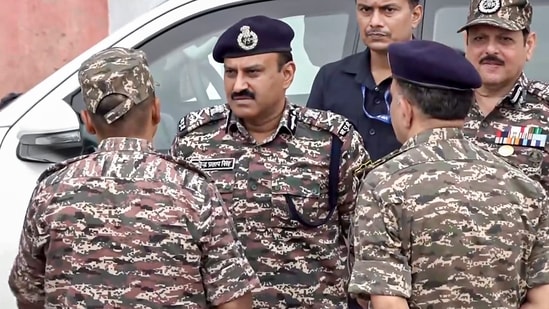
Bengal polls: 'Singham' officer on ground as polling underway in South 24 Parganas
# Bengal Polls: ‘Singham’ Cop Secures Diamond Harbor
**By Special Correspondent, National Election Desk, April 29, 2026**
As the crucial phases of the 2026 West Bengal Assembly elections unfold, the volatile South 24 Parganas district witnessed heightened security on Wednesday, April 29. At the center of this massive administrative mobilization is IPS officer Ajay Pal Sharma, currently posted as Assistant Commissioner of Police (ACP) in Prayagraj, Uttar Pradesh. Known colloquially as ‘Singham’ for his tough-cop persona, Sharma’s deployment as a special police observer in the Diamond Harbour area has drawn intense political controversy. Tasked with ensuring a violence-free voting process, his proactive area domination measures, preventive arrests, and aggressive route marches have sparked a fierce debate over the Election Commission’s strategies in one of India’s most politically sensitive landscapes.
[Source: Hindustan Times | Additional: Election Commission of India Public Briefings]
## The ‘Singham’ Factor: Cross-Cadre Deployment
The Election Commission of India (ECI) has a long-standing tradition of appointing strict, no-nonsense officers from outside cadres to oversee elections in states with a history of poll-related violence. The appointment of **Ajay Pal Sharma**, a 2011-batch Indian Police Service (IPS) officer from the Uttar Pradesh cadre, is a testament to this strategy.
During his tenure in Uttar Pradesh, particularly in districts like Noida, Rampur, and currently as ACP in Prayagraj, Sharma cultivated a formidable reputation. His track record of dismantling organized crime syndicates and his hands-on approach to law enforcement earned him the moniker ‘Singham’—a reference to the righteous, fearless police officer popularized in Indian cinema.
Bringing a UP-cadre officer to West Bengal for the 2026 assembly elections signals the ECI’s zero-tolerance policy toward booth capturing and voter intimidation. On the ground in South 24 Parganas, Sharma has been seen personally leading Central Armed Police Force (CAPF) personnel through the narrow, densely populated alleys of Diamond Harbour, conducting late-night raids, and establishing strict checkpoints at district borders. His operational mandate is clear: neutralize local strongmen and create a secure environment where marginalized and fearful voters can exercise their franchise without coercion.
[Source: Original RSS | Additional: Public IPS Service Records & Uttar Pradesh Police Archives]
## Diamond Harbour: A Geopolitical Tinderbox
To understand the controversy surrounding Sharma’s deployment, one must understand the political geography of **South 24 Parganas**, and specifically, **Diamond Harbour**.
Diamond Harbour is not just another constituency; it is the political fortress of the ruling Trinamool Congress (TMC) and the turf of its national general secretary, Abhishek Banerjee. The region has historically recorded some of the highest voter turnouts in the state, but it has also been a focal point for allegations of systemic electoral malpractice. Opposition parties, including the Bharatiya Janata Party (BJP) and the Communist Party of India (Marxist) [CPI(M)], have long claimed that an entrenched local syndicate prevents opposition agents from manning polling booths and uses intimidation tactics against vulnerable rural voters.
The terrain of South 24 Parganas adds to the security challenge. With its vast riverine stretches leading into the Sundarbans and porous internal borders, the district provides ample cover for anti-social elements to transport illicit cash, country-made firearms, and political mercenaries. Securing this region requires not just manpower, but tactical ingenuity—a void the Election Commission hopes to fill with officers like Ajay Pal Sharma.
## Political Controversy Over “Proactive Measures”
Sharma’s operational style has triggered a predictable political firestorm. Over the past 48 hours leading up to the April 29 polling day, local police and central forces operating under his observation executed over 200 preventive detentions. Significant caches of crude bombs and unaccounted cash were seized in raids across the Diamond Harbour sub-division.
The ruling Trinamool Congress has vehemently objected to these measures. TMC spokespersons have accused the ECI of acting as an extension of the BJP-led central government. “Bringing an officer from Uttar Pradesh—a state ruled by the BJP—to aggressively target our grassroots workers in Bengal is a direct assault on the federal structure. These so-called ‘proactive measures’ are nothing but veiled intimidation tactics designed to suppress the voter turnout in our strongholds,” stated a senior TMC leader during a press briefing in Kolkata.
Conversely, the state BJP leadership has lauded the ECI’s intervention. “For the first time in a decade, the voters of Diamond Harbour are breathing freely. The local syndicate’s reign of terror is being dismantled by honest officers who refuse to bow down to political pressure. The ECI is finally fulfilling its constitutional duty,” argued a local BJP candidate.
Dr. Arundhati Sen, an independent political analyst based in Kolkata, offers a nuanced perspective on the friction. *“When the Election Commission parachutes an officer with a ‘tough-cop’ image from a BJP-ruled state into the TMC’s most prized bastion, the optics are bound to be highly combustible,”* Dr. Sen explains. *“However, given the bloody history of the 2023 Bengal Panchayat polls, the Commission has empirical justification to implement disproportionately heavy security measures in historically sensitive zones.”*
[Source: Hindustan Times | Additional: Independent Political Analysis, 2026 Bengal Election Coverage]
## ECI’s Unprecedented Security Blueprint
The deployment of Ajay Pal Sharma is just one cog in a massive electoral machinery engineered by the Election Commission for the 2026 West Bengal Assembly polls. The overarching strategy revolves around saturation security and technological surveillance.
Key elements of the security matrix in South 24 Parganas include:
* **100% Webcasting:** Every single polling booth in the Diamond Harbour area has been equipped with live HD webcasting, monitored directly by control rooms in Kolkata and New Delhi.
* **Central Armed Police Force (CAPF) Saturation:** State armed police have been largely relegated to the outer perimeters. The inner core of the polling stations is manned exclusively by CAPF personnel.
* **Quick Response Teams (QRTs):** Motorized QRTs, coordinated by central observers like Sharma, guarantee a response time of under 10 minutes to any report of violence or booth capturing.
* **Drone Surveillance:** For the first time, tethered drones are being heavily utilized to monitor the dense, riverine topographies surrounding Diamond Harbour to prevent the mass movement of political cadres.
## Voices from the Ground: Fear and Relief
For the ordinary voter in South 24 Parganas, the heavy boots on the ground evoke a mix of apprehension and deep relief. Polling day visuals from Diamond Harbour show long, orderly queues of women and first-time voters, a stark contrast to previous elections marked by sporadic clashes.
*“Normally, the night before the election is terrifying. We hear the sound of crude bombs going off to scare us into staying home,”* shared a 45-year-old school teacher waiting to cast her vote in the Falta area of Diamond Harbour. *“But the past two days have been completely silent. The central forces and the new special officer have been marching through our lanes day and night. We feel safe enough to come out today.”*
Former IPS officer and security strategist, R.N. Bhattacharya, emphasizes the psychological impact of such deployments. *“In states where political violence is institutionalized, the local police often suffer from a crisis of credibility. By bringing in an officer like Ajay Pal Sharma, who has zero local vested interests and a reputation for ruthlessness against criminals, the ECI shifts the psychological advantage from the local goons back to the democratic state.”*
## The Historical Shadow of Poll Violence
The Election Commission’s heavy-handed approach in 2026 cannot be viewed in isolation. It is a direct response to the traumatic electoral history of West Bengal. The 2021 Assembly elections, despite heavy central deployment, saw severe post-poll violence that led to interventions by the National Human Rights Commission (NHRC) and the Calcutta High Court.
The situation deteriorated further during the 2023 Panchayat elections, which claimed over 50 lives across the state, with South 24 Parganas being one of the worst-hit districts. The 2024 Lok Sabha elections also witnessed localized skirmishes, though large-scale casualties were averted.
By 2026, the ECI recognized that standard operating procedures were insufficient for regions like Diamond Harbour. The strategy shifted from “responsive policing” to “preventive domination.” The proactive measures criticized by local politicians—such as binding down local miscreants under Section 107 of the CrPC weeks in advance—are part of this new doctrine to ensure that the electoral narrative is dictated by the voter, not the violent political worker.
[Source: Hindustan Times | Additional: Historical Election Commission Reports 2021-2024]
## Conclusion: Implications for Indian Democracy
As polling continues in South 24 Parganas under the vigilant eyes of officers like Ajay Pal Sharma, the immediate outcome will be measured in voter turnout percentages and the absence of casualties. However, the broader implications for Indian democracy are profound.
The events unfolding in Diamond Harbour highlight a critical tension in India’s electoral mechanics: the necessity of semi-militarized police interventions to conduct a fundamental civic exercise. While the proactive, ‘Singham’-style measures successfully curtail immediate violence, they also spark valid debates regarding federalism and the neutrality of state versus central machinery.
Ultimately, the peaceful conduct of the election in South 24 Parganas could serve as a model for managing hypersensitive constituencies across India. If the heavy security apparatus translates into a high, coercion-free voter turnout, the Election Commission will likely view its cross-cadre deployment strategy as a resounding success, setting a stringent precedent for all future state and national elections.





