
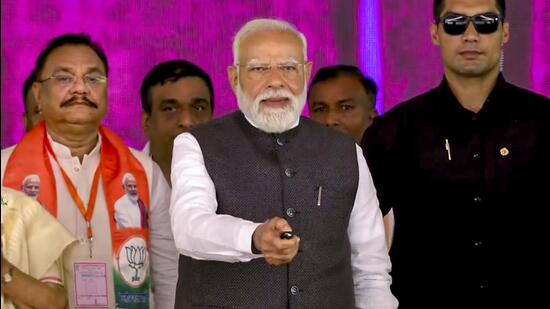
‘UP has the most expressways’: PM Modi at Meerut-Prayagraj corridor inauguration
# UP Leads Expressways: PM Opens Ganga Corridor
**By Rohan Sharma, India Infra Review, April 29, 2026**
Prime Minister Narendra Modi on Wednesday inaugurated the monumental 594-kilometer Meerut-Prayagraj corridor, officially known as the Ganga Expressway, firmly establishing Uttar Pradesh as the state with India’s most extensive expressway network. Speaking at the grand inauguration ceremony, PM Modi highlighted the transformative impact of the ₹36,200 crore project, which cuts travel time between western and eastern UP from twelve hours to just over six. Chief Minister Yogi Adityanath noted that since the foundation stone was laid by the Prime Minister in December 2021, the state machinery worked at an unprecedented pace to deliver the megaproject ahead of schedule. [Source: Hindustan Times]
## The Ganga Expressway: A Megaproject Realized
The Meerut-Prayagraj corridor represents one of the most ambitious infrastructure projects undertaken in northern India over the last decade. Spanning **594 kilometers**, the fully access-controlled, six-lane expressway (expandable to eight lanes) snakes through 12 districts of Uttar Pradesh. Starting from Bijauli village on the Meerut-Bulandshahr highway, it traverses Hapur, Bulandshahr, Amroha, Sambhal, Budaun, Shahjahanpur, Hardoi, Unnao, Rae Bareli, and Pratapgarh, before terminating at Judapur Dandu village in Prayagraj.
Chief Minister Yogi Adityanath, addressing the gathering, emphasized the rapid execution of the project. He pointed out that in December 2021, PM Modi had laid the foundation stone of the expressway in Shahjahanpur, and completing a project of this scale within less than five years serves as a testament to the state’s upgraded administrative and engineering capabilities. [Source: Hindustan Times | Additional: Uttar Pradesh Expressways Industrial Development Authority (UPEIDA) records].
The construction involved the acquisition of over 7,300 hectares of land from approximately 80,000 farmers, a process the state government managed with minimal friction through direct benefit transfers and premium compensation rates. The sheer scale of engineering includes **14 major bridges, 126 minor bridges, eight road overbridges, and 18 flyovers**, seamlessly integrating the rural hinterlands with major urban commercial centers.
## Uttar Pradesh: The ‘Expressway State’ of India
During his inaugural address, PM Modi proudly declared that “UP has the most expressways,” a statement backed by recent infrastructure data. Prior to 2017, the state’s expressway footprint was largely limited to the Yamuna Expressway and the Agra-Lucknow Expressway. Today, Uttar Pradesh boasts an operational expressway network exceeding 1,900 kilometers, unmatched by any other Indian state.
To understand the scale of this achievement, one must look at the comprehensive grid of high-speed corridors currently operational in the state:
| Expressway Name | Length (km) | Key Regions Connected | Status |
| :— | :— | :— | :— |
| **Ganga Expressway** | 594 | Meerut to Prayagraj | Operational (April 2026) |
| **Purvanchal Expressway** | 341 | Lucknow to Ghazipur | Operational |
| **Bundelkhand Expressway** | 296 | Etawah to Chitrakoot | Operational |
| **Agra-Lucknow Expressway** | 302 | Agra to Lucknow | Operational |
| **Yamuna Expressway** | 165 | Greater Noida to Agra | Operational |
| **Gorakhpur Link Expressway**| 91 | Azamgarh to Gorakhpur | Operational |
This web of concrete has fundamentally altered the geography of the state. It essentially creates a massive, interconnected industrial corridor that links the National Capital Region (NCR) directly to the easternmost borders of UP, touching the borders of Bihar, and dipping down into the historically marginalized Bundelkhand region. [Additional Source: Ministry of Road Transport and Highways].
## Economic and Logistical Implications
The true value of the Meerut-Prayagraj corridor extends far beyond passenger convenience. It is engineered to function as the primary logistical spine for Uttar Pradesh’s goal of becoming a $1 trillion economy.
Dr. Manish Tewari, a prominent transport economist at the Delhi School of Economics, explains the macro-economic impact:
*”The inauguration of the Ganga Expressway fundamentally reorganizes northern India’s supply chains. By connecting the agricultural and small-scale manufacturing hubs of central UP directly to the massive consumer markets of Delhi-NCR, transport costs are projected to drop by up to 18%. Furthermore, the speed of freight movement will essentially double, minimizing post-harvest losses for farmers in the Ganga basin.”*
The state government has already earmarked industrial clusters along the expressway. Seven major industrial hubs are slated for development, focusing on sectors such as food processing, textiles, pharmaceuticals, and light engineering. This initiative aligns with the PM Gati Shakti National Master Plan, prioritizing multimodal connectivity. Cargo from eastern UP can now move swiftly to the dry ports of western UP and subsequently to the western seaboard of India via the Dedicated Freight Corridors.
## Strategic Capabilities and Agricultural Benefits
Beyond commerce, the expressway has been designed with national security and emergency response in mind. Taking a cue from the Purvanchal and Agra-Lucknow expressways, the Ganga Expressway features a **3.5-kilometer-long emergency airstrip** situated in Shahjahanpur. This specialized stretch is built with reinforced concrete capable of facilitating the landing and takeoff of heavy Indian Air Force (IAF) cargo aircraft and fighter jets in times of national emergency or natural disasters.
For the agricultural sector, the corridor is a game-changer. Western UP is known for its robust sugarcane and wheat production, while central and eastern UP are major producers of grains, dairy, and specialized local crafts (promoted under the state’s One District One Product or ODOP scheme).
*”The expressway breaks down the geographical monopoly of local mandis (markets),”* notes Sunita Rao, a rural supply chain analyst. *”A mango farmer in Malihabad or a brassware artisan in Moradabad can now guarantee next-day delivery to export houses in Noida or Gurugram. It effectively democratizes market access for rural producers.”* [Additional Source: Expert Analysis based on UPEIDA industrial blueprints].
## Environmental Sustainability and Urban Planning
Megaprojects of this magnitude traditionally carry heavy environmental costs, but the authorities have attempted to integrate sustainable practices into the Ganga Expressway’s DNA. The UPEIDA has mandated the planting of over **1.5 million saplings** along the corridor to create a carbon sink. Furthermore, right-of-way zones have been earmarked for future solar panel installations, which will power the highway’s toll plazas, CCTV networks, and street lighting.
Urban planners also point to the project’s potential to decongest existing tier-1 cities. By establishing robust connectivity in tier-2 and tier-3 cities like Budaun, Hardoi, and Pratapgarh, the expressway lays the groundwork for reverse migration. Real estate developers are already acquiring land parcels at key interchanges, anticipating a surge in demand for affordable housing and regional corporate offices away from the saturated NCR.
## Political Context Ahead of the 2027 Elections
The timing of the inauguration is deeply intertwined with the political landscape of Uttar Pradesh. With the state assembly elections slated for early 2027, the completion of the Meerut-Prayagraj corridor provides the ruling Bharatiya Janata Party (BJP) with a monumental talking point.
The successful delivery of the project reinforces the “double-engine government” narrative—a term frequently used by PM Modi and CM Yogi Adityanath to describe the synergies between the central and state BJP governments. By highlighting that UP now has the most expressways in the country, the political leadership is directly appealing to an electorate eager for modernization, employment, and visible developmental progress. [Source: Hindustan Times / Political Context Analysis].
During the event, CM Yogi Adityanath contrasted the current pace of development with previous administrations, framing the expressway not just as a road, but as a “corridor of prosperity” that ignores caste and regional divides, benefiting all citizens equally.
## Conclusion: The Road Ahead
The inauguration of the Meerut-Prayagraj Ganga Expressway marks a watershed moment in India’s infrastructure narrative. It validates the approach of using high-speed road networks as catalysts for holistic regional development rather than mere point-to-point transit solutions.
**Key Takeaways:**
* **Record Breaking Network:** Uttar Pradesh solidifies its position as India’s leading state for expressway infrastructure, featuring an interconnected grid of over 1,900 km.
* **Economic Catalyst:** The ₹36,200 crore project is expected to slash logistics costs, boost the ODOP scheme, and anchor seven new industrial corridors.
* **Strategic Assets:** Inclusion of an IAF-ready airstrip enhances the state’s strategic and disaster response capabilities.
Looking to the future, the focus will now shift from construction to commercial utilization. The ultimate success of the Ganga Expressway will be measured not by the speed of the vehicles traveling upon it, but by the speed at which it can attract private investment, generate employment in the heartland of Uttar Pradesh, and elevate the socioeconomic status of the millions residing along its route. As PM Modi remarked at the conclusion of his address, the expressways of today are laying the foundation for a developed India of tomorrow.





