
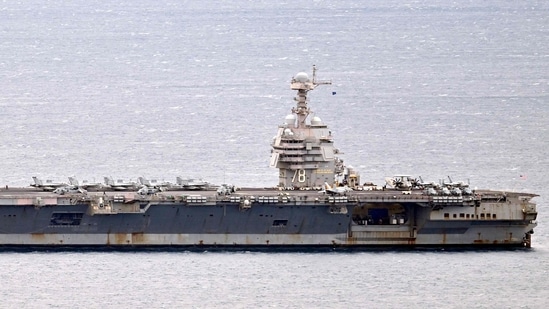
US naval carrier likely to leave West Asia amid stalled talks with Iran: Report
# US Carrier Exits West Asia Amid Iran Impasse
**Byline: John Davis, Senior Defense Correspondent | April 30, 2026**
**WASHINGTON** — The United States Navy is set to withdraw the USS Gerald R. Ford from West Asia this week, reducing its unprecedented three-carrier regional presence amid stalled diplomatic negotiations with the Islamic Republic of Iran. The departure of the advanced supercarrier, confirmed in late April 2026, marks a pivotal shift in the Pentagon’s force posture in the United States Central Command (CENTCOM) area of responsibility. While Washington maintains the redeployment is tied to long-overdue maintenance cycles, the move coincides with a deep freeze in backchannel talks aimed at curbing Tehran’s nuclear enrichment and proxy militia operations across the Middle East.
## Shifting Naval Footprint in the Middle East
The withdrawal of the USS Gerald R. Ford (CVN-78) from West Asia represents a significant recalibration of American military assets. Over the past several months, the waters spanning the Eastern Mediterranean to the Gulf of Oman have hosted a highly unusual concentration of American naval firepower. The overlapping presence of three Carrier Strike Groups (CSGs)—the Ford, alongside two Nimitz-class carriers—was designed as a maximum-pressure deterrent against regional escalation [Source: Hindustan Times | Additional: US Department of Defense briefings].
However, sustaining three nuclear-powered supercarriers in a single geographic theater is logistically grueling. The USS Gerald R. Ford, the lead ship of its class and the most technologically advanced vessel in the US fleet, has faced multiple deployment extensions since the initial outbreak of regional hostilities in late 2023. Equipped with the Electromagnetic Aircraft Launch System (EMALS) and Advanced Arresting Gear (AAG), the Ford has conducted thousands of sorties, providing a vital protective umbrella for commercial shipping and allied forces.
“The Navy operates on the Optimized Fleet Response Plan, a strict cycle of deployment, maintenance, and training,” explains Dr. Marcus Vance, a senior naval warfare analyst at the Center for Strategic and International Studies (CSIS). “Keeping three carriers in CENTCOM was a temporary surge, not a permanent strategy. The Ford’s departure is less a geopolitical concession to Tehran and more a stark reality of naval physics. Ships break down, and sailors need rest.”
Despite the Ford’s departure, the US will retain a formidable dual-carrier presence in the region, ensuring that Washington’s capacity to project power and respond to sudden crises remains intact.
## Stalled Diplomatic Channels with Tehran
The timing of the carrier’s exit is highly sensitive, aligning with a prolonged deadlock in indirect negotiations between Washington and Tehran. For the past year, Omani and Qatari mediators have attempted to broker a localized “de-escalation understanding.” These talks have centered on three core US demands: capping Iran’s uranium enrichment well below weapons-grade levels, halting the transfer of ballistic missiles to proxy forces in Lebanon and Yemen, and ensuring the safety of international maritime routes.
In exchange, Tehran has sought the unfreezing of billions of dollars in trapped oil revenues and a loosening of the sweeping economic sanctions that have crippled its domestic economy. However, reports as of April 2026 indicate these discussions have reached an impasse [Source: Hindustan Times].
Iranian negotiators have reportedly balked at demands to dismantle the sophisticated drone and missile assembly sites operated by the Houthi movement in Yemen, claiming these allied groups act independently. Consequently, the Biden-Harris administration has refused to authorize any further sanctions relief, leading to a diplomatic stalemate.
“We are looking at a classic standoff where neither side wants a full-scale war, but neither is willing to make the necessary concessions to achieve formal peace,” notes Dr. Elena Rostova, Director of Middle East Security Studies at the Brookings Institution. “The US parking three aircraft carriers off Iran’s coast was meant to force Tehran’s hand at the negotiating table. With talks stalled, Washington is realizing that indefinite military overstretch does not inherently translate into diplomatic breakthroughs.”
## The Strain on US Naval Readiness
The decision to pull the USS Gerald R. Ford out of the region highlights a growing crisis in US naval readiness. The global demand for American maritime security has arguably never been higher in the post-Cold War era.
To understand the weight of this deployment, it is vital to examine the current distribution of American carrier assets.
**Table: Current Estimated US Carrier Strike Group Deployments (April 2026)**
| Carrier | Class | Current Operating Region | Status / Expected Movement |
| :— | :— | :— | :— |
| **USS Gerald R. Ford (CVN-78)** | Ford | West Asia / Mediterranean | **Departing for Norfolk (Maintenance)** |
| **USS Dwight D. Eisenhower (CVN-69)** | Nimitz | Red Sea / Gulf of Aden | Active Operations |
| **USS Theodore Roosevelt (CVN-71)** | Nimitz | Arabian Sea | Active Operations |
| **USS Ronald Reagan (CVN-76)** | Nimitz | Indo-Pacific | Forward Deployed (Japan) |
| **USS Carl Vinson (CVN-70)** | Nimitz | Eastern Pacific | Training Cycle |
Maintaining 30% of the active US carrier fleet in West Asia has forced the Pentagon to cannibalize the training and maintenance schedules of other strike groups. The USS Gerald R. Ford will now return to Naval Station Norfolk in Virginia to undergo a comprehensive Planned Incremental Availability (PIA) period. This involves months of dry-dock repairs, software upgrades, and nuclear reactor servicing—a process that cannot be indefinitely delayed without risking catastrophic mechanical failures.
## Regional Security and Proxy Dynamics
While the US Navy insists the departure of the Ford will not create a security vacuum, regional allies remain anxious. The waterways of West Asia, particularly the Bab el-Mandeb Strait, the Red Sea, and the Strait of Hormuz, remain highly volatile.
Throughout 2025 and into 2026, Iran-aligned proxy networks have maintained a steady tempo of asymmetric warfare. Anti-ship ballistic missiles and one-way attack drones continue to harass commercial freighters, forcing major global shipping conglomerates to route their vessels around the Cape of Good Hope. The USS Gerald R. Ford’s air wing has been instrumental in intercepting these airborne threats before they reach civilian targets.
There is a palpable concern in allied capitals—from Riyadh to London—that Tehran may misinterpret the Ford’s departure as a waning of American resolve.
“Deterrence is not just about the hardware you have in the water; it is about the adversary’s perception of your willingness to use it,” says retired Vice Admiral Thomas Vance. “Iran will undoubtedly spin the exit of the Ford in their state media as a retreat of the ‘Great Satan.’ The remaining US forces, likely led by the Eisenhower and the Roosevelt, will have to maintain an incredibly high operational tempo to ensure the deterrence ceiling doesn’t crack.”
## Broader Geopolitical Pivot to the Indo-Pacific
Beyond the Middle East, the Pentagon faces immense pressure to pivot its resources back to the Indo-Pacific. The United States Indo-Pacific Command (INDOPACOM) has repeatedly voiced concerns over the concentration of naval assets in CENTCOM at the expense of deterring an increasingly assertive China.
As Beijing continues to expand its naval modernization program and conduct aggressive exercises in the Taiwan Strait and the South China Sea, American strategic planners are eager to free up their most advanced carriers. The USS Gerald R. Ford, with its superior sortie generation rate and next-generation F-35C Lightning II integration, is desperately needed in the Pacific theater once its maintenance cycle is complete.
The current geopolitical landscape forces the United States to play a high-stakes game of resource allocation. Keeping three carriers in the Middle East to manage Iran meant accepting heightened vulnerability in the Pacific. The departure of the Ford represents a cautious step back toward grand strategic balance, prioritizing great power competition over regional containment.
## What This Means for Allied Forces
With the US scaling back from three carriers to two, the burden of maritime security in West Asia will increasingly fall on a coalition of international partners.
The European Union’s naval mission, Operation Aspides, alongside the US-led Operation Prosperity Guardian, will need to increase their patrol frequencies. Warships from the United Kingdom, France, Italy, and Greece are currently operating in the Red Sea, utilizing their own advanced air-defense destroyers to intercept Houthi projectiles.
Furthermore, the US is leaning heavily on regional Gulf partners to share the intelligence and early-warning burden. Enhanced radar integration between Saudi Arabia, the United Arab Emirates, and US bases in Qatar and Bahrain will serve as a digital safety net to compensate for the reduction in carrier-based airborne early warning aircraft.
## Conclusion: A Precarious Balancing Act
The departure of the USS Gerald R. Ford from West Asia in April 2026 is a multifaceted development born of both logistical necessity and strategic recalibration. While it reduces the unprecedented armada the US had amassed in the region, a robust two-carrier strike force remains on station to check Iranian ambitions and protect international commerce.
The stalled diplomatic talks with Iran complicate the narrative. Without a formal de-escalation agreement, the Middle East remains a tinderbox. The remaining US naval forces will continue to operate in a high-threat environment, engaging in daily defensive actions against proxy militias.
Ultimately, the Ford’s journey home underscores the limits of American military overstretch. As global flashpoints multiply from Eastern Europe to the Taiwan Strait, the US Navy is forced to make difficult calculations. The transition from three carriers to two in West Asia serves as a stark reminder that while American naval power is vast, it is not infinite. How Tehran reacts to this subtle shift in the regional balance of power will likely dictate the security trajectory of the Middle East for the remainder of the year.





