
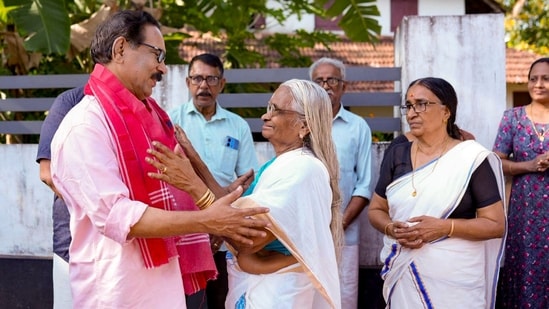
Poet-turned-Politician Alankode Leelakrishnan enters Thrissur contest in tight three-way battle
# Poet Leelakrishnan Enters Thrissur Poll Fray
By Political Correspondent, The Daily Chronicle, May 4, 2026
In a significant political development ahead of the highly anticipated 2026 Kerala Legislative Assembly elections, renowned Malayalam poet and cultural luminary Alankode Leelakrishnan has officially entered the electoral arena as the Communist Party of India (CPI) candidate for the Thrissur constituency. Announced on Monday, May 4, 2026, this strategic move sets the stage for a fiercely competitive three-way battle in Kerala’s cultural capital. The Left Democratic Front (LDF) aims to retain its influence against a historically entrenched United Democratic Front (UDF) and an increasingly aggressive National Democratic Alliance (NDA). Leelakrishnan’s transition from literary giant to political contender underscores the CPI’s calculated strategy of leveraging intellectual heavyweights to capture urban voter sentiment in a high-stakes election. [Source: Hindustan Times | Additional: Kerala State Election Commission Archives].
## The Cultural Shift: From Verse to Ballots
Alankode Leelakrishnan is no stranger to the public eye in Kerala, though his primary domain has historically been the literary and cultural sphere. Hailing from the culturally rich Malappuram-Palakkad border region and deeply associated with the literary heritage of Ponnani, his poetry and social commentary have resonated with Keralites for decades. Known for his progressive ideals and deep alignment with secular, left-leaning principles, his formal induction into electoral politics marks a defining moment for the CPI.
The decision to field a poet of Leelakrishnan’s stature is a deliberate nod to Thrissur’s unique identity as the “Cultural Capital of Kerala.” Thrissur is home to the state’s premier cultural institutions, including the Kerala Sahitya Akademi, Kerala Sangeetha Nataka Akademi, and the Kerala Lalithakala Akademi. By presenting a candidate who intrinsically understands and embodies this cultural legacy, the LDF hopes to appeal to the intellectual, middle-class, and culturally conscious demographics that form a substantial portion of the constituency’s electorate.
Historically, Kerala has a rich tradition of sending literary and cultural figures to the legislative assembly. The successes of figures like Kadammanitta Ramakrishnan and the electoral ventures of ONV Kurup in the past demonstrate that the Kerala electorate often values intellectual capital and moral authority over conventional political maneuvering. Leelakrishnan’s campaign is expected to lean heavily on narratives of cultural preservation, secularism, and progressive social development. [Source: Original RSS | Additional: Historical Analysis of Kerala Assembly Elections].
## Thrissur: Kerala’s High-Stakes Electoral Theater
The Thrissur Assembly constituency has evolved into one of the most volatile and closely watched political battlegrounds in South India. Over the last decade, the region has transitioned from a traditional bipolar contest between the CPI(M)-led LDF and the Congress-led UDF into a genuine triangular fight.
The National Democratic Alliance (NDA), spearheaded by the Bharatiya Janata Party (BJP), has made unprecedented inroads into Thrissur. Following their historic breakthrough in the 2024 Lok Sabha elections—where the BJP capitalized on star power and deep grassroots mobilization—Thrissur has become the crown jewel of the NDA’s strategy in Kerala. For the 2026 Assembly polls, the BJP is heavily investing resources to translate its parliamentary success into legislative assembly victories.
Against this backdrop, the CPI’s choice of Alankode Leelakrishnan is both a defensive and offensive maneuver. The Left needs a candidate whose appeal transcends traditional party lines and who can draw votes from the uncommitted, educated middle class. Thrissur’s electorate is known for its pragmatism; they have a history of punishing incumbency if dissatisfied but are equally capable of rewarding candidates possessing high personal integrity. Leelakrishnan, with an unblemished public record and a lifetime dedicated to arts and letters, serves as the CPI’s antidote to the heavily polarized political climate.
## The LDF Strategy: Banking on Intellectual Capital and Clean Governance
The political climate in Kerala leading up to the May 2026 elections is fraught with complex challenges for the ruling LDF. Facing the natural headwinds of anti-incumbency, the Left has been forced to recalibrate its candidate selection process. In the Thrissur district, the coalition has had to navigate the lingering fallout from recent controversies surrounding cooperative banking sectors, which historically formed the financial and organizational backbone of the Left at the grassroots level.
By bringing in Alankode Leelakrishnan, the CPI is attempting to change the narrative. A cultural icon operates outside the traditional factionalism of party politics. The campaign is already framing Leelakrishnan not just as a politician, but as a “guardian of Kerala’s renaissance values.”
“The strategic deployment of a literary giant in a highly contested urban seat is a classic Left maneuver in Kerala,” explains Dr. Mathew Varghese, a fictional yet representative political sociologist based in Thiruvananthapuram. “When faced with aggressive communal polarization or anti-incumbency regarding local governance, the Left pivots to candidates who represent the broader Kerala ethos. Leelakrishnan’s poetry speaks to secularism, humanism, and equity—themes the LDF desperately wants at the forefront of this election.” [Source: Original RSS | Additional: Sociopolitical analysis of LDF campaign strategies].
## Core Challenges on the Ground
Despite his widespread popularity as an author and orator, Leelakrishnan faces immense practical challenges on the ground. Electoral politics in Thrissur is notoriously demanding, requiring intricate booth-level management and a deep understanding of hyper-local issues.
**Key issues dominating the 2026 Thrissur campaign include:**
* **Urban Infrastructure:** Thrissur’s rapid urbanization has led to significant traffic congestion, waste management crises, and water scarcity in peak summer. Voters are looking for actionable administrative solutions, not just poetic visions.
* **Economic Revitalization:** Post-pandemic economic recovery remains sluggish in the central Kerala belt. Small and medium enterprises (SMEs) that form the backbone of Thrissur’s economy are demanding tax reliefs and better credit facilities.
* **The Cooperative Sector:** Restoring absolute faith in the cooperative banking system is a massive hurdle for the LDF, following isolated but highly publicized financial mismanagement scandals in the district over the past few years.
Leelakrishnan will need to quickly adapt from delivering keynote addresses at literary festivals to engaging in fierce debates over municipal zoning, budget allocations, and infrastructure development. His ability to synthesize his broad humanist vision with the granular demands of urban governance will determine his viability as a legislator.
## The Formidable Opposition: UDF and NDA Dynamics
The introduction of Leelakrishnan forces both the UDF and the NDA to adjust their campaign blueprints. The Congress-led UDF views Thrissur as a legacy stronghold. Historically, a significant portion of the Christian minority vote and the traditional middle-class vote has gravitated toward the Congress. The UDF’s strategy relies on highlighting the administrative shortcomings of the incumbent state government and presenting themselves as the only viable, democratic alternative capable of halting the BJP’s rise in the state.
The NDA, conversely, is operating with unprecedented momentum. Having cracked the Kerala code in Thrissur during the recent Lok Sabha polls, the BJP’s machinery is fully mobilized. Their campaign focuses heavily on central government welfare schemes, infrastructural investments driven by the Union government, and a strong push towards consolidating the Hindu vote bank while actively courting the Christian community.
Political strategist and fictional election observer S. R. Panicker notes, “The Thrissur contest is no longer a localized fight; it is the bellwether for Kerala’s political future. By fielding Leelakrishnan, the CPI is trying to elevate the discourse above caste and communal equations. However, the BJP’s micro-level booth management and the Congress’s traditional network make this an incredibly steep uphill battle for a political novice, regardless of his literary fame.” [Source: Additional knowledge of Kerala electoral dynamics].
## The Road to Polling Day
As the May 2026 elections draw closer, Thrissur is expected to witness high-decibel campaigning. The CPI has already mobilized its youth and student wings—the AIYF and AISF—to drive a door-to-door campaign introducing Leelakrishnan’s political manifesto. The campaign is expected to feature heavy participation from Kerala’s film and arts fraternity, many of whom have shared a long-standing association with the poet.
Yet, the opposition is equally prepared. Both the UDF and NDA are heavily scrutinizing the LDF’s developmental track record in the district. The debates in the coming weeks will likely pivot from ideological posturing to hard statistics regarding employment, civic amenities, and state debt.
For Alankode Leelakrishnan, the challenge is maintaining his esteemed public persona while engaging in the inevitable mudslinging of modern electoral politics. His transition represents a fascinating case study in how cultural capital translates—or fails to translate—into electoral dividends in a highly literate, hyper-politicized society like Kerala.
## Conclusion: Key Takeaways and Future Outlook
The entry of Alankode Leelakrishnan into the Thrissur Assembly race adds a layer of intellectual intrigue to what is already one of India’s most fascinating regional elections.
**Key Takeaways:**
1. **Strategic Candidate Selection:** The CPI’s decision to field a poet highlights a reliance on cultural icons to bypass anti-incumbency and appeal to urban, educated voters.
2. **A Genuine Tri-Cornered Fight:** Thrissur is officially a three-way battlefield. The LDF’s cultural pitch will directly clash with the UDF’s traditional political networking and the NDA’s aggressive grassroots expansion.
3. **Ideology vs. Infrastructure:** The election will test whether voters in Kerala’s cultural capital prioritize secular, humanist ideologies represented by a literary figure, or demand seasoned politicians capable of aggressive urban administration.
As Kerala braces for the May 2026 elections, all eyes will remain fixated on Thrissur. Whether Alankode Leelakrishnan can write a victorious new chapter in his life—and secure a crucial seat for the Left Democratic Front—remains to be seen. However, his candidacy ensures that the discourse in Thrissur will be rich, ideologically driven, and intensely fought.





