
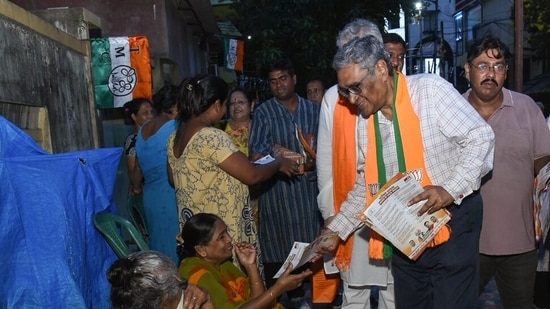
West Bengal polls 2026: Padma Bhushan awarde Swapan Dasgupta banks on urban vote in high-stakes contest
# Dasgupta Eyes Rashbehari in 2026 Bengal Poll
**By Senior Electoral Correspondent, India Desk, May 4, 2026**
Padma Bhushan awardee and former Rajya Sabha Member of Parliament Swapan Dasgupta is officially contesting the prestigious Rashbehari constituency for the Bharatiya Janata Party (BJP) in the highly anticipated 2026 West Bengal Assembly elections. As the May 2026 polling dates approach, Dasgupta is spearheading the BJP’s strategic offensive to capture Kolkata’s crucial urban intelligentsia and middle-class vote. This high-stakes electoral battle in South Kolkata represents a broader ideological clash between the incumbent Trinamool Congress (TMC) and a resurgent BJP aiming to breach Chief Minister Mamata Banerjee’s traditional metropolitan fortress [Source: Hindustan Times].
## The Strategic Significance of Rashbehari
Located in the heart of South Kolkata, the Rashbehari assembly constituency is widely regarded as the cultural and intellectual nerve center of the city. For over a decade, it has been an impenetrable bastion for the ruling Trinamool Congress. The constituency is predominantly populated by the Bengali “Bhadralok”—the educated, middle-to-upper-middle-class demographic that has historically shaped the political and cultural discourse of West Bengal.
The BJP’s decision to field a heavy-weight national intellectual like Swapan Dasgupta in this specific seat is a calculated maneuver. Rashbehari is not merely a geographic constituency; it is a bellwether for urban Bengali sentiment. In the 2021 assembly elections, TMC’s Debasish Kumar secured a comfortable victory here, continuing the legacy of veteran TMC leader Sovandeb Chattopadhyay who held the seat prior. To breach this stronghold, the BJP requires a candidate whose personal brand resonates with the sophisticated, urban electorate—a demographic that has frequently expressed skepticism toward the BJP’s traditional hinterland politics.
## A Tactical Course Correction for Swapan Dasgupta
Swapan Dasgupta’s electoral journey in West Bengal is a fascinating study in political positioning. An Oxford-educated historian, veteran journalist, and prominent right-wing intellectual, Dasgupta was awarded the Padma Bhushan in 2015 for his contributions to literature and education. He served as a nominated member of the Rajya Sabha before resigning to contest the 2021 West Bengal assembly elections.
In 2021, the BJP fielded Dasgupta from Tarakeshwar, a predominantly rural and semi-urban constituency in the Hooghly district. The electoral outcome was unfavorable, with Dasgupta losing to the TMC candidate. Political analysts widely viewed that deployment as a tactical mismatch.
“Fielding Swapan Dasgupta in Tarakeshwar in 2021 was akin to fitting a square peg in a round hole,” notes Dr. Anirban Mitra, a Kolkata-based political scientist. “His appeal has always been cosmopolitan and intellectual. By relocating him to Rashbehari for the 2026 contest, the BJP is finally aligning its candidate profile with the appropriate demographic. Dasgupta speaks the language of the South Kolkata elite, making this a genuinely competitive fight.” [Source: Independent Political Analysis | Public Electoral Data].
## The BJP’s Evolving Urban Playbook
The 2026 assembly election marks a pivotal moment for the BJP’s state unit. Following the fiercely contested 2021 assembly polls and the subsequent 2024 Lok Sabha elections, the BJP has realized that relying solely on rural polarization and anti-incumbency is insufficient to dislodge Mamata Banerjee’s government.
To win West Bengal, the party must make substantial inroads into Kolkata and its surrounding urban agglomerations. The BJP’s 2026 manifesto and campaign rhetoric heavily emphasize urban governance, targeting the TMC on issues of municipal corruption, infrastructure deficits, and the highly publicized state education recruitment controversies.
By anchoring their South Kolkata campaign around Dasgupta, the BJP hopes to shed the “outsider” tag frequently weaponized against them by the TMC. Dasgupta provides the BJP with a homegrown, culturally rooted Bengali face capable of articulating conservative, nationalist politics without alienating the liberal sensibilities of the metropolitan voter.
## Trinamool Congress’s Fortress Defense
Despite the BJP’s formidable challenge, defeating the Trinamool Congress in Rashbehari remains a monumental task. South Kolkata is the political backyard of Chief Minister Mamata Banerjee, whose own Bhabanipur constituency sits adjacent to Rashbehari. The TMC’s local organizational machinery here is notoriously robust, built on decades of grassroots networking and club-level patronage.
Furthermore, the TMC relies on a dual strategy of intense local welfare and regional pride. The party’s flagship welfare schemes, particularly *Lakshmir Bhandar* (direct cash transfers to women) and *Swasthya Sathi* (health insurance), continue to yield massive electoral dividends across class divides.
“The BJP may have an intellectual heavyweight, but the TMC has the ground game,” explains Subrata Mukhopadhyay, a veteran journalist covering Bengal politics. “In Rashbehari, elections are often decided by the neighborhood corporators and local club associations. The TMC has meticulously cultivated these micro-networks. Dasgupta’s national stature must translate into street-level mobilization if he hopes to overcome the TMC’s structural advantage.” [Source: Independent Political Analysis].
## Key Battleground Issues in South Kolkata
The contest in Rashbehari serves as a microcosm of the broader urban issues defining the 2026 West Bengal elections. Voters in this demographic are weighing national ideology against local governance.
**Primary Electoral Issues in Rashbehari (2026):**
* **Urban Infrastructure & Civic Amenities:** Frustrations over waterlogging, traffic congestion, and municipal maintenance in South Kolkata neighborhoods.
* **Corruption Allegations:** The lingering shadows of the SSC (School Service Commission) recruitment scams and municipal controversies that the BJP is heavily amplifying.
* **Youth Migration and Employment:** The continuous “brain drain” of educated Bengali youth to cities like Bengaluru, Mumbai, and Delhi due to a lack of white-collar job creation in the state.
* **Welfare vs. Development:** The ideological debate between TMC’s reliance on direct benefit transfers and the BJP’s promise of industrialization and capital-driven development.
* **Cultural Identity:** The ongoing narrative battle over who represents the “true” Bengali ethos, with the TMC promoting regional sub-nationalism against the BJP’s pan-India cultural nationalism.
## The Battle for the “Bhadralok” Soul
At its core, Dasgupta’s candidacy in Rashbehari is about optics and ideological legitimacy. For decades, the Left Front and subsequently the TMC monopolized the intellectual space in West Bengal. The BJP, despite its massive surge in vote share since 2019, has struggled to attract the state’s intellectual and cultural elite, who have historically viewed the party’s Hindi-heartland style of politics with apprehension.
Swapan Dasgupta is uniquely positioned to bridge this gap. His campaign is characterized by smaller, town-hall-style meetings, intellectual symposiums, and dialogues with the city’s professionals, artists, and academics. He is presenting a vision of a “resurgent Bengal” that honors its Renaissance past while integrating seamlessly into the broader economic growth engine of modern India.
However, TMC campaigners are aggressively countering this narrative, labeling the BJP’s sudden affection for Bengali culture as performative. They continue to highlight Mamata Banerjee as the sole authentic guardian of Bengal’s secular and inclusive traditions.
## Conclusion and Future Outlook
The 2026 West Bengal Assembly elections are shaping up to be a historic, high-stakes democratic exercise, and the battle for the Rashbehari seat is at the very heart of the urban contest. By fielding Padma Bhushan awardee Swapan Dasgupta [Source: Hindustan Times], the BJP has laid down a formidable challenge in Trinamool Congress territory, indicating a refined, demographically targeted strategy.
If Dasgupta manages to secure a victory in Rashbehari, it will signal a profound shift in Kolkata’s urban voting patterns and provide the BJP with the intellectual beachhead it desperately seeks in Bengal. Conversely, if the Trinamool Congress successfully defends the seat, it will reaffirm Mamata Banerjee’s unbroken grip over the urban electorate and demonstrate the enduring power of her grassroots welfare machinery.
As the campaign enters its final, fever-pitched phase, the discerning voters of South Kolkata hold the key to not just a single assembly seat, but the ideological trajectory of West Bengal’s political future.





