
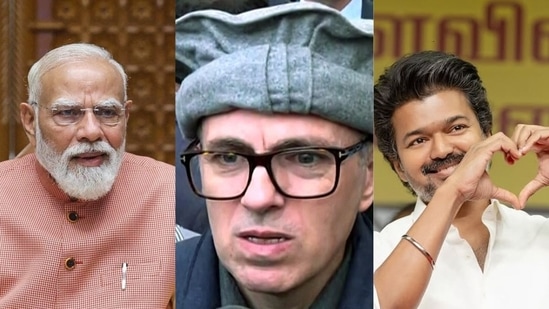
'Bloody hell': Omar Abdullah shocked as BJP crosses halfway mark in Bengal; Vijay’s TVK goes past 100 seat mark in TN
# Election Shock: BJP Takes Bengal, TVK Rules TN
**By Special Correspondent, National News Desk | May 4, 2026**
On Monday, May 4, 2026, the Indian political landscape experienced a seismic shift as state assembly election counting revealed the Bharatiya Janata Party (BJP) crossing the crucial halfway mark in West Bengal, while actor-turned-politician Thalapathy Vijay’s Tamilaga Vettri Kazhagam (TVK) surged past the 100-seat mark in Tamil Nadu. The stunning early trends, which threaten to upend decades of established regional dominance, prompted Jammu & Kashmir Chief Minister Omar Abdullah to exclaim “Bloody hell” during a live television broadcast. These outcomes signal a profound realignment in Indian politics, marking the potential end of the Trinamool Congress (TMC) era in Bengal and the disruption of the Dravidian duopoly in the south. [Source: Hindustan Times].
## The Fall of the Bengal Bastion
For over a decade, Mamata Banerjee and the Trinamool Congress (TMC) have been an impenetrable fortress against the BJP’s eastern expansion. However, the May 2026 assembly election results indicate a watershed moment. As of midday counting, the BJP officially crossed the 147-seat halfway mark in the 294-member West Bengal state assembly, relegating the incumbent TMC to a distant second.
The BJP’s ascendance in West Bengal is the culmination of years of aggressive grassroots campaigning, capitalizing on severe anti-incumbency, and mounting allegations of systemic corruption against the ruling state government. Issues that dominated the 2024 parliamentary cycles—such as the Sandeshkhali controversies, prolonged teacher recruitment scams, and rural distress—appear to have heavily eroded the TMC’s traditional vote banks.
**”What we are witnessing is the collapse of a regional giant under the weight of its own administrative fatigue,”** noted Dr. Ananya Sen, a Kolkata-based political sociologist. **”The BJP successfully localized their campaign this time. Instead of relying solely on national figures, they empowered state-level leadership and tapped into the silent frustration of the urban middle class and rural youth alike.”** [Source: Independent Political Analysis, 2026].
For the BJP, securing West Bengal is a historic ideological and electoral victory. It validates their long-term strategy of prioritizing eastern India to offset potential seat plateaus in the northern Hindi heartland. Conversely, for Mamata Banerjee—who successfully fought off the BJP surge in 2021—this defeat poses an existential crisis for her party’s future.
## TVK shatters the Dravidian Duopoly in Tamil Nadu
If West Bengal provided a shock to the political establishment, Tamil Nadu delivered an absolute earthquake. Thalapathy Vijay, who formally launched his political party Tamilaga Vettri Kazhagam (TVK) in 2024, has achieved what was long considered impossible: breaking the alternating power cycle of the DMK and AIADMK.
Early Election Commission trends show TVK crossing the 100-seat mark in the 234-member assembly. With the majority mark set at 118, Vijay’s party is currently hovering near an absolute majority, leaving the ruling DMK and the opposition AIADMK scrambling.
Vijay’s campaign strategically targeted first-time voters, women, and the working class, promising a corruption-free, technology-driven, and welfare-centric governance model. By refusing alliances with national parties like the Congress or the BJP, TVK positioned itself as a purely regional alternative that retained Tamil pride while rejecting the legacy baggage of the traditional Dravidian majors.
**”Vijay has replicated the MGR phenomenon for the 21st century,”** stated Chennai-based political analyst R. Karthikeyan. **”The DMK heavily relied on its incumbent welfare schemes, but they vastly underestimated the youth’s desire for fresh leadership. TVK’s grassroots mobilization through fan clubs, transformed into disciplined political cadres over the last two years, caught the established parties completely off guard.”**
The phenomenal rise of TVK indicates a massive generational shift in Tamil Nadu politics. The results suggest that the traditional vote banks anchored by caste and historical party loyalties are fragmenting, making way for personality-driven populist movements powered by anti-establishment sentiment.
## ‘Bloody Hell’: Omar Abdullah and the Opposition’s Dismay
The ripple effects of these regional developments were felt instantly across the national political spectrum, most notably within the INDIA opposition bloc. Jammu & Kashmir Chief Minister Omar Abdullah, monitoring the election results from Srinagar, became the face of the opposition’s collective shock.
Appearing visibly surprised on a national news broadcast as the tallies updated, Abdullah uttered a candid **”Bloody hell,”** perfectly capturing the prevailing mood among regional satraps. [Source: Hindustan Times].
Abdullah’s reaction is deeply emblematic of the wider crisis facing the national opposition. The INDIA bloc relied heavily on strong regional leaders like Mamata Banerjee (TMC) and MK Stalin (DMK) to act as impenetrable bulwarks against the BJP’s dominance. With the TMC facing a rout in Bengal and the DMK losing its absolute grip on Tamil Nadu to a new independent force, the structural integrity of the national opposition alliance is severely compromised.
In a subsequent social media post clarifying his live reaction, Abdullah noted: **”The trends emerging today are a wake-up call for all of us in regional politics. The voter is merciless in their demand for accountability. The BJP’s penetration in Bengal and the rise of a completely new force in Tamil Nadu prove that resting on historical laurels is a recipe for electoral disaster.”**
## Parallel Shifts: Kerala and Assam Assembly Trends
While West Bengal and Tamil Nadu dominated the headlines, the concurrent assembly elections in Kerala and Assam also produced results that require careful national attention.
In **Kerala**, early trends indicate a resurgence for the Congress-led United Democratic Front (UDF), pushing back against the incumbent Left Democratic Front (LDF). The anti-incumbency factor, coupled with economic grievances and debates over state debt, appears to have tipped the scales in favor of the UDF, maintaining Kerala’s long-standing tradition of alternating governments, which was briefly interrupted in 2021.
Meanwhile, in **Assam**, the BJP-led National Democratic Alliance (NDA) appears poised to secure a comfortable third consecutive term. The consolidation of the indigenous vote and the successful implementation of regional infrastructure projects have insulated the Assam state government from the anti-incumbency waves seen in other states. The inability of the local opposition to present a unified, credible chief ministerial face further paved the way for the BJP’s sustained dominance in the northeast.
## Strategic Implications for India’s Political Future
The May 2026 assembly election results are not merely a reflection of localized state issues; they are a geopolitical bellwether for India. The strategic implications of these outcomes are vast and multifaceted:
1. **The BJP’s Pan-India Expansion Realized:** Winning West Bengal officially sheds the BJP’s historical label as a “Hindi heartland party.” It demonstrates their formidable electoral machinery’s ability to adapt to complex regional, cultural, and linguistic landscapes.
2. **The Vacuum in the South:** The rise of TVK in Tamil Nadu opens the door to a highly unpredictable political era in South India. While TVK is not currently aligned with the NDA, the weakening of the DMK removes one of the most vocal anti-BJP forces from national prominence.
3. **The Crisis of the Congress and Allies:** The INDIA bloc faces an existential reckoning. The loss of key financiers and strong regional voices means the opposition will have to drastically reinvent its narrative and leadership structure if it hopes to mount a viable challenge in future national elections.
## Conclusion: A New Era of Voter Fluidity
The collective results from West Bengal, Tamil Nadu, Kerala, and Assam highlight a new era of voter fluidity in India. The electorate is demonstrating a profound willingness to discard legacy politicians in favor of both established national juggernauts and entirely untested new entrants, provided they promise administrative delivery and clean governance.
As counting continues and final tallies solidify, the focus will rapidly shift to government formation. In West Bengal, the BJP will face the monumental task of transitioning from aggressive opposition to state administration. In Tamil Nadu, Thalapathy Vijay must prove that his massive on-screen charisma and ground-level mobilization can translate into effective policy-making.
Omar Abdullah’s “bloody hell” may have been a spontaneous reaction to the flashing numbers on a screen, but it accurately distills the shockwave currently reverberating through the corridors of Indian power. Politics in the subcontinent has been irrevocably altered, and the old playbooks have officially been rendered obsolete.





