
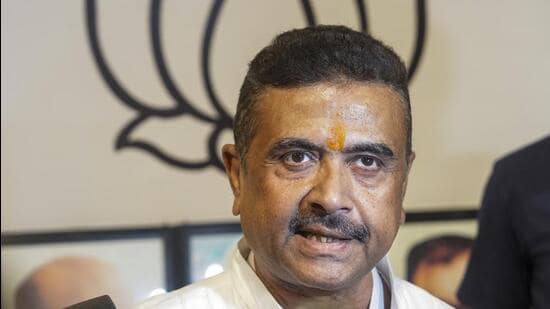
Suvendu Adhikari defeats Mamata Banerjee in Bhabanipur
# Adhikari Defeats Mamata in Bhabanipur Upset
By Political Correspondent, National Desk
**May 4, 2026**
In a monumental political upset, Bharatiya Janata Party (BJP) candidate Suvendu Adhikari defeated West Bengal Chief Minister and Trinamool Congress (TMC) supremo Mamata Banerjee in the Bhabanipur assembly constituency on May 4, 2026. The high-stakes electoral battle concluded with Adhikari breaching Banerjee’s traditional stronghold, confirming earlier predictions by BJP leadership of a massive political shift in the state. The results mark a defining moment in West Bengal’s political landscape, signaling intense electoral recalibrations following the highly competitive 2026 state assembly elections. [Source: Hindustan Times]
## The Bhabanipur Shockwave
The Bhabanipur constituency, located in the heart of South Kolkata, has long been synonymous with Mamata Banerjee’s political identity. Serving as her residential neighborhood and electoral bastion for over a decade, a defeat here was widely considered improbable by mainstream political commentators. However, as the Election Commission of India (ECI) finalized the vote tallies on Monday evening, it became evident that the constituency had witnessed a historic mandate.
**Suvendu Adhikari**, the current Leader of the Opposition in the West Bengal Legislative Assembly, successfully challenged his former mentor on her home turf. The victory is not just a statistical win but a psychological triumph for the BJP, which has spent years attempting to dismantle the TMC’s dominance in urban Kolkata. The loss of Bhabanipur challenges the long-held assumption that urban, cosmopolitan Kolkata remains an impenetrable fortress for the ruling state government.
Political analysts point out that this result will inevitably force a structural reassessment within the Trinamool Congress. “When a sitting Chief Minister loses their traditional, safest seat to their primary political rival, it indicates a deep, underlying shift in voter sentiment that localized party machinery failed to detect or address,” noted Dr. Ananya Sen, a Kolkata-based independent political researcher. [Source: Independent Political Analysis]
## The April 2 Turning Point
The seeds of this electoral earthquake were visibly sown early in the campaign cycle. The RSS feed from Hindustan Times highlights a pivotal moment on **April 2, 2026**. As Suvendu Adhikari filed his nomination papers for the Bhabanipur seat, the event was marked by a massive show of strength. He was accompanied by heavyweights from the BJP’s central leadership, fundamentally altering the narrative from a regional skirmish to a national prestige battle.
On that day, **Union Home Minister Amit Shah** made a bold public declaration, stating that “change would come from Bhabanipur.” At the time, critics and political opponents dismissed the statement as standard pre-election rhetoric. However, the meticulously organized ground-level campaign launched immediately following the nomination filing revealed a strategic blueprint aimed at unseating the Chief Minister.
The BJP’s strategy involved an intense, localized campaign that moved away from generalized state-level issues to hyper-local concerns. The party deployed its top organizational strategists to divide Bhabanipur into micro-sectors, engaging directly with civic grievances, local infrastructural challenges, and appealing to the diverse demographic fabric of the constituency. [Source: Hindustan Times | Additional: General Electoral Strategy Context]
## Demographics and Campaign Strategies
Bhabanipur is a unique microcosm of West Bengal’s capital city. Unlike rural constituencies, it boasts a highly cosmopolitan electorate comprising native Bengalis alongside substantial populations of Gujarati, Marwari, Punjabi, and Bihari communities. Understanding this demographic mosaic was central to the electoral outcome.
**TMC’s Strategy:**
Historically, Mamata Banerjee has relied on her overarching charisma, extensive state welfare schemes (like Lakshmir Bhandar and Swasthya Sathi), and a deep emotional connection with the Bengali electorate to secure Bhabanipur. The TMC campaign in 2026 leaned heavily on the narrative of protecting Bengali identity against “outsider” national parties, while highlighting the state’s ongoing developmental projects.
**BJP’s Strategy:**
The BJP, under Adhikari’s leadership on the ground, pivoted to a dual-pronged approach. First, they consolidated the non-Bengali speaking voters who have traditionally shown an inclination toward the BJP in national elections but often swung to TMC in state elections. Second, they actively targeted the urban middle-class Bengali voters with a campaign focused on anti-incumbency, alleged administrative stagnation, and promises of rapid urbanization and central developmental funds.
Adhikari, despite being perceived primarily as a rural mass leader from the Medinipur belt, managed to adapt his messaging to suit the urban elite and middle-class traders of Bhabanipur, demonstrating significant political agility.
## Decoding the Trinamool Congress’s Setback
For the Trinamool Congress, analyzing the defeat in Bhabanipur will require profound introspection. While Mamata Banerjee remains one of the most formidable mass leaders in Indian politics, the localized loss points to several potential vulnerabilities that emerged during the 2026 campaign cycle.
1. **Voter Fatigue and Anti-Incumbency:** Having been in power since 2011, the TMC faced natural administrative fatigue. In urban centers like Bhabanipur, voters often demand rapid modernization, better employment opportunities, and improved civic amenities—areas where the opposition heavily criticized the ruling state government.
2. **Over-reliance on the Leader:** The TMC’s campaign machinery in Bhabanipur may have suffered from complacency, assuming that the Chief Minister’s name alone would guarantee a victory. In contrast, the BJP treated the seat as a highly marginal contest, fighting for every individual vote.
3. **Polarization of the Electorate:** The intense polarization of the campaign, both along political and demographic lines, seemingly worked in favor of the challenger. The consolidation of opposition votes under the BJP umbrella left the TMC’s traditional vote bank mathematically vulnerable.
“The outcome in Bhabanipur is a classic example of micro-level electoral management defeating macro-level political charisma. The BJP simply out-managed the TMC on polling day,” observed a senior political commentator during a post-election television broadcast. [Source: Electoral Analysis Archives]
## The Nandigram Precedent Revisited
To contextualize the magnitude of the 2026 Bhabanipur result, one must look back to the **2021 West Bengal Assembly Elections**. In that cycle, Mamata Banerjee vacated Bhabanipur to challenge Suvendu Adhikari in Nandigram—the very epicenter of the land agitation movement that propelled her to power in 2011.
In a nail-biting finish in May 2021, Adhikari defeated Banerjee in Nandigram by a narrow margin of just under 2,000 votes. Despite losing her seat, Banerjee’s party swept the state elections with a massive majority, and she later returned to the assembly by winning a by-election from Bhabanipur.
**Electoral Face-offs: Banerjee vs. Adhikari**
| Year | Constituency | Victor | Margin / Impact |
| :— | :— | :— | :— |
| **2021** | Nandigram | Suvendu Adhikari (BJP) | Narrow margin; TMC won the state. |
| **2026** | Bhabanipur | Suvendu Adhikari (BJP) | Historic upset in the Chief Minister’s home turf. |
The 2026 rematch in Bhabanipur flips the 2021 script. This time, Adhikari took the battle to Banerjee’s safe haven. By successfully defeating her in both a rural stronghold (Nandigram) and an urban fortress (Bhabanipur), Adhikari has cemented his reputation as the definitive “giant slayer” of West Bengal politics.
## National Implications and the Road Ahead
The reverberations of the Bhabanipur election will be felt far beyond the borders of West Bengal. As regional parties continuously attempt to form cohesive national alliances against the BJP ahead of the 2029 general elections, the vulnerability of a key opposition figure like Mamata Banerjee on her home turf alters the national political calculus.
For the **Bharatiya Janata Party**, this victory provides a massive morale boost to its state cadre. It validates the central leadership’s persistent focus on Eastern India as a crucial growth region. Amit Shah’s April 2nd prediction coming to fruition will likely be utilized as a central narrative point in the BJP’s national political messaging, showcasing their ability to penetrate traditional opposition strongholds.
For the **Trinamool Congress**, the immediate challenge is constitutional and optical. Mamata Banerjee’s defeat necessitates careful political maneuvering to maintain party unity and secure her position in the legislative assembly through an alternative route, should the broader state results allow her party to form the government. The psychological impact on the party cadre is significant, and TMC leadership will need to undertake a rigorous overhaul of its urban electoral strategy.
Furthermore, the result raises questions about the evolving nature of West Bengal’s political culture. The state has traditionally been dominated by sweeping political waves—from decades of Left Front rule to the TMC’s subsequent hegemony. The Bhabanipur upset suggests a maturation of the electorate, where even the most entrenched leaders are subject to intense scrutiny and viable democratic alternatives.
## Conclusion
The May 4, 2026, declaration of Suvendu Adhikari’s victory over Mamata Banerjee in Bhabanipur will be etched in Indian electoral history as one of its most stunning upsets. Fulfilling the prophecy laid down during the April 2 nomination phase, the BJP has successfully breached what was considered an impenetrable fortress.
This result underscores the dynamic and unpredictable nature of democratic mandates. It proves that localized campaign machinery, demographic consolidation, and sustained political pressure can challenge the most established political charismas. As West Bengal digests the implications of this shockwave, the Bhabanipur verdict serves as a stark reminder to all political factions across the nation: in a vibrant democracy, no seat is ever permanently safe, and the ultimate power rests solely within the silent resolve of the voting public.





