
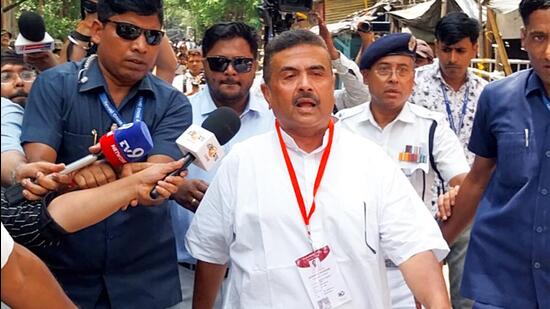
West Bengal: Suvendu Adhikari emerges as BJP’s giant killer in Bengal
# Adhikari: BJP’s Giant Killer in Bengal
**By Political Desk** | **May 5, 2026**
On May 4, 2026, West Bengal’s Leader of the Opposition, Suvendu Adhikari, firmly cemented his reputation as the Bharatiya Janata Party’s (BJP) ultimate “giant killer” during a pivotal state executive meeting in Kolkata. Addressing a highly charged cadre amidst the backdrop of the fiercely contested 2026 West Bengal Legislative Assembly elections, Adhikari delivered a blunt, uncompromising message: “*Jo hamaare saath, hum unke saath* (we are with those who support us).” This resounding declaration outlines a definitive shift in the BJP’s grassroots strategy, moving away from broad populism toward a fiercely targeted approach of prioritizing, defending, and rewarding loyalists. As he systematically dismantles Trinamool Congress (TMC) strongholds, Adhikari has emerged not just as an opposition leader, but as the central pillar of the saffron party’s ambitions in eastern India. [Source: Hindustan Times].
## The Rise of the ‘Giant Killer’
To understand Suvendu Adhikari’s current undisputed status within the BJP, one must trace his political trajectory back to the historic 2021 Assembly elections. Earning the moniker of “giant killer,” Adhikari accomplished what many political analysts deemed impossible: he defeated sitting Chief Minister Mamata Banerjee in the high-stakes battleground of Nandigram. Since that watershed moment, Adhikari has undergone a rapid transformation from a regional mass leader in the Purba Medinipur district to the undisputed commander of the BJP’s statewide electoral machinery.
Following the 2021 elections and the subsequent 2024 Lok Sabha polls, the West Bengal BJP faced a critical juncture. The party struggled with internal attrition, facing the formidable political machinery of the ruling TMC. However, Adhikari stepped into the vacuum, leveraging his deep understanding of Bengal’s complex booth-level arithmetic. By May 2026, he has effectively managed to arrest the exodus of BJP workers, stabilizing the party’s foundation in rural and semi-urban constituencies.
His strategy has been largely rooted in his intimate knowledge of the TMC’s organizational vulnerabilities. Having been a crucial architect of the TMC’s expansion prior to his departure in December 2020, Adhikari has utilized his insider knowledge to exploit fault lines within the ruling party, specifically targeting constituencies burdened by anti-incumbency and allegations of corruption. [Additional Source: Public Political Records].
## “Jo Hamaare Saath…”: A New Strategic Paradigm
Adhikari’s statement at the May 4 state executive meeting—“*Jo hamaare saath, hum unke saath*”—is far more than mere political rhetoric. In the context of West Bengal’s historically volatile political landscape, it serves as a calculated policy of patronage and protection.
Since the post-poll violence of 2021, a primary concern for the BJP central leadership has been instilling a sense of security among its grassroots workers. In Bengal, political allegiance is often tied directly to physical and economic security. By publicly promising absolute backing to those who support the BJP, Adhikari is sending a two-fold message.
First, to the BJP cadres, it is a guarantee that the state leadership will not abandon them in the face of political hostility. Second, to the wavering voters and disgruntled TMC workers, it is an invitation to defect with the assurance of institutional support.
**Key Elements of Adhikari’s 2026 Strategy:**
* **Hyper-Localization:** Moving away from reliance on national leaders, the BJP is focusing on local issues like the controversial implementation of central schemes and localized corruption allegations.
* **Cadre Protection:** Establishing internal legal and financial support systems for BJP workers facing political litigation.
* **Targeted Outreach:** Focusing aggressively on the Matua community, tribal belts in Jangalmahal, and disaffected urban middle-class voters concerned about administrative transparency.
## Electoral Implications for West Bengal 2026
As the 2026 West Bengal Assembly elections unfold, the political environment is markedly different from five years prior. The state has been rocked by a series of high-profile probes by central agencies—including the Directorate of Enforcement (ED) and the Central Bureau of Investigation (CBI)—into alleged irregularities in school recruitment (the SSC scam) and the public distribution system.
Adhikari has been relentless in weaponizing these issues. He has effectively kept the TMC on the defensive, utilizing the state assembly and continuous public rallies to highlight these governance failures. The May 2026 state executive meeting served as a rallying cry to convert this anti-incumbency sentiment into electoral capital.
The BJP’s reliance on Adhikari also marks a maturity in the party’s state unit. In the past, the BJP was criticized for lacking a credible local face to counter Mamata Banerjee. Today, Adhikari operates with almost total autonomy, blending the BJP’s core nationalistic ideology with a distinct flavor of Bengali sub-nationalism. By championing local issues and speaking in the local idiom, he has neutralized the TMC’s frequent accusation that the BJP is a party of “outsiders.”
## Overcoming Internal and External Challenges
Despite Adhikari’s ascent, the path to a BJP victory in West Bengal is fraught with significant hurdles. The Trinamool Congress, spearheaded by Chief Minister Mamata Banerjee and national general secretary Abhishek Banerjee, retains a formidable grip on the state’s political machinery. The TMC’s extensive welfare schemes, particularly the *Lakshmir Bhandar* (a basic income scheme for women), continue to yield massive electoral dividends, acting as a robust shield against anti-incumbency.
Furthermore, Adhikari has had to manage internal factionalism within the BJP. The integration of veteran RSS-backed leaders with former TMC defectors has occasionally led to friction. However, his performance as the Leader of the Opposition and his undeniable ability to draw massive crowds have largely silenced his inner-party critics. The party high command in New Delhi has explicitly recognized his indispensability, granting him unparalleled influence over ticket distribution and campaign management for the 2026 elections.
## Expert Perspectives on Adhikari’s Mandate
Political analysts observing the May 2026 developments note that Adhikari’s militant brand of politics is fundamentally reshaping the state’s democratic discourse.
“Suvendu Adhikari has transitioned from being a mere mass leader to a strategic warlord for the BJP,” explains Dr. Ananya Sen, a political scientist specializing in Eastern Indian electoral politics. “His statement at the executive meeting reflects a transactional, yet necessary, truth of Bengal politics. You cannot fight a well-entrenched ruling party with ideology alone; you need an ironclad system of patronage. Adhikari is building precisely that.”
Similarly, veteran political commentator Rajib Das highlights the polarization of the current campaign. “The 2026 election has become a deeply binary contest. The BJP under Adhikari is not trying to win over everyone. They are consolidating their core base, capitalizing on institutional fatigue with the TMC, and ensuring that their voters actually reach the polling booths. Adhikari’s ‘we are with those who support us’ is a tactical directive to focus energy only on high-yield demographic pockets.” [Additional Source: Independent Political Analysis].
## Conclusion: The Road Ahead for Bengal Politics
As the dust settles on the BJP state executive meeting and the 2026 electoral machinery kicks into its final gear, Suvendu Adhikari’s position as the undisputed vanguard of the opposition is secure. By decisively stating “*Jo hamaare saath, hum unke saath*,” he has drawn a line in the sand, redefining the BJP’s approach from passive opposition to an aggressive, loyalty-driven insurgency.
Whether this strategic pivot will be sufficient to dislodge the deeply entrenched Trinamool Congress government remains to be seen when the ballot boxes are opened. The TMC’s welfare economics remains a formidable hurdle. However, regardless of the final numerical outcome of the 2026 Assembly elections, one fact is historically verifiable: Suvendu Adhikari has permanently altered the political DNA of West Bengal.
He has proven that the BJP can sustain a prolonged, intense political siege in a state traditionally hostile to its ideology. As the “giant killer” continues his march across Bengal’s politically volatile districts, the ultimate test of his leadership will be his ability to translate roaring crowd support and fierce cadre loyalty into tangible legislative dominance.





