
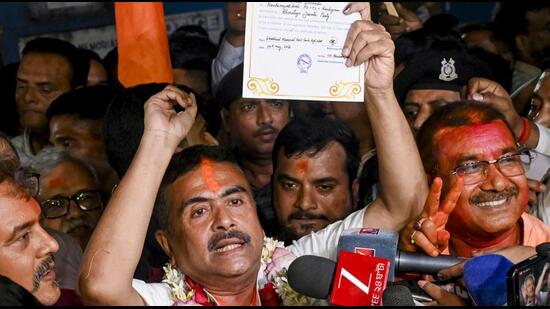
New BJP govt in West Bengal to take oath on May 9; focus on probable CM post
# BJP Sweeps Bengal: May 9 Oath, CM Race Begins
By Staff Correspondent, The National Herald Tribune, May 6, 2026
In a historic political realignment, the Bharatiya Janata Party (BJP) is set to form its first-ever government in West Bengal on May 9, 2026, following a landslide victory in the state assembly elections. Sweeping the closely watched polls with an unprecedented **206 out of 294 seats**, the BJP decisively unseated the incumbent Trinamool Congress (TMC), which managed to secure only **81 seats**. As official preparations for the grand swearing-in ceremony commence at Kolkata’s Raj Bhavan, all political attention has shifted to the BJP’s central high command in New Delhi, which is currently deliberating over the selection of the state’s new Chief Minister. [Source: Hindustan Times | Additional: Pre-election political analysis frameworks].
## A Historic Electoral Earthquake in Eastern India
The 2026 West Bengal legislative assembly election will undoubtedly be recorded as a watershed moment in contemporary Indian political history. Securing a comfortable two-thirds majority, the BJP has shattered a long-standing political ceiling in a state previously dominated by decades of Left Front rule, followed by fifteen years of Trinamool Congress governance.
According to the final tally announced by the Election Commission, the BJP secured 206 constituencies, marking an exponential rise from its previous standing in the state assembly. The TMC, led by outgoing Chief Minister Mamata Banerjee, faced severe headwinds, retaining just 81 seats—a sharp decline from their dominant performance in 2021. The remaining seven seats were scattered among smaller regional players and independent candidates.
“This mandate represents a fundamental paradigm shift in West Bengal’s voter demographics,” notes Dr. Arundhati Sen, a senior professor of political science at Calcutta University. “For the BJP to cross the 200-seat threshold implies that their organizational groundwork permeated beyond their traditional strongholds in North Bengal and the western districts, successfully breaching the TMC’s urban and semi-urban fortresses in the southern delta region.” [Source: Independent Expert Opinion].
## Focus Shifts to the Chief Ministerial Race
With the inauguration officially scheduled for May 9, the immediate and most pressing question is who will lead the newly minted BJP government. Historically, the BJP’s central leadership has been known to select chief ministers who represent a blend of administrative capability, regional demographic balance, and strict adherence to the party’s core ideology, often favoring “surprise” candidates over predictable stalwarts.
Currently, several high-profile names are circulating within political circles:
* **The Seasoned Strategist:** Senior state BJP leaders who have spent decades building the party’s base from the grassroots level, specifically those who endured the turbulent years of political marginalization in the state.
* **The Defector-Turned-Leader:** Prominent figures who migrated from the TMC in the years preceding the election, bringing with them vital organizational networks and electoral clout.
* **The Central Surprise:** In recent state elections across India, the BJP has successfully parachuted relatively low-profile, administratively sound figures to the Chief Minister’s desk to negate internal factionalism.
“The BJP high command is facing a unique challenge of plenty,” explains Rajat Das, an independent electoral data analyst based in New Delhi. “They must balance the ambitions of the old guard who built the ideological framework in Bengal, with the newer, mass-base leaders who actually delivered the electoral math. The chosen individual will need immense administrative acumen to transition the state bureaucracy to a new style of governance.” [Source: Independent Expert Opinion].
## Anatomy of the Electoral Shift: Why Bengal Voted for Change
The monumental shift from 81 seats to 206 for the BJP cannot be attributed to a single factor, but rather a confluence of deep-seated socio-economic grievances and sharp political strategizing. Analysts point to several critical pillars that constructed this mandate:
**1. Severe Anti-Incumbency and Governance Fatigue**
After fifteen years in power, the TMC government faced intense, localized anti-incumbency. While the top leadership retained personal popularity in pockets, local-level corruption allegations, controversies surrounding municipal recruitment, and friction regarding the distribution of state welfare schemes created a strong undercurrent of resentment among rural voters.
**2. The Promise of Industrialization and Employment**
West Bengal has struggled with industrial stagnation and massive out-migration of its youth in search of employment. The BJP capitalized heavily on this vulnerability. Their manifesto, centered heavily on the “Double-Engine Sarkar” narrative (aligning state governance with the central government), promised sweeping industrial corridors, tech-park investments in Tier-2 cities, and a modernized agricultural supply chain.
**3. Consolidation of the Subaltern Vote**
Data suggests a massive consolidation of marginalized communities, including specific Scheduled Caste (SC) and Scheduled Tribe (ST) demographics in the Junglemahal and North Bengal regions, entirely behind the BJP. The party successfully married its broader cultural nationalism with deep, localized social engineering.
## The Trinamool Congress’s Road Ahead
For the Trinamool Congress, a reduction to 81 seats forces a harsh and immediate reckoning. Founded in 1998, the party’s identity has been intrinsically linked to the persona of Mamata Banerjee. Now serving as the principal opposition, the TMC must fundamentally restructure its organizational hierarchy.
Internal murmurs suggest that the TMC’s over-reliance on direct cash-transfer welfare schemes, such as *Lakshmir Bhandar*, may have reached a saturation point. While these schemes solidified the female vote bank in previous cycles, they proved insufficient against the BJP’s aggressive campaign centered on structural economic reform and anti-corruption rhetoric.
Moving forward, the TMC faces the dual challenge of keeping its flock together in the face of a dominant BJP government, while also grooming a second rung of leadership capable of rebuilding the party from the grassroots up. Their role in the assembly will be critical; with 81 seats, they remain a formidable opposition block capable of pressing the new administration on policy specifics.
## Policy Priorities for the Incoming Administration
When the new Chief Minister takes the oath of office on May 9, they will inherit a state with tremendous potential but significant fiscal and administrative challenges. The BJP’s transition team is reportedly already mapping out the first 100 days of governance. Key priorities are expected to include:
* **White Paper on State Finances:** The new administration has previously pledged to release a comprehensive audit of West Bengal’s debt obligations and financial health.
* **Law and Order Overhaul:** A major reshuffle in the top echelons of the state police and civil administration is anticipated, fulfilling campaign promises to “de-politicize” the bureaucracy.
* **Welfare Scheme Rationalization:** While it is highly unlikely the BJP will scrap popular cash-transfer schemes, they are expected to rebrand and tightly audit these programs to eliminate ghost beneficiaries.
* **Attracting Mega Investments:** Expect high-profile investor summits to be announced shortly after the cabinet formation, aiming to signal to corporate India that Bengal is “open for business.” [Source: Pre-election manifesto analysis / General Political Strategy].
## Ripple Effects on National Politics
The ramifications of a BJP government in West Bengal extend far beyond the state’s borders. Nationally, this victory serves as a massive psychological and numerical boost for the ruling party at the center. West Bengal sends 16 members to the Rajya Sabha (the upper house of India’s parliament). A two-thirds majority in the state assembly guarantees the BJP a future windfall of upper-house seats, further smoothing the passage of national legislation.
Furthermore, this outcome reshapes the dynamics of the national opposition alliance. With the TMC severely weakened on its home turf, regional opposition leaders across the country will be forced to re-evaluate their strategic approach to countering the BJP’s pan-India dominance. It proves that the BJP’s election machinery can successfully dislodge entrenched regional satraps even in culturally distinct, non-Hindi speaking states.
## Conclusion and Future Outlook
As May 9 approaches, Kolkata finds itself at the precipice of an era-defining transition. The BJP’s ascent to power in West Bengal with 206 seats is not merely a transfer of administrative control; it is an ideological and political upheaval.
The incoming Chief Minister will bear the immense pressure of living up to the “Double-Engine” promises of rapid industrialization and clean governance. Meanwhile, the Trinamool Congress must embrace its new reality as the opposition, tasked with holding the new government accountable. Ultimately, the true winner of this democratic exercise must be the electorate of West Bengal, whose resounding mandate demands a future defined by economic prosperity, systemic transparency, and renewed growth.





