
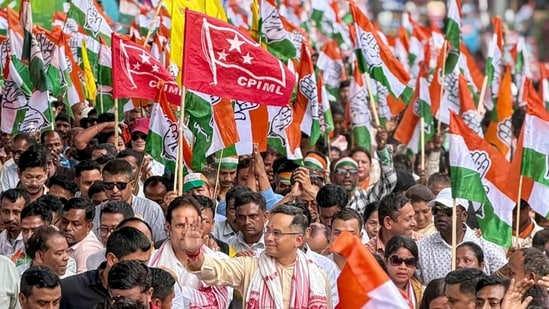
18 out of 19 MLAs who won on the Congress ticket in Assam are Muslims
# Assam Polls: Muslim Tally Dominates Congress Wins
By Senior Correspondent, National Politics Desk, May 05, 2026
The recently concluded 2026 Assembly elections in Assam have unveiled a starkly polarized electoral landscape, deeply reflecting the state’s shifting demographic and political fault lines. According to the latest electoral data, out of the 19 seats secured by the Indian National Congress, an overwhelming 18 of the winning Members of Legislative Assembly (MLAs) are Muslims. The party fielded 20 Muslim candidates, achieving a staggering 90% strike rate in this demographic. Conversely, out of the 79 non-Muslim candidates the Congress party placed on the ballot across the state, only a single candidate managed to secure a victory. This dramatic statistical disparity raises profound questions about the party’s changing voter base, the impact of recent constituency delimitations, and the broader socio-political dynamics defining modern Assam [Source: Hindustan Times].
## A Tale of Two Strike Rates: Dissecting the Electoral Data
To understand the magnitude of this electoral outcome, one must delve into the raw statistics that define the Congress party’s performance in this election cycle. The data paints a picture of a severely fractured mandate where the party’s traditional “rainbow coalition” of indigenous Assamese, tea tribes, and religious minorities has completely collapsed, leaving only the minority demographic intact.
**Key Electoral Statistics for the Indian National Congress (Assam 2026):**
* **Total Candidates Fielded:** 99
* **Total Seats Won:** 19
* **Muslim Candidates Fielded:** 20
* **Muslim Candidates Won:** 18 (90% Strike Rate)
* **Non-Muslim Candidates Fielded:** 79
* **Non-Muslim Candidates Won:** 1 (1.26% Strike Rate)
This unprecedented divergence in strike rates—90% for Muslim candidates versus a dismal 1.26% for non-Muslim candidates—illustrates a total concentration of the Congress’s electoral viability within specific geographic and demographic pockets, primarily in Lower Assam and the Barak Valley.
## Consolidation in Lower Assam and the AIUDF Factor
The concentration of Congress victories among Muslim candidates is not merely a statistical anomaly but the result of highly strategic voting by the minority electorate. Historically, the Muslim vote in Assam—which constitutes roughly 34% of the state’s population—has been fractured between the Congress and the All India United Democratic Front (AIUDF), led by Badruddin Ajmal.
However, the 2026 results suggest a decisive tactical shift. Minority voters appear to have consolidated entirely behind the Congress to prevent vote-splitting, which in previous elections allowed the Bharatiya Janata Party (BJP) and its regional allies to secure narrow victories in multi-cornered contests. By effectively absorbing the AIUDF’s traditional support base, Congress managed to sweep Muslim-majority constituencies, ensuring 18 of its 20 minority candidates crossed the finish line [Source: Hindustan Times | Additional: Historical Electoral Trends in Assam].
Dr. Arup Barman, a political sociologist specializing in Northeast Indian electoral dynamics, explains this phenomenon: “What we are witnessing is defensive consolidation. Following the implementation rules of the Citizenship Amendment Act (CAA) and the persistent rhetoric around the National Register of Citizens (NRC) leading up to April 2026, the minority electorate made a calculated decision to back the principal opposition party with the highest winnability factor, practically sidelining smaller regional outfits.”
## The 2023 Delimitation Ripple Effect
No analysis of the 2026 Assam elections is complete without factoring in the comprehensive delimitation exercise concluded by the Election Commission of India in August 2023. The redrawing of assembly and parliamentary constituency boundaries was a highly contentious process. Critics, including the Congress and AIUDF, previously argued that the exercise was designed to fragment minority-dominated areas and secure advantages for the ruling BJP coalition.
Paradoxically, while the delimitation may have reduced the overall number of minority-influence seats, it hyper-concentrated the minority vote in specific newly drawn constituencies. The Congress’s success in winning 18 out of 20 Muslim-fielded seats demonstrates that within these concentrated pockets, the party’s candidates faced minimal internal opposition, riding a massive wave of localized demographic support. Conversely, in the reshaped constituencies of Upper and Central Assam, the newly consolidated Hindu and indigenous majorities heavily favored the ruling coalition, decimating the 79 non-Muslim Congress candidates.
## Collapse in the Heartland: The Indigenous Vote Deficit
While the Congress celebrates a high strike rate among its Muslim candidates, the failure of 78 out of 79 non-Muslim candidates is an existential crisis for the state party unit. Assam’s political identity is heavily tied to the rights and representation of its indigenous communities—including the Ahoms, the ethnic tribes (such as the Bodos, Mishings, and Karbis), and the influential tea-tribe community.
For decades, the Congress held a vice-like grip on the tea-tribe vote and substantial sway in Upper Assam. The 2026 election results confirm that the party has entirely lost its ideological and emotional connect with the Assamese heartland. The ruling BJP’s relentless focus on “indigenous rights,” infrastructure development, and direct benefit transfers (DBT) has effectively firewall-ed the non-Muslim vote.
“The Congress is now facing an identity crisis in Assam,” notes Meenakshi Sen, a senior political analyst based in Guwahati. “When 95% of your legislative strength comes from one specific religious community, it becomes exceedingly difficult to project a pan-Assam, secular, and inclusive narrative. The BJP will undoubtedly leverage this statistical reality to brand the Congress as a party exclusively catering to minority interests, which could further alienate the indigenous vote in future elections.”
## Strategic Miscalculations and Leadership Woes
The vast discrepancy in the electoral success of its candidates points to profound strategic and organizational failures within the Assam Pradesh Congress Committee (APCC). Fielding 79 non-Muslim candidates who lacked the grassroots momentum to secure victories suggests a severe disconnect between the party high command and the ground realities of the state’s electorates.
Observers note that many of these 79 candidates were left to fend for themselves, lacking adequate campaign funding, strong local narratives, or the organizational machinery required to counter the ruling party’s formidable booth-level management. Furthermore, internal factionalism and a lack of charismatic state-level leadership capable of bridging the gap between minority voters and the indigenous Assamese majority proved fatal to the Congress’s broader ambitions.
## National Implications for the Congress Party
The outcome in Assam is likely to have significant reverberations for the Indian National Congress on a national scale. As the party attempts to rebuild its image as the default secular alternative to the ruling national government, the demographic skew of its victories in key states presents a complex narrative challenge.
The results provide ready ammunition for political opponents who frequently accuse the Congress of “minority appeasement.” The fact that almost the entirety of the party’s representation in the Assam legislative assembly belongs to a single religious demographic will be utilized to push a narrative that the party is no longer broadly representative of the Hindu and indigenous pluralities [Source: Hindustan Times | Additional: Expert Political Analysis].
However, party loyalists argue that the results simply reflect the realities of the first-past-the-post electoral system in a highly polarized environment. They maintain that the Congress’s willingness to field 79 non-Muslim candidates demonstrates its commitment to broad-based representation, even if the electoral math did not materialize in their favor during this specific cycle.
## Conclusion: A Fractured Road Ahead
The 2026 Assam Assembly elections have redrawn the state’s political map in bold, uncompromising lines. The Indian National Congress’s tally of 19 seats—anchored almost exclusively by 18 Muslim MLAs—highlights a successful, albeit highly localized, consolidation of the minority vote. Yet, the devastating loss of 78 non-Muslim candidates underscores a catastrophic disconnect with the broader indigenous and Hindu electorate.
**Key Takeaways:**
1. **Minority Consolidation:** The Congress has effectively absorbed the minority vote bank, leaving regional players like the AIUDF marginalized.
2. **Heartland Erasure:** The near-total wipeout of non-Muslim Congress candidates confirms the ruling coalition’s absolute dominance over the indigenous and tea-tribe vote banks.
3. **Delimitation Impact:** The 2023 constituency redrawing has successfully isolated demographic voting blocs, resulting in high strike rates for concentrated communities but eliminating multi-demographic swing seats.
Moving forward, the Congress in Assam faces a monumental task. To ever reclaim the seat of power in Dispur, the party cannot rely solely on the arithmetic of minority consolidation. It must undergo a radical reinvention to rebuild trust with the indigenous communities of the Brahmaputra Valley, or risk remaining a geographically restricted opposition bloc in a rapidly evolving state.





