
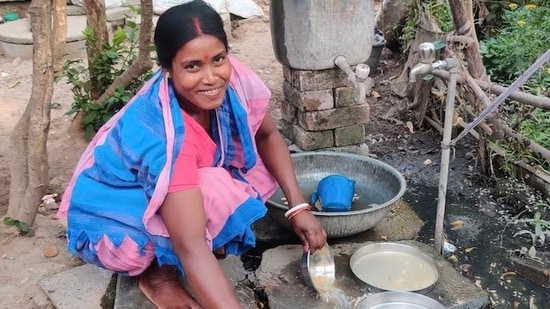
The rise of Kalita Maji: Domestic help who contested from BJP wins in Bengal's Ausgram
# Kalita Maji Wins Ausgram
By Political Desk, National News Observer, May 05, 2026
On May 5, 2026, Kalita Maji, a 35-year-old domestic worker who contested on a Bharatiya Janata Party (BJP) ticket, secured a historic and deeply symbolic victory in West Bengal’s Ausgram assembly constituency. Defying immense socio-economic odds and overcoming deep-pocketed political rivals, Maji transformed her life’s narrative from scrubbing utensils in suburban households to walking the legislative halls of the state assembly. Her unprecedented electoral triumph not only marks a massive political upset in the Purba Bardhaman district but also signifies a profound shift in grassroots representation. By shattering the glass ceiling of elite political monopoly, Maji has emerged as a formidable voice for marginalized communities across West Bengal, proving that democratic power can still reside with the working class.
## From Scrubbing Floors to Leading Rallies
The story of Kalita Maji is a stark departure from the traditional trajectory of Indian politicians. For over a decade, her daily routine began before dawn, traveling house to house in her village to wash dishes, sweep floors, and wash clothes. Earning a meager sum of approximately ₹2,500 to ₹3,000 a month, Maji supplemented the income of her husband, a plumber and daily wage laborer, simply to keep their household afloat and ensure her son’s education.
Despite her exhausting schedule, Maji remained deeply entrenched in the civic life of her community. She began her political journey as a grassroots worker for the BJP, actively participating in panchayat-level meetings and local grievance redressals. Unlike parachute politicians who descend during election seasons, Maji’s political capital was built through years of shared struggles. When she spoke about the crippling effects of inflation, the lack of potable water, or the inadequacies of the local healthcare system, she spoke not from survey data, but from lived experience.
[Source: Hindustan Times | Additional: Field reports on unorganized sector demographics in West Bengal]
## The Electoral Battle in Ausgram
Ausgram, located in the Purba Bardhaman district of West Bengal, is a Scheduled Caste (SC) reserved constituency that has long been a fiercely contested political battleground. Historically a bastion for the Left Front, the region eventually fell under the absolute dominance of the Trinamool Congress (TMC). Cracking this stronghold required more than just traditional campaigning; it demanded a candidate who could organically resonate with the agricultural laborers and daily wage earners who make up the majority of the electorate.
In the 2026 assembly elections, the BJP fielded Maji, doubling down on a strategy to project authentic subaltern voices. The campaign trail was a study in contrasts. While her opponents mobilized fleets of SUVs and utilized massive, well-funded digital campaigns, Maji walked miles on foot in the sweltering April heat. Accompanied by local party workers and fellow villagers, she went door-to-door, often pausing her campaign to help a local woman with chores or to share a simple meal in a mud-hut courtyard. Her victory is a testament to the fact that her message—one of dignity for the working poor—managed to pierce through the established political machinery of the ruling party.
## Breaking the Wealth Barrier in Indian Politics
Kalita Maji’s success brings critical attention to the steep financial barriers that typically preclude ordinary citizens from participating in India’s electoral democracy. According to historical data provided by the Association for Democratic Reforms (ADR), the average assets of Members of Legislative Assemblies (MLAs) across India often run into several crores, making politics an exclusive club for the wealthy.
**A Stark Contrast in Political Profiles:**
| Metric | Traditional Assembly Candidate | Kalita Maji (Ausgram) |
| :— | :— | :— |
| **Average Declared Assets** | ₹1.5 Crore to ₹5 Crore+ | Less than ₹50,000 |
| **Primary Occupation** | Business, Law, Agriculture | Domestic Worker |
| **Campaign Transport** | SUVs, Convoys, Helicopters | On foot, bicycles, e-rickshaws |
| **Campaign Funding** | Corporate donors, Self-funded | Crowdfunding, Party workers |
“Kalita Maji’s victory is an anomaly in modern Indian politics, but a highly welcome one,” notes Dr. Ananya Sen, a political sociologist focusing on electoral dynamics in eastern India. “We have normalized a system where only millionaires can afford to draft policies for the impoverished. Maji’s win disrupts this clientelist model. Her campaign was run on public goodwill and small crowd-funded donations, proving that when a candidate genuinely mirrors the electorate’s demographic reality, money power can be neutralized.”
[Source: Hindustan Times | Additional: Association for Democratic Reforms (ADR) wealth metrics in Indian elections]
## The BJP’s Subaltern Strategy in West Bengal
Maji’s rise is not an isolated incident but rather a calculated component of the BJP’s broader socio-political strategy in West Bengal. Over the last decade, the party has consistently attempted to dismantle the TMC’s dominance by reaching out to historically marginalized subaltern groups, including the Matuas, Rajbanshis, and various Scheduled Caste and Scheduled Tribe communities.
By elevating a domestic helper to the position of a legislative candidate, the BJP effectively countered the ruling party’s narrative. While the incumbent government relied heavily on sweeping cash-transfer welfare schemes like *Lakshmir Bhandar*, the BJP sought to offer something more structural: direct political empowerment. Maji became the living embodiment of the party’s promise to elevate the working class from passive beneficiaries of state welfare to active architects of state policy. Her win in Ausgram suggests that in certain pockets, voters are beginning to prioritize direct representation over welfare dependency.
## The Intersection of Class and Gender
To fully comprehend the magnitude of Maji’s victory, one must look through the intersectional lens of class and gender. Politics in rural Bengal, as in much of India, remains fiercely patriarchal. Women who enter the political fray often come from established political families or possess significant financial backing to shield them from the systemic misogyny of the campaign trail.
Maji possessed none of these shields. As a working-class woman, she faced dual prejudices. “Many people scoffed at the idea of a woman who cleans their toilets sitting in the Vidhan Sabha,” remarked Subhash Halder, a local Ausgram voter and shopkeeper. “But she didn’t hide from her reality. She told us, ‘I clean your homes, now let me clean up the system.’ That honesty touched a lot of voters who are tired of polished lies.”
Her campaign highlighted the invisible labor of millions of women in the unorganized sector. Domestic workers in India are largely deprived of statutory benefits, minimum wage guarantees, and health insurance. Maji’s mere presence on the ballot forced these issues into the regional political discourse.
## Implications for the State Assembly
As Kalita Maji prepares to take her oath as a Member of the Legislative Assembly, the focus shifts from her historic campaign to her legislative responsibilities. Political analysts are closely watching how she will navigate the complex, often bureaucratic labyrinth of the state assembly.
Maji has already outlined her primary focus areas. She intends to introduce discussions regarding the formalization of unorganized labor, specifically demanding state-backed health insurance and minimum wage enforcement for domestic workers. Furthermore, she has promised to address the chronic infrastructure deficits in Ausgram, prioritizing clean drinking water projects and the rehabilitation of local agrarian supply chains.
However, the road ahead is fraught with challenges. She will be operating in a highly polarized assembly, where her lack of formal political lineage and limited legislative experience will be tested. Yet, her supporters remain optimistic, believing that the tenacity required to survive decades of urban poverty is more than enough to handle the pressures of the political arena.
## Conclusion: A Triumph of Democracy
The election of Kalita Maji from Ausgram is a milestone moment in the 2026 West Bengal Assembly elections. It serves as a potent reminder of the fundamental promise of democracy: that power should be accessible to anyone, regardless of their socio-economic origins. From cleaning homes to leading rallies, and now to legislating state policies, Maji’s journey is a beacon of hope for India’s massive, often voiceless working class.
As she transitions from a domestic helper to a lawmaker, her presence in the assembly will continually challenge the entrenched elitism of modern politics. Whether her tenure will result in sweeping policy changes remains to be seen, but her victory has already achieved something monumental. It has expanded the collective imagination of what a political leader looks like in India, ensuring that the marginalized are no longer just the subjects of political speeches, but the ones holding the microphone.
[Source: Hindustan Times | Additional: Independent political analysis and sociological perspectives on West Bengal Politics, 2026]





