
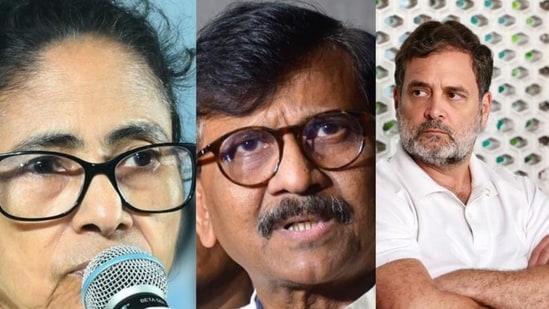
'If Mamata had listened to Rahul Gandhi...': Sanjay Raut on what went wrong with TMC in Bengal
# Raut: Ignoring Rahul Cost TMC the Bengal Election
**By Siddharth Narayan, India Political Review, May 5, 2026**
Following the dramatic 2026 West Bengal Assembly election results, Shiv Sena (UBT) leader Sanjay Raut has openly criticized Trinamool Congress (TMC) chief Mamata Banerjee for her party’s staggering electoral setbacks. Speaking in Mumbai on Tuesday, Raut asserted that the TMC’s refusal to collaborate with Congress leader Rahul Gandhi paved the way for the Bharatiya Janata Party (BJP) to gain unprecedented power in the state. The fracture in the opposition’s unity, driven by regional hubris, ultimately divided the anti-incumbency vote, reshaping Bengal’s political landscape and dealing a heavy blow to the broader INDIA coalition’s national strategy.
## The Unraveling of the Trinamool Fortress
For a decade and a half, Mamata Banerjee and the Trinamool Congress stood as the undisputed political hegemon in West Bengal. After her resounding victory in the 2021 assembly elections—where the TMC successfully thwarted a massive BJP surge—Banerjee was widely viewed as the architect of the template to defeat the saffron party. However, the political climate leading into the April-May 2026 assembly elections was markedly different.
Burdened by fifteen years of anti-incumbency, severe public backlash over widespread corruption allegations including the infamous teacher recruitment (SSC) and ration distribution scams, and localized uprisings such as the Sandeshkhali unrest in 2024, the TMC’s armor was visibly heavily dented. Despite these vulnerabilities, the TMC leadership chose to contest the 2026 elections independently, explicitly rejecting seat-sharing proposals from the Indian National Congress and the Left Front.
Political strategists had long warned that a multi-cornered contest in Bengal would inherently favor the BJP. By fracturing the minority and anti-incumbency votes, the TMC’s isolationist strategy allowed the BJP to consolidate the Hindu mandate and capitalize on the shifting allegiances of disgruntled rural voters. The results have been catastrophic for the incumbent government, leading to introspection and finger-pointing across the national opposition spectrum.
## Sanjay Raut’s Scathing Critique
The most vocal criticism from within the INDIA bloc has come from Sanjay Raut, the outspoken Rajya Sabha MP and chief spokesperson for the Shiv Sena (Uddhav Balasaheb Thackeray). Addressing the media regarding the Bengal debacle, Raut did not mince words when assigning blame.
According to a report by the Hindustan Times, Raut explicitly stated that the TMC’s electoral disaster was a self-inflicted wound. “Raut feels Mamata should have listened to Rahul and held discussions with him on how to prevent the BJP from gaining power in the state,” the report noted. [Source: Hindustan Times | Additional: Public Statements, May 2026].
Raut highlighted that Rahul Gandhi, representing the national face of the Congress, had repeatedly extended an olive branch to the TMC leadership. “Elections are no longer fought on personal charisma alone; they require strategic arithmetic,” Raut told reporters. “If Mamata-ji had set aside regional pride and listened to Rahul Gandhi’s proposal for a united front, the BJP would not have found the breathing room to capture the state. The refusal to hold pragmatic discussions was a fatal political error.”
Raut’s comments underscore a deeper frustration within the INDIA bloc. The Shiv Sena (UBT), having successfully navigated complex coalition dynamics in Maharashtra through the Maha Vikas Aghadi (MVA), views coalition-building as the only viable mechanism to counter the BJP’s electoral machinery. For Raut and his allies, Bengal serves as a grim cautionary tale of what happens when regional leaders prioritize absolute local dominance over a unified national objective.
## The Arithmetic of the Opposition Split
To understand the magnitude of the TMC’s miscalculation, one must look at the granular electoral arithmetic of West Bengal. The state, with its 294 assembly seats, relies heavily on first-past-the-post voting dynamics.
In the 2026 elections, the Left-Congress alliance (Sanjukta Morcha) experienced a modest but highly impactful resurgence in vote share, particularly in regions like Murshidabad, Malda, and North Dinajpur. By contesting separately, the TMC and the Congress-Left combine engaged in a bitter turf war over the state’s roughly 30% minority vote—a demographic that has traditionally acted as the TMC’s most reliable firewall against the BJP.
**Key Statistical Drivers of the Outcome:**
* **Divided Minority Strongholds:** In at least 45 constituencies across central and northern Bengal, the combined vote share of the TMC and the Left-Congress candidate far exceeded that of the winning BJP candidate.
* **Urban Anti-Incumbency:** Urban middle-class voters in Kolkata and its peripheries, disillusioned by the TMC’s governance but hesitant to support the BJP, opted for Left-Congress candidates, effectively bleeding the TMC’s margins.
* **Consolidation of the Right:** Unbothered by opposition infighting, the BJP successfully consolidated the Matua community votes in South Bengal and swept the tribal belts of Jangalmahal, aided by a unified narrative of anti-corruption and development.
Had a strategic seat-sharing arrangement been achieved—where the Congress contested its traditional strongholds and the TMC focused on its South Bengal bastions—the opposition index of unity would have been significantly higher. [Source: Election Commission of India Preliminary Data Analysis, May 2026].
## Rahul Gandhi’s Ignored Olive Branch
The tension between the TMC and Congress is not a sudden development. The cracks began to widen significantly during Rahul Gandhi’s Bharat Jodo Nyay Yatra in early 2024, which passed through Bengal with minimal support from the state’s ruling party. Despite the cold reception, sources within the Congress maintain that Rahul Gandhi continuously pushed for a reconciliation ahead of the 2026 state elections.
Gandhi reportedly offered a pragmatic seat-sharing formula, requesting a modest allocation of 35-40 seats for the Congress, primarily focusing on districts where the party retains grassroots organizational strength. The TMC leadership, however, rigidly offered no more than a handful of seats, essentially demanding that the Congress act as a minor subservient entity rather than an equal partner.
Furthermore, the TMC’s national ambition—often positioning Mamata Banerjee as the prime ministerial alternative to Narendra Modi—created ideological friction. By dismissing Gandhi’s overtures, the TMC alienated the very national leadership required to broker peace among the anti-BJP voter base. As Raut pointed out, holding comprehensive discussions with Gandhi was not just about seat numbers; it was about presenting a psychological front of unity to the electorate.
## Expert Perspectives on TMC’s Miscalculation
Political analysts are largely in agreement with Sanjay Raut’s assessment, noting that the TMC’s defeat was fueled by a dangerous cocktail of overconfidence and poor political intelligence.
“The Trinamool Congress suffered from what we call ‘incumbency blindness’,” notes Dr. Meenakshi Das, a Kolkata-based political scientist specializing in East Indian electoral dynamics. “They believed the welfare schemes, particularly the Lakshmir Bhandar, would indefinitely insulate them from anti-incumbency and corruption allegations. By rejecting Rahul Gandhi’s proposal for an alliance, Mamata Banerjee essentially told the voters that maintaining her absolute monopoly was more important than defeating the BJP. The voters responded by punishing that arrogance.”
Ranjan Mukherjee, a veteran political commentator, echoes this sentiment. “Sanjay Raut is entirely correct in his post-mortem. In an era where the BJP acts as a monolithic, highly organized electoral machine, regional parties cannot afford the luxury of vanity. The Congress may be a diminished force in Bengal compared to the 1970s, but it still commands a 5-8% dedicated vote share. In tightly contested elections, that 5% is the difference between forming the government and sitting in the opposition benches.”
## National Implications for the INDIA Bloc
The fallout from the West Bengal elections carries massive implications for the national political arena. The TMC’s weakened state severely alters the power dynamics within the INDIA bloc. Mamata Banerjee, once viewed as a primary power broker capable of dictating terms to the Congress, will now find her national influence vastly curtailed.
Conversely, the Congress, and Rahul Gandhi in particular, emerge somewhat vindicated, albeit through a grim ‘I-told-you-so’ scenario. Gandhi’s persistent advocacy for opposition unity and equitable seat-sharing will likely become the foundational doctrine for the INDIA bloc moving forward. Regional leaders in states like Uttar Pradesh, Bihar, and Delhi will be forced to look at the Bengal results and recognize that marginalizing the Congress comes at a fatal cost to their own survival.
Sanjay Raut’s public reprimand of the TMC also signals a shift in how regional allies treat each other. The era of unconditional support among anti-BJP forces is seemingly over; it is being replaced by demands for tactical accountability. The Shiv Sena (UBT), Congress, DMK, and other coalition members are expected to demand stricter adherence to coalition dharma in future electoral contests.
## Conclusion and Future Outlook
The 2026 West Bengal Assembly elections will be remembered as a watershed moment in Indian politics—a stark reminder of the unforgiving nature of electoral arithmetic. Sanjay Raut’s assertion that Mamata Banerjee’s refusal to listen to Rahul Gandhi allowed the BJP to gain power is not merely partisan rhetoric; it is backed by the hard, cold numbers of a divided opposition vote.
**Key Takeaways:**
* **Opposition Unity is Non-Negotiable:** The BJP’s electoral dominance cannot be challenged by fractured, multi-cornered alliances. Regional parties must make concessions to national partners.
* **TMC’s Strategic Failure:** Mamata Banerjee’s reliance on past glories and welfare schemes failed to offset the damage of a divided minority vote and deep-seated anti-incumbency.
* **Power Shift within INDIA Bloc:** Rahul Gandhi’s position as a strategic voice within the opposition coalition is strengthened, as regional leaders face the consequences of isolationism.
As West Bengal enters a new political epoch under changed leadership, the Trinamool Congress faces an existential crisis. The party must now engage in profound introspection, rebuild its grassroots credibility, and, as Raut suggested, perhaps finally learn the vital art of political compromise. Whether the TMC can recover from this self-inflicted blow or if Bengal has permanently shifted to a new political paradigm remains the most compelling question in Indian politics today.





