
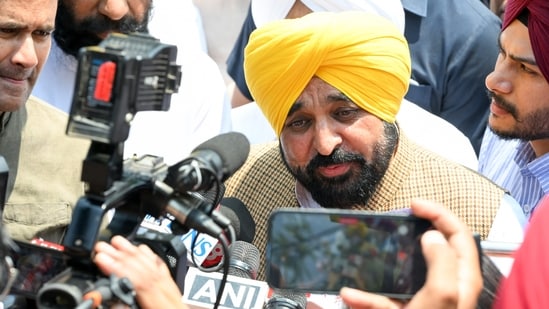
'Can't do as they please': Punjab CM Bhagwant Mann hits out at Raghav Chadha, ex-AAP MPs for BJP switch
# Mann Petitions Murmu Over AAP MPs’ BJP Switch
**By Senior Political Correspondent, Insight India | May 5, 2026**
On Tuesday, Punjab Chief Minister Bhagwant Mann met President Droupadi Murmu in New Delhi, officially demanding the termination of six Rajya Sabha Members of Parliament from Punjab who recently defected from the Aam Aadmi Party (AAP) to the Bharatiya Janata Party (BJP). Highlighting the shocking exit of senior AAP leader Raghav Chadha among the defectors, Mann firmly stated that elected representatives “can’t do as they please” after securing mandates under a specific party banner. This unprecedented mass defection has triggered a massive constitutional debate in the national capital, severely altering the balance of power in the Upper House and raising complex questions regarding India’s anti-defection framework ahead of the 2027 Punjab Assembly elections. [Source: Hindustan Times]
## The Defection Earthquake in Punjab Politics
The political landscape of Punjab and the national capital experienced a seismic shift this week following the defection of six prominent Rajya Sabha MPs from AAP to the BJP. The most notable among the defectors is Raghav Chadha, a founding member of the Aam Aadmi Party, a close confidant of AAP national convener Arvind Kejriwal, and the primary architect of the party’s sweeping victory in the 2022 Punjab Assembly elections.
For years, Chadha served as the youthful, articulate face of AAP in Parliament, heavily defending the party against the central government’s policies. His sudden switch to the BJP, accompanied by five other Upper House parliamentarians from Punjab, represents one of the most significant political coups in recent Indian history. The move effectively decimates AAP’s presence in the Rajya Sabha and hands the BJP a crucial numerical advantage in the Upper House, where passing controversial legislation has historically required intense floor management.
Speaking to the press outside the Rashtrapati Bhavan after submitting his memorandum, Chief Minister Bhagwant Mann did not mince his words. “Democracy is being mocked in broad daylight. Leaders who were sent to the highest house of Parliament by the people of Punjab on an AAP ticket cannot simply do as they please for personal political gains,” Mann stated, confirming that his government would explore every legal and constitutional avenue to ensure the MPs are disqualified. [Source: Hindustan Times]
## Mann’s Appeal to the President: A Strategic Move
Chief Minister Mann’s decision to directly petition President Droupadi Murmu highlights a distinct, aggressive political strategy. Technically, matters regarding the disqualification of Members of Parliament under the Tenth Schedule (Anti-Defection Law) fall under the jurisdiction of the Chairman of the Rajya Sabha. However, by taking the grievance directly to the Head of State, the Aam Aadmi Party aims to elevate the issue from a procedural parliamentary dispute to a national constitutional crisis.
Mann’s memorandum to the President reportedly emphasizes the moral and ethical breaches involved in the defection. AAP alleges that the defecting MPs were coerced and heavily incentivized by the ruling BJP, an accusation commonly referred to in Indian political discourse as “Operation Lotus.” AAP maintains that this orchestrated defection is a direct assault on the federal structure and the mandate of the Punjabi electorate, who emphatically voted against traditional national parties in 2022.
Furthermore, AAP leadership has requested the President to exercise her moral authority to advise the Rajya Sabha Chairman against recognizing the breakaway faction as a legitimate merger under the current anti-defection statutes, pending a thorough, independent investigation into the circumstances surrounding the switch. [Additional Source: Public Parliamentary Procedures Analysis]
## Legal Complexities of the Tenth Schedule
The legal battle over the fate of these six MPs is poised to be long and complex, hinging on the intricacies of the Tenth Schedule of the Indian Constitution. The Anti-Defection Law was designed to prevent political defections by disqualifying elected members who voluntarily give up their party membership. However, Paragraph 4 of the Tenth Schedule provides a crucial exemption: disqualification does not apply if a party merges with another, provided that at least two-thirds of the legislature party’s members agree to the merger.
**The Rajya Sabha Numbers Game:**
| Political Party | Total Punjab RS Seats (Before Defection) | Seats Defected | Percentage of Legislature Party |
| :— | :—: | :—: | :—: |
| Aam Aadmi Party | 7 | 6 | **85.7%** |
Because AAP had seven Rajya Sabha MPs from Punjab, the defection of six members accounts for approximately 85.7% of their legislative strength in the Upper House. This comfortably surpasses the two-thirds (66.6%) threshold required to claim a legal split or merger without facing immediate disqualification.
However, legal experts note that the interpretation of the law is not entirely black and white. “The legal defense of the defecting MPs will rely entirely on the two-thirds majority clause,” explains Dr. Vikramjeet Deshmukh, a New Delhi-based constitutional lawyer and former parliamentary advisor. “But AAP will likely argue that a ‘legislature party’ cannot merge independently of the ‘original political party.’ If the national executive of the Aam Aadmi Party has not authorized a merger with the BJP, AAP will argue that the exemption under Paragraph 4 is null and void. This is a profound legal gray area that will inevitably reach the doors of the Supreme Court.” [Additional Source: Expert Legal Analysis]
## BJP’s Strategic Expansion in Punjab
For the Bharatiya Janata Party, integrating Raghav Chadha and five other prominent Punjab leaders is a masterstroke in its long-term strategy for the state. Historically, the BJP functioned as a junior partner to the Shiromani Akali Dal (SAD) in Punjab, relying on SAD to bring in the rural Sikh vote while the BJP secured the urban Hindu vote. Following the collapse of their alliance over the controversial farm laws in 2020, the BJP has struggled to establish an independent, formidable base in the agrarian state.
By inducting high-profile, recognizable faces from the ruling state party, the BJP instantly acquires ready-made organizational leaders with deep roots in Punjab’s political ecosystem. Raghav Chadha’s organizational acumen, previously utilized to engineer AAP’s rise, will now be a critical asset for the BJP as it prepares for the high-stakes 2027 Punjab Legislative Assembly elections.
Political analyst Smita R. Krishnan observes, “The BJP has realized that to win in Punjab, they need local faces who understand the state’s unique socio-political fabric. Breaking AAP’s core leadership not only weakens their most vocal opponent nationally but also provides the BJP with a much-needed springboard in a border state where they have historically lacked mass independent appeal.” [Additional Source: Indian Political Strategy Review]
## What This Means for the Aam Aadmi Party
For the Aam Aadmi Party, the defections represent an existential crisis. Since capturing power in Punjab in 2022, AAP has marketed itself as the principal national alternative to the BJP, leveraging its status as a ruling party in two distinct regions (Delhi and Punjab). The Rajya Sabha numbers were crucial for AAP to project national influence and stall unfavorable legislation.
Losing Raghav Chadha is particularly devastating for the party’s morale. Chadha was not just an MP; he was a core strategist who navigated the party through several legal and political storms. His departure—especially to the BJP, a party AAP has built its entire ideological opposition around—threatens to demoralize the cadre on the ground.
Chief Minister Bhagwant Mann now faces the arduous task of keeping his local flock together. With the 2027 state elections looming on the horizon, Mann must project absolute strength and administrative control. By aggressively pursuing the disqualification of the defectors and taking the battle to the Rashtrapati Bhavan, Mann is sending a clear message to his remaining Members of Legislative Assembly (MLAs) in Punjab: any further rebellion will be met with immediate, high-profile retribution.
## Broader Implications for Indian Democracy
The events unfolding in May 2026 highlight a persistent vulnerability in India’s democratic machinery. The Tenth Schedule was enacted in 1985 specifically to end the “Aaya Ram, Gaya Ram” culture of frequent political defections. Yet, loopholes regarding mergers and splits have repeatedly been weaponized by major political parties across the spectrum to circumvent the spirit of the law.
When elected representatives switch allegiances without returning to the electorate for a fresh mandate, it fundamentally challenges the trust placed in the democratic process. While the BJP views this as a successful political consolidation, critics argue it sets a dangerous precedent where numerical strength in the legislature can override the ideological mandate granted by the voters.
## Conclusion
Chief Minister Bhagwant Mann’s petition to President Droupadi Murmu is just the opening salvo in what promises to be a bitter, protracted political and legal war. As the Aam Aadmi Party fights to secure the disqualification of Raghav Chadha and the five other defecting MPs, the matter will undoubtedly shift to the Rajya Sabha Chairman’s office and, subsequently, the Supreme Court of India.
The ultimate ruling on this mass defection will have far-reaching consequences. It will not only determine the political fate of the six MPs and reshape the Rajya Sabha’s arithmetic but will also establish a critical legal precedent on how the Anti-Defection Law is interpreted in modern Indian politics. As the 2027 Punjab elections draw nearer, both AAP and the BJP are acutely aware that the outcome of this constitutional battle could very well decide who controls the state moving forward.





