
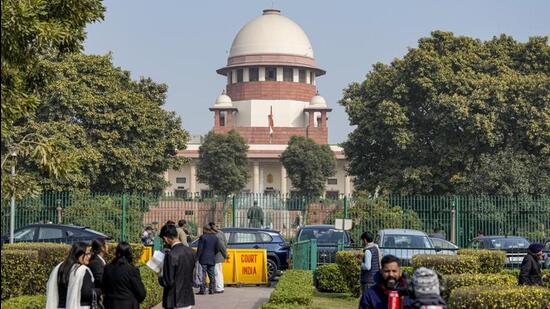
Sabarimala PIL papers should have been ‘thrown in dustbin’: Supreme Court
# SC: Sabarimala PIL Belongs in Dustbin
By Senior Legal Correspondent, Supreme Court Desk | May 5, 2026
**NEW DELHI** — On Tuesday, May 5, 2026, the Supreme Court of India issued a blistering reprimand against the petitioners of a Public Interest Litigation (PIL) regarding the Sabarimala temple, declaring that the foundational papers of the case should have been “thrown in the dustbin.” The bench, visibly frustrated by the lack of substantive research, noted that the apex court had unfortunately entertained a petition devoid of any material meriting judicial consideration. This sharp rebuke underscores the judiciary’s growing intolerance for frivolous litigation, particularly concerning highly sensitive religious matters already under the comprehensive scrutiny of larger constitutional benches.
## A Scathing Courtroom Rebuke
The Supreme Court’s remarks came during the hearing of a tangential PIL attempting to reopen or influence specific administrative and religious parameters of the Lord Ayyappa temple in Sabarimala, Kerala. Taking strong exception to the foundation of the PIL, the bench categorically stated that the court had initially entertained the petition on the basis of material that, upon closer inspection, did not merit judicial consideration.
The justices highlighted that the petition was heavily reliant on unverified claims, anecdotal reports, and hearsay, rather than robust constitutional arguments or empirical legal evidence. “When matters of such profound constitutional and theological significance are brought before the highest court of the land, we expect rigorous legal scholarship, not compilations of newspaper clippings that belong in the dustbin,” the bench observed orally.
[Source: https://www.hindustantimes.com/india-news/sabarimala-pil-papers-should-have-been-thrown-in-dustbin-supreme-court-101777970801660.html | Additional: Supreme Court Daily Hearing Archives, May 2026]
## The Burden of the Sabarimala Legacy
To understand the Supreme Court’s palpable frustration, one must look at the monumental legal history surrounding the Sabarimala temple. The controversy reached its first major judicial climax in September 2018, when a five-judge Constitution Bench, in a 4:1 majority, struck down the centuries-old tradition that barred women of menstruating age (10 to 50 years) from entering the hill shrine.
The 2018 verdict, authored by then-Chief Justice Dipak Misra, held that the exclusion violated the fundamental rights to equality and freedom of religion. However, the lone dissenting voice, Justice Indu Malhotra, argued that courts should not interfere in matters of deep religious faith unless there is an aggrieved person from that specific religious denomination.
The judgment sparked massive protests across Kerala and led to a deluge of over 60 review petitions. Acknowledging the complexity of the issue—which intertwines fundamental rights under Articles 14, 15, and 21 with the freedom to manage religious affairs under Articles 25 and 26—the Supreme Court eventually referred the broader questions of religious freedom to a larger nine-judge bench.
With this heavyweight constitutional mechanism already in motion, the Supreme Court views supplementary, poorly drafted PILs as an unnecessary distraction that trivializes a profoundly complex legal debate.
## The Evolution and Misuse of the PIL Mechanism
The Supreme Court’s “dustbin” remark also brings to the forefront a chronic issue plaguing the Indian judicial system: the misuse of Public Interest Litigations. Pioneered in the late 1970s and 1980s by legal luminaries like Justice P.N. Bhagwati and Justice V.R. Krishna Iyer, the PIL was designed as a revolutionary tool to provide marginalized and voiceless communities access to the highest courts.
However, over the decades, the mechanism has frequently devolved into what legal scholars cynically refer to as “Publicity Interest Litigation” or “Private Interest Litigation.”
**Key factors contributing to PIL misuse:**
* **Media Attention:** Litigants often file sensational petitions on trending socio-political issues to garner prime-time news coverage.
* **Bypassing Lower Courts:** Petitioners use PILs to jump the judicial queue, bringing issues directly to the Supreme Court that should ideally be handled by High Courts or administrative bodies.
* **Vague Locus Standi:** The relaxed rules of standing, meant to help activists represent the poor, are sometimes exploited by busybodies with no real stake in the matter.
In a system burdened by a staggering backlog of over 50 million pending cases nationwide as of early 2026, judicial time is an incredibly scarce resource. Entertaining half-baked petitions directly impacts the court’s ability to adjudicate genuine grievances.
## Legal Experts Weigh In
Constitutional scholars and senior advocates have largely welcomed the Supreme Court’s stringent stance on the matter.
“The apex court’s remarks are a necessary course correction,” explains Dr. Vikramaditya Singh, a senior constitutional law expert and former Additional Solicitor General. “When a nine-judge bench is already tasked with defining the boundaries of the Essential Religious Practices (ERP) test, allowing peripheral, badly researched petitions to clutter the docket is a disservice to the justice system. The ‘dustbin’ comment, while harsh, is a much-needed deterrent.”
Meera Nambiar, a Supreme Court advocate specializing in religious jurisprudence, echoes this sentiment. “There is a dangerous trend of activists attempting to shape monumental constitutional outcomes through back-door PILs. The Sabarimala issue is deeply tied to the socio-cultural fabric of Kerala and broader Hindu jurisprudence. The evidence required to debate these tenets must be rigorous, historical, and deeply theological. A petition based on superficial grievances deserves to be dismissed with exemplary costs.”
## The Essential Religious Practices Doctrine at Stake
The broader context of why the Supreme Court is so protective of the Sabarimala litigation lies in the “Essential Religious Practices” (ERP) doctrine. Stemming from the historic Shirur Mutt case of 1954, the ERP test requires the judiciary to determine what parts of a religion are absolutely core to its existence, and what parts are merely secular or peripheral traditions that can be legislated away by the state.
In the case of Sabarimala, the deity Lord Ayyappa is worshipped in the form of a ‘Naishtika Brahmachari’ (eternal celibate). The temple’s defenders argue that the restriction on women of menstruating age is not rooted in misogyny or concepts of pollution, but is an essential practice directly tied to the celibate nature of the deity. Opponents argue that such exclusion is inherently discriminatory and violates the basic structure of the Constitution.
Because the stakes involve redefining the balance between state intervention and religious autonomy in India, the Supreme Court cannot afford to let the narrative be hijacked by poorly drafted PILs. The material brought before the judges must withstand intense constitutional, historical, and scriptural scrutiny.
## Implications for Future Litigants
The sharp dismissal of this particular PIL serves as a stern warning to the legal fraternity. Moving forward, petitioners and their legal counsels can expect:
1. **Stricter Scrutiny at Admission:** The registry and the judges are likely to be far more unforgiving during the preliminary admission stages of a PIL, strictly evaluating the foundational material before issuing notices to the respondents.
2. **Imposition of Heavy Costs:** While it is unclear if the petitioners in Tuesday’s hearing were fined, the Supreme Court has increasingly utilized heavy exemplary costs to penalize lawyers and litigants who waste judicial time.
3. **Emphasis on Original Research:** Petitions relying solely on newspaper articles, social media trends, or secondary opinions without independent, primary research will face immediate rejection.
## Conclusion and Future Outlook
The Supreme Court’s declaration that the Sabarimala PIL papers belonged in the “dustbin” is more than just a moment of judicial frustration; it is a reaffirmation of the sanctity of the constitutional process. As India awaits the final, historic deliberations of the larger constitutional bench regarding religious freedoms and the Essential Religious Practices doctrine, the apex court has made its boundaries clear.
The intersection of faith and fundamental rights remains one of the most volatile and complex areas of Indian constitutional law. Resolving the Sabarimala conundrum will require the highest caliber of legal debate. By aggressively weeding out substandard and frivolous petitions, the Supreme Court is ensuring that when the final legal pronouncements are made, they are built on a foundation of unshakeable legal rigor, not on the shifting sands of opportunistic litigation.





