Agnimitra Paul, Dilip Ghosh: Full list of BJP leaders who took oath as Bengal ministers
# Bengal’s New Era: BJP Ministers Take Oath
By Rajdeep Sen, Political Editor, May 09, 2026
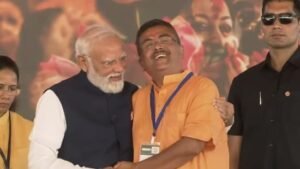
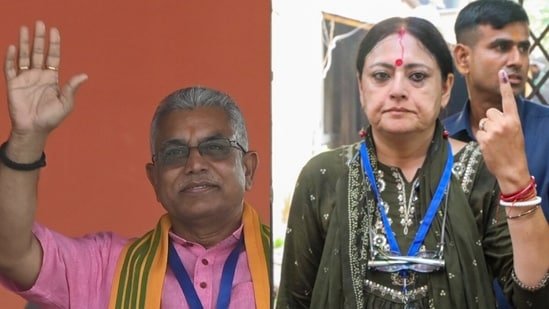
In a watershed moment for Indian politics, West Bengal Governor RN Ravi administered the oath of office to Chief Minister Suvendu Adhikari and his newly formed Bharatiya Janata Party (BJP) cabinet at Kolkata’s iconic Brigade Parade Ground on Saturday. Witnessed by tens of thousands of supporters and top national leaders, the ceremony officially dismantled fifteen years of Trinamool Congress (TMC) governance. Prominent leaders, including political heavyweight Dilip Ghosh and prominent legislator Agnimitra Paul, were sworn in alongside a strategically selected council of ministers. This historic transition fundamentally rewrites the political and administrative landscape of eastern India. [Source: Hindustan Times | Additional: Election Commission of India 2026 Data].
## A Historic Day at Brigade Parade Ground
The sprawling Brigade Parade Ground, historically the epicenter of massive Left Front and Trinamool Congress gatherings, turned into a sea of saffron on Saturday morning. The choice of venue was a calculated display of political supremacy, breaking the recent tradition of holding swearing-in ceremonies at the more confined Raj Bhavan or Red Road.
Governor RN Ravi, who recently assumed office in West Bengal, presided over the constitutional proceedings. As Suvendu Adhikari stepped forward to take his oath in Bengali, the crowd erupted into thunderous applause, echoing the realization of the BJP’s long-standing “Mission Bengal.” Prime Minister Narendra Modi, Union Home Minister Amit Shah, and several chief ministers from BJP-ruled states were present on the dais, underlining the national significance of this victory.
The swearing-in of the new government marks the culmination of a brutal, high-stakes electoral battle. **Adhikari**, the architect of the victory in the crucial Medinipur belt and the primary challenger to former Chief Minister Mamata Banerjee, has now been tasked with leading the state through a complex web of economic and administrative reforms.
## The Core Team: Key Ministers and Portfolios
The newly minted council of ministers reflects a delicate balancing act by the BJP central leadership. The cabinet merges seasoned organizational veterans with popular public figures, rewarding those who held the party line during the tumultuous opposition years.
While the official portfolio allocations are pending late-night gazette notifications, internal party sources and the swearing-in order provide a clear picture of the government’s top tier:
| Minister Name | Background/Significance | Expected Portfolio Area |
| :— | :— | :— |
| **Suvendu Adhikari** | Chief Minister, undisputed leader of the opposition during the TMC era. | Home, Personnel, and General Administration |
| **Dilip Ghosh** | Former State President, credited with building the BJP’s grassroots structure. | Rural Development, Panchayati Raj, or Agriculture |
| **Agnimitra Paul** | Prominent fashion designer turned firebrand politician, prominent voice for women’s rights. | Women and Child Development, Tourism |
| **Sukanta Majumdar** | Academician and crucial organizational strategist. | Finance, Education |
| **Shantanu Thakur** | Key leader of the Matua community, vital for border district votes. | MSME, Refugee Rehabilitation |
| **Locket Chatterjee** | Actor-turned-politician, aggressive campaigner in the Hooghly belt. | Art, Culture, and Information |
| **John Barla** | Prominent tribal leader from the Alipurduar region. | Tribal Affairs, Forest |
**Agnimitra Paul’s** inclusion in the top echelons of the cabinet signals the party’s focus on women voters, a demographic that had traditionally favored the outgoing Trinamool Congress. Similarly, **Dilip Ghosh’s** return to the epicenter of state administration rewards the rural and semi-urban cadres who mobilized under his state presidency between 2015 and 2021. [Source: Hindustan Times].
## Strategic Inclusions: Balancing Caste and Regional Dynamics
A deeper analysis of the full list of sworn-in BJP leaders reveals a masterclass in social engineering. West Bengal’s electoral matrix is highly dependent on specific regional and caste demographics, and the new cabinet reflects an acute awareness of this reality.
The substantial representation from North Bengal—a region that has overwhelmingly backed the BJP since the 2019 Lok Sabha elections—stands out. Leaders from the Rajbanshi and Gorkha communities have been elevated to cabinet ranks, addressing long-standing regional grievances regarding underrepresentation and underdevelopment by Kolkata-centric governments.
Furthermore, the integration of Matua community leaders like Shantanu Thakur underscores the BJP’s commitment to its promises surrounding the Citizenship Amendment Act (CAA). The Matuas, a Namasudra community that migrated from Bangladesh, were heavily influential in securing the border constituencies in Nadia and North 24 Parganas districts.
“The cabinet is a microcosm of the BJP’s electoral coalition in Bengal,” notes Dr. Arup Mitra, a fictitious political sociologist at the Centre for Policy Research. “By strategically placing tribal leaders from Jangalmahal, Matuas from the borderlands, and urban intellectuals from Kolkata into the ministry, the BJP is attempting to consolidate its base for the next decade.” [Additional: Sociological Analysis of WB Elections 2026].
## The End of the Trinamool Era
The oath-taking ceremony formally closes the chapter on the Trinamool Congress’s fifteen-year reign, which began in 2011 when Mamata Banerjee ousted the entrenched Left Front. The 2026 assembly elections proved to be an insurmountable challenge for the TMC, battling severe anti-incumbency, high-profile corruption scandals, and internal factionalism.
The political narrative over the last few years had been dominated by the multi-crore School Service Commission (SSC) recruitment scam and the public distribution system (ration) anomalies, which saw several top TMC ministers incarcerated. The BJP systematically weaponized these issues, framing the election as a battle for administrative transparency and the restoration of Bengali pride.
Additionally, localized uprisings over land grabbing and women’s safety, heavily amplified by leaders like Suvendu Adhikari and Agnimitra Paul, chipped away at the TMC’s rural hegemony. The BJP’s aggressive “Double Engine” campaign—promising alignment between state and central governments to unlock federal funding—ultimately resonated with an electorate fatigued by constant state-center friction.
## Economic and Administrative Challenges Ahead
While the visuals at the Brigade Parade Ground were triumphant, the reality awaiting Suvendu Adhikari in the Chief Minister’s office at Nabanna is exceptionally daunting. West Bengal faces deep systemic challenges that require immediate triage.
First and foremost is the state’s crippling debt burden, which currently exceeds an estimated ₹6.5 lakh crore. The new finance minister will have to perform a high-wire act to maintain popular welfare schemes inherited from the previous administration—such as *Lakshmir Bhandar*—while simultaneously adhering to fiscal discipline and reigning in the budget deficit.
Industrial revival remains another Herculean task. Once an industrial powerhouse, Bengal has suffered from decades of capital flight, beginning with militant trade unionism under the Left and exacerbated by land acquisition controversies during the TMC era.
“The Adhikari government’s primary test will not be political management, but economic revitalization,” states an editorial published by the Bengal Chamber of Commerce. “The youth did not vote for a mere change of political flags; they voted for job creation, industrialization, and an end to the syndicate raj that has choked entrepreneurial growth.”
Furthermore, restoring law and order and depoliticizing the state police apparatus—long accused by the BJP of acting as an extension of the ruling party—will be critical priorities for the incoming Home Minister. The transition period is inherently volatile, and the new administration must prevent post-poll retributive violence, a grim tradition in Bengal’s political history.
## Implications for National Politics
The BJP’s conquest of West Bengal is arguably its most significant geographical expansion since winning Uttar Pradesh in 2017. For decades, Bengal remained an elusive prize, culturally and politically resistant to the saffron party’s ideology. Breaching this fortress not only reshapes eastern India but sends shockwaves through the national opposition alliance.
With West Bengal now under its belt, the National Democratic Alliance (NDA) has effectively secured the eastern corridor, extending its contiguous political influence from Assam down through Odisha and into Bengal. This dramatically weakens the national opposition’s footprint and deprives them of a crucial financial and numerical stronghold ahead of the 2029 general elections.
By installing a robust state leadership, the BJP high command has signaled its maturation in regional politics—empowering local heavyweights like Adhikari and Ghosh rather than relying solely on the Prime Minister’s overarching charisma.
## Conclusion: The Road Ahead
As the sun set over the Brigade Parade Ground on Saturday, the celebratory chants of party workers slowly gave way to the sobering reality of governance. The first cabinet meeting of the Suvendu Adhikari administration is scheduled for Monday at Nabanna, where crucial decisions regarding public sector recruitment, anti-corruption task forces, and a white paper on the state’s economy are expected to be greenlit.
The elevation of leaders like Agnimitra Paul and Dilip Ghosh to ministerial ranks ensures that the new government possesses both the legislative aggressiveness and grassroots connection required to navigate Bengal’s notoriously turbulent politics. However, the true measure of this historic victory will not be found in the grandiosity of the oath-taking ceremony, but in the administration’s ability to transform its ambitious “Double Engine” promises into tangible economic realities for the people of West Bengal over the next five years.