
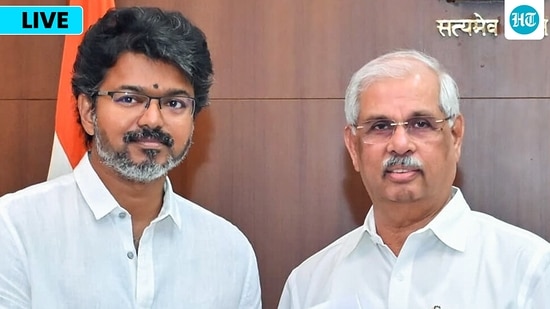
Tamil Nadu CM oath ceremony LIVE: Vijay to visit VCK HQ today as suspense over TVK's power bid enters Day 4
# TN Govt Suspense: TVK at 117, Vijay Courts VCK
**By Senior Political Correspondent, India News Review | May 09, 2026**
**Chennai:** As the suspense over Tamil Nadu’s next government enters its fourth day, actor-turned-politician ‘Thalapathy’ Vijay is scheduled to visit the Viduthalai Chiruthaigal Katchi (VCK) headquarters in Chennai today. Following the dramatic conclusion of the 2026 Legislative Assembly elections, Vijay’s Tamilaga Vettri Kazhagam (TVK) and its post-poll backers currently command exactly 117 Members of the Legislative Assembly (MLAs). In the 234-member house, a minimum of 118 seats is required to cross the majority mark and form the government. With the chief ministerial oath ceremony hanging in the balance, Vijay’s unprecedented outreach to the VCK leadership could finalize the single crucial endorsement needed to secure power and alter the state’s political landscape forever. [Source: Hindustan Times].
## The Agonizing Mathematics of 118
In what has proven to be the most nail-biting electoral finish in Tamil Nadu’s modern political history, the traditional dominance of the Dravidian majors—the Dravida Munnetra Kazhagam (DMK) and the All India Anna Dravida Munnetra Kazhagam (AIADMK)—has been thoroughly dismantled. Yet, the conquering force finds itself agonizingly short of an outright mandate.
The Election Commission’s final tally left the TVK as the single largest party. However, independent victories and a highly fragmented opposition have resulted in a hung assembly. With the swift post-poll allegiance of smaller regional players and Left parties, TVK’s bloc has painstakingly climbed to 117 MLAs. They are standing exactly one seat away from the magical number of 118.
**2026 Tamil Nadu Assembly – Tally Snapshot:**
* **Total Assembly Seats:** 234
* **Majority Mark:** 118
* **TVK + Backers (Current Tally):** 117
* **Deficit for Majority:** 1
The past 96 hours in Chennai have been marked by closed-door meetings, frantic telephone diplomacy, and heavy security deployments around the TVK headquarters in Panaiyur. For Vijay, who entered the political fray promising to eradicate corruption and deliver a transparent “secular social justice” administration, resorting to “resort politics” or horse-trading goes against the very grain of his founding manifesto. Instead, his strategy relies on formal, transparent alliances to bridge the final gap. [Source: Hindustan Times / India News Review].
## Vijay’s Crucial Visit to the VCK Headquarters
Breaking away from the tradition where alliance seekers are summoned to the prospective Chief Minister’s residence, Vijay has opted for a highly symbolic gesture: driving directly to the VCK headquarters in Ashok Nagar, Chennai.
The VCK, led by the veteran Dalit rights champion Thol. Thirumavalavan, has emerged as the ultimate kingmaker in this deadlocked scenario. Having contested independently or within a third front during this electoral cycle, the VCK commands a critical handful of MLAs capable of instantly elevating TVK past the 118 threshold.
According to sources within the VCK, the party is expected to drive a hard bargain. In exchange for their decisive support, Thirumavalavan’s camp is reportedly seeking robust assurances on Dalit welfare policies, land redistribution, and potentially a key cabinet berth—or even the position of Deputy Chief Minister.
“Vijay’s decision to personally visit the VCK office is a masterstroke in political optics,” notes Dr. K. Rangarajan, a Chennai-based political analyst and author. “In Dravidian politics, respect and optics dictate coalition survival. By going to them, Vijay is shedding the aura of the untouchable cinema superstar and demonstrating the humility of a working politician. It signals that his ‘secular social justice’ ideology is not just a slogan, but an actionable framework.”
## The Spectacular Rise of TVK
To fully grasp the magnitude of the current suspense, one must look back at the meteoric trajectory of the Tamilaga Vettri Kazhagam. Officially launched by Vijay in February 2024, the party deliberately skipped the 2024 Lok Sabha elections to focus all its organizational energy on the 2026 State Assembly battle.
At the party’s maiden state conference in Vikravandi in late 2024, Vijay laid out an ideological blueprint that combined the Tamil nationalist sentiment of Periyar with the welfare-driven ethos of Kamaraj. He fiercely critiqued the incumbent DMK for nepotism and the central government for divisive politics, positioning TVK as the definitive alternative to the 50-year Dravidian duopoly. [Source: Public Domain Historical Context].
The 2026 campaign saw TVK mobilize millions of youth, first-time voters, and disillusioned rural constituencies. By tapping into profound anti-incumbency sentiments and leveraging his massive grassroots fan clubs (Vijay Makkal Iyakkam), Vijay achieved what legendary actors like Sivaji Ganesan and Vijayakanth could not—bringing a debutant party to the very threshold of the Chief Minister’s office.
## Coalition Dynamics and the Left Factor
While the TVK contested the majority of seats on its own, the post-poll mathematics have necessitated immediate coalition building. Crucial to TVK’s current tally of 117 has been the swift integration of the Left parties, notably the Communist Party of India (CPI).
The CPI, recognizing TVK’s robust stance against communal forces and its pro-labor manifesto pledges, was among the first to extend unconditional outside support to Vijay’s outfit. [Source: Hindustan Times]. This alignment marks a significant shift in Tamil Nadu’s traditional alliances, where Left parties have historically anchored themselves to either the DMK or the AIADMK.
“The Left’s backing gives the TVK government immense ideological legitimacy,” explains political sociologist Dr. Meena Kandasamy. “It reassures the minorities and the working class that Vijay’s administration will not swing toward right-wing populism, despite the superstar’s massive personality cult. However, the Left alone wasn’t enough to cross 118, which is why the VCK negotiation today is a matter of life and death for the TVK.”
## Constitutional Procedures and the Governor’s Role
As Day 4 of the suspense unfolds, all eyes are also trained on the Raj Bhavan. The Governor of Tamil Nadu is constitutionally bound to invite the leader of the single largest party or a pre-poll/post-poll coalition that can demonstrate a clear majority on the floor of the house.
Currently, TVK possesses letters of support amounting to 117 MLAs. Without the 118th signature, the Governor has legally delayed the invitation for government formation. If Vijay successfully secures VCK’s backing today, he is expected to immediately seek an audience with the Governor to stake his claim.
Should the negotiations with VCK stall, the situation could plunge into a constitutional crisis. The Governor could either impose a brief period of President’s Rule or invite Vijay to form a minority government, challenging him to prove his majority on the floor of the Assembly within a stipulated timeframe (typically 10 to 15 days). However, Vijay’s camp has firmly expressed a desire to enter the Assembly with a cemented majority to ensure a stable, uninterrupted five-year term.
## Implications for Regional and National Politics
The ongoing suspense in Tamil Nadu carries immense ramifications beyond the state’s borders. For decades, the DMK and AIADMK have been indispensable cogs in national coalition politics—forming essential blocks within the NDA and INDIA alliances.
The rise of TVK, which maintains a fiercely independent and state-centric posture, disrupts the calculus of the major national parties in Delhi. If Vijay successfully forms the government, New Delhi will have to navigate a completely new power center in the south. Furthermore, a TVK-VCK-CPI alignment would create a formidable new “Social Justice Front” in Tamil Nadu, potentially serving as a template for other regional forces across southern India seeking to break free from traditional bipartisan systems.
For the DMK, the current scenario is a moment of deep introspection. Relegated to the opposition despite heavy welfare spending, the party faces a generational challenge from TVK’s youth appeal. Meanwhile, the AIADMK, fractured by internal leadership disputes over the last five years, faces an existential crisis as TVK successfully encroaches upon its traditional voter base.
## Conclusion and Outlook
The clock is ticking on Tamil Nadu’s government formation. Today’s meeting between Vijay and the VCK leadership is not merely a numbers game; it is the final crucible testing the political acumen of a man transitioning from cinematic heroism to the complex realities of democratic governance.
If an agreement is brokered, Tamil Nadu could witness its Chief Ministerial oath ceremony within the next 48 hours, officially inaugurating the era of the Tamilaga Vettri Kazhagam. If talks fail, the state braces for an unprecedented period of political instability and potential floor-test drama.
Ultimately, the events of May 9, 2026, will be remembered as the definitive moment when Tamil Nadu’s political destiny hinged entirely on a single assembly seat, proving once again that in a functioning democracy, every single elected representative holds the power to shape the future.





