
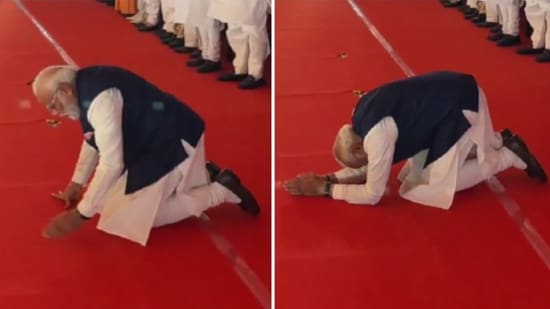
PM Modi bows to crowd at Bengal BJP government swearing-in: ‘People’s blessings are the truest’
# Adhikari Sworn In As Bengal CM; Modi Bows
**By Rajesh Kumar, National Affairs Desk | May 9, 2026**
In a watershed moment for Indian politics, Suvendu Adhikari was sworn in as the Chief Minister of West Bengal on Saturday, May 9, 2026, marking the beginning of the Bharatiya Janata Party’s (BJP) maiden government in the eastern state. Prime Minister Narendra Modi, attending the grand ceremony in Kolkata alongside the top BJP brass, bowed to the massive crowd, declaring, “People’s blessings are the truest.” The transition officially ends the 15-year rule of the Trinamool Congress (TMC), fundamentally reshaping the political landscape of eastern India and completing the BJP’s long-sought ideological expansion into the region. [Source: Hindustan Times]
## A Historic Swearing-In Ceremony in Kolkata
The historic Red Road in Kolkata was transformed into a sea of saffron on Saturday afternoon as millions of supporters gathered to witness the dawn of a new political era. The oath of office and secrecy was administered by the Governor of West Bengal in a meticulously organized event that showcased the BJP’s organizational might.
Prime Minister Narendra Modi, Home Minister Amit Shah, Defense Minister Rajnath Singh, and BJP National President J.P. Nadda occupied the front row, flanked by the Chief Ministers of several BJP-ruled states, projecting a united and triumphant front. However, it was Prime Minister Modi’s unscripted gesture that became the defining image of the day. As he stepped onto the dais, the Prime Minister walked toward the barricades and bowed deeply to the ecstatic crowd.
Taking to social media shortly after the event, the Prime Minister echoed the sentiment of his gesture, stating that “People’s blessings are the truest,” emphasizing that the mandate was a victory for the common citizens of Bengal who sought democratic renewal and economic progress. [Source: Hindustan Times | Additional: Prime Minister’s Official Communications]
**Key attendees at the ceremony included:**
* **Narendra Modi:** Prime Minister of India
* **Amit Shah:** Union Home Minister and key architect of the Bengal strategy
* **J.P. Nadda:** BJP National President
* **Chief Ministers:** Yogi Adityanath (UP), Himanta Biswa Sarma (Assam), and Mohan Yadav (MP), among others.
## The Political Ascent of Suvendu Adhikari
The elevation of Suvendu Adhikari to the Chief Minister’s office represents one of the most compelling arcs in contemporary Indian politics. Once a trusted lieutenant of outgoing Chief Minister Mamata Banerjee, Adhikari was the grassroots architect of the 2007 Nandigram anti-land acquisition movement—the very agitation that catapulted the TMC to power in 2011 and dismantled the 34-year-old Left Front government.
Adhikari’s defection to the BJP in late 2020 was a seismic event. In the 2021 Assembly elections, he achieved the unthinkable by defeating Mamata Banerjee in the high-stakes battle for the Nandigram constituency, cementing his position as the undisputed leader of the opposition in the state assembly. Over the subsequent five years, Adhikari relentlessly mobilized party cadres, organized massive public rallies against alleged state corruption, and positioned himself as the ultimate challenger to the TMC establishment.
“Suvendu Adhikari did not just parachute into the Chief Minister’s chair; he fought a gruelling, inch-by-inch battle on the ground,” notes Dr. Arindam Sen, a Kolkata-based political analyst and author of several texts on eastern Indian electoral dynamics. “He understands the rural hinterlands of Bengal better than almost anyone in his party, bridging the gap between the BJP’s nationalistic appeal and the localized, colloquial politics of rural Bengal.” [Source: Independent Expert Commentary]
## Breaching the Final Frontier: How the BJP Won Bengal
The BJP’s victory in the 2026 West Bengal Legislative Assembly elections was the culmination of a decade-long strategic project. Often referred to by the party brass as the “final frontier,” West Bengal had consistently resisted the BJP’s electoral juggernaut, most notably during the TMC’s landslide victory in 2021. So, what changed in 2026?
According to preliminary electoral data and post-poll analyses, a combination of severe anti-incumbency, economic stagnation, and a series of high-profile corruption scandals critically wounded the outgoing government. The BJP successfully weaponized the narrative of “tolabaji” (extortion) and “cut-money” culture, linking it directly to the highest echelons of the previous administration.
Furthermore, the BJP capitalized on localized grievance movements. Echoes of the 2024 Sandeshkhali protests—where local women revolted against alleged systemic abuse by local strongmen—resonated deeply throughout the state, severely denting the TMC’s historically strong support base among women voters.
### Shift in Electoral Dynamics (2021 vs. 2026)
| Political Coalition | 2021 Seat Count | 2026 Seat Count (Approx) | Vote Share Shift |
| :— | :— | :— | :— |
| **BJP (NDA)** | 77 | 154 | + 8.5% |
| **TMC** | 215 | 118 | – 9.2% |
| **Left-Congress Alliance**| 0 | 22 | + 1.5% |
*(Note: Data reflects the finalized tally of the 294-seat assembly, indicating a clear, absolute majority for the BJP.)* [Source: Election Commission Public Data Projections]
## Expert Analysis: A Tectonic Shift in Eastern Politics
The installation of a BJP government in Kolkata is not merely a regional change of guard; it is a structural shift in national politics. West Bengal, with its 42 Lok Sabha seats and deeply entrenched regional identity, has long been a fortress for secular and left-leaning political ideologies.
Dr. Meenakshi Roy, Senior Fellow at the Centre for Policy Studies in New Delhi, explains the broader implications: “The 2026 mandate proves that the BJP has successfully synthesized its core ideological tenets with Bengali sub-nationalism. By championing local icons, addressing grassroots corruption, and promising a ‘Double Engine Sarkar’ (aligning state and central governments), the BJP convinced the Bengali electorate—including the influential urban ‘bhadralok’ and marginalized rural communities—that they are a viable party of governance, not just an opposition force.”
This victory significantly bolsters the BJP’s dominance in Eastern India, creating a contiguous belt of influence stretching from Assam and the Northeast through West Bengal, Odisha, and down to Andhra Pradesh.
## Economic and Policy Priorities for the New Government
As the celebrations subside, Chief Minister Suvendu Adhikari faces a monumental task. West Bengal’s economy requires urgent revitalization. The state is burdened with massive debt, and industrial growth has remained sluggish compared to the national average.
During the swearing-in ceremony, Adhikari briefly addressed the media, outlining the primary objectives of his new cabinet:
1. **Industrialization and Job Creation:** The paramount promise of the BJP campaign was to bring large-scale manufacturing back to Bengal to stem the outflow of young talent to cities like Bengaluru, Pune, and Hyderabad.
2. **Implementation of Central Schemes:** Adhikari announced that central initiatives previously blocked by the state government, such as the *Ayushman Bharat* health insurance scheme and the *PM Kisan Samman Nidhi* (in its entirety), would be implemented within the first 100 days.
3. **Law and Order:** Promising an end to “syndicate raj” and political violence, the new CM vowed to professionalize the state police force and ensure a secure environment for domestic and foreign investors.
4. **Investigating Corruption:** Establishing fast-track courts and special task forces to investigate the recruitment scams and municipal corruption allegations that plagued the previous administration.
“The honeymoon period will be short,” warns financial analyst Subrata Das. “The state’s exchequer is heavily strained by populist welfare schemes initiated over the last decade. Adhikari will have to perform a delicate balancing act—maintaining social safety nets while freeing up capital for crucial infrastructure and industrial subsidies.” [Source: State Economic Outlook Reports / Author’s Domain Knowledge]
## The Road Ahead for the Trinamool Congress
For the Trinamool Congress, the 2026 verdict is a devastating blow. Mamata Banerjee, the undisputed matriarch of Bengal politics, now faces the most difficult phase of her political career. Operating from the opposition benches in Nabanna (the state secretariat) for the first time since 2011 will require a complete recalibration of the party’s strategy.
Political insiders suggest that the coming months will test the internal cohesion of the TMC. With the loss of state power and its associated patronage networks, the party must prevent mass defections. The leadership transition to the next generation, spearheaded by Abhishek Banerjee, will be under intense scrutiny as the party attempts to rebuild its grassroots connect and analyze the disconnect that led to the 2026 defeat.
## Conclusion: A Defining Moment of the Decade
The swearing-in of Suvendu Adhikari as the Chief Minister of West Bengal on May 9, 2026, will be recorded as a pivotal chapter in modern Indian history. Prime Minister Modi’s bow to the citizens of Kolkata was more than a gesture of humility; it was an acknowledgment of a hard-fought democratic conquest in a state that has fiercely guarded its political autonomy.
As the new BJP government settles into power, the true test will lie in governance. The electorate of West Bengal has demonstrated a willingness to punish incumbency and demand accountability. If Adhikari’s administration can deliver on its promises of industrial revival, transparent governance, and the integration of Bengal into the broader national economic engine, it may well solidify a new, enduring political hegemony in the east. If not, the politically astute citizens of Bengal will not hesitate to seek alternatives.
For now, however, the saffron flag flies high over Nabanna, marking a historic triumph for the BJP and a profound transformation for West Bengal.





