
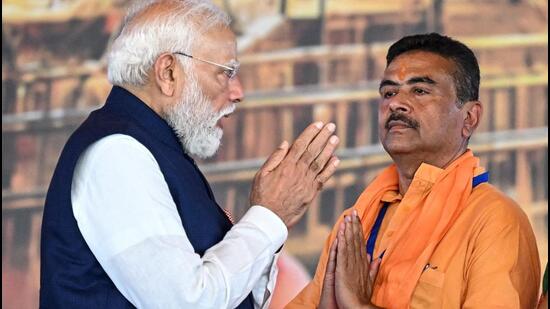
Bengal gets its first BJP CM as Suvendu Adhikari takes oath at Brigade Parade Ground
# Adhikari Sworn In As Bengal’s First BJP CM
By Senior Political Desk, National News Tribune, May 09, 2026
Marking a historic shift in Indian politics, Suvendu Adhikari was sworn in as West Bengal’s first Bharatiya Janata Party (BJP) Chief Minister on Saturday, May 9, 2026. The monumental oath-taking ceremony unfolded at Kolkata’s iconic Brigade Parade Ground in the presence of Prime Minister Narendra Modi, Union Home Minister Amit Shah, and a consortium of top National Democratic Alliance (NDA) leaders. This transition of power follows the BJP’s decisive victory in the fiercely contested 2026 state assembly elections, officially ending the 15-year administration of Mamata Banerjee’s Trinamool Congress (TMC). Adhikari’s ascension signals a fundamental realignment of political power in eastern India.
## A Historic Swearing-In Ceremony
The Brigade Parade Ground, historically known for hosting massive political rallies that have shaped the destiny of West Bengal, witnessed a sea of saffron on Saturday afternoon. Over half a million supporters gathered under the sweltering May sun to witness the dawn of what the BJP has long termed *Ashol Poriborton* (Real Change).
Governor C.V. Ananda Bose administered the oath of office and secrecy to the **55-year-old Suvendu Adhikari**, who took the pledge in Bengali, drawing thunderous applause from the sprawling crowds. Prime Minister Narendra Modi, who personally led the BJP’s high-octane campaign across the state, was seated on the dais alongside Chief Ministers from several BJP-ruled states, including Uttar Pradesh’s Yogi Adityanath, Assam’s Himanta Biswa Sarma, and Odisha’s Mohan Charan Majhi.
“This is not just a victory for a political party; it is a victory for the democratic spirit of Bengal,” Prime Minister Modi noted in a social media statement shortly after the ceremony concluded. “Under the leadership of Chief Minister Suvendu Adhikari, West Bengal will reclaim its lost glory and embark on an accelerated path of industrial and social development.” [Source: https://www.hindustantimes.com/india-news/bengal-gets-its-first-bjp-cm-as-suvendu-adhikari-takes-oath-at-brigade-parade-ground-101778317930040.html | Additional: Public Statements, May 2026]
## The Road to Victory: Defeating the TMC
The road to the Chief Minister’s office has been a tumultuous one for Adhikari and the BJP. The 2026 Legislative Assembly elections were widely regarded as a do-or-die battle for both the ruling TMC and the ascendant BJP. The BJP successfully capitalized on deep-seated anti-incumbency, rural distress, and systemic fatigue after fifteen years of TMC rule.
The election results, declared earlier this week, showcased a definitive mandate. To understand the scale of the political shift, one must look at the electoral arithmetic:
**2026 West Bengal Legislative Assembly Election Results**
| Political Party / Alliance | Seats Won | Vote Share (%) |
| :— | :— | :— |
| **Bharatiya Janata Party (BJP)** | **152** | **44.8%** |
| Trinamool Congress (TMC) | 114 | 41.2% |
| Left Front + Congress (ISF) | 26 | 11.5% |
| Others / Independents | 2 | 2.5% |
*(Note: Total Assembly Seats: 294. Majority Mark: 148)*
The BJP’s strategic focus on the tribal-dominated Jangalmahal region, the Matua-majority belts in North 24 Parganas, and widespread gains in North Bengal provided the necessary numbers to cross the halfway mark. Furthermore, the party made unprecedented inroads into the urban and semi-urban constituencies around Greater Kolkata, regions that had traditionally remained loyal to Mamata Banerjee.
## End of an Era: The Trinamool Congress Legacy
Mamata Banerjee, affectionately known as ‘Didi’ to her supporters, first came to power in 2011 by dismantling the 34-year-old Left Front bastion. Over her three consecutive terms, she implemented several popular welfare schemes like *Kanyashree* (for girls’ education) and *Lakshmir Bhandar* (direct cash transfers to women), which historically cemented her vast rural vote bank.
However, the final years of the TMC government were severely marred by allegations of institutional corruption. High-profile arrests of state ministers related to the multi-crore teachers’ recruitment scam and the public distribution system (ration) scam alienated the state’s middle class and educated youth. Additionally, recurrent localized unrest, most notably the echoes of the 2024 Sandeshkhali protests regarding land grabs and law-and-order failures, severely dented the TMC’s image among female voters—a demographic that was previously the bedrock of Banerjee’s support.
“The TMC government ultimately succumbed to the weight of its own administrative paradoxes,” explains Dr. Ritesh Sengupta, a political sociologist at the Centre for Studies in Social Sciences, Kolkata. “While welfare schemes kept them afloat in 2021, by 2026, the demand for formal employment, industry, and a corruption-free administration superseded the appeal of basic cash handouts.” [Source: Independent Political Analysis, May 2026]
## Suvendu Adhikari’s Political Evolution
For Suvendu Adhikari, the oath-taking ceremony is the culmination of a dramatic political arc. Hailing from the influential Adhikari family of Purba Medinipur, Suvendu was once the most trusted lieutenant of Mamata Banerjee. He was the principal architect of the 2007 Nandigram anti-land acquisition movement, the very agitation that propelled the TMC to national prominence and eventual power.
His abrupt resignation from the state cabinet and defection to the BJP in December 2020 sent shockwaves through Bengal’s political landscape. In the 2021 assembly elections, Adhikari cemented his heavyweight status by directly defeating Chief Minister Mamata Banerjee in the high-stakes Nandigram constituency by a narrow margin of 1,956 votes.
Over the past five years as the Leader of the Opposition in the West Bengal Legislative Assembly, Adhikari emerged as the unquestioned face of the anti-TMC resistance. He aggressively pursued litigation against the state government regarding corruption and political violence, effectively keeping the ruling party on the defensive. His relentless grassroots touring and ability to match the TMC’s aggressive street politics gave the BJP the local organizational muscle it previously lacked.
## Key Priorities for the New Government
As the euphoria of the Brigade Parade Ground settles, the newly formed BJP government faces a mountain of administrative and economic challenges. West Bengal currently grapples with a massive debt burden exceeding ₹6 lakh crore, stymied industrial growth, and widespread unemployment among the youth.
According to sources within the new Chief Minister’s office, Adhikari’s immediate priorities will encompass:
* **Law and Order Overhaul:** The new administration has promised to depoliticize the state police force and establish fast-track courts to investigate incidents of post-poll violence and alleged political murders.
* **Economic Revitalization:** A ‘Bengal Global Investors Summit’ is reportedly being planned for late 2026, with the active backing of the central government, to attract large-scale manufacturing and IT investments.
* **White Paper on State Finances:** The BJP manifesto promised to release a comprehensive white paper detailing the financial health of the state and outlining a roadmap to reduce debt while maintaining sustainable welfare measures.
* **Implementation of Central Schemes:** The Adhikari government is expected to immediately notify the implementation of key central initiatives, including the Ayushman Bharat health insurance scheme, which the previous TMC government had opted out of.
## Expert Perspectives on Bengal’s New Reality
The BJP’s triumph in Bengal is not merely an electoral victory; it represents a profound ideological shift in a state that has been ruled strictly by Leftist and regional centrist forces since independence.
“The integration of West Bengal into the BJP’s political map is arguably the party’s most significant achievement since taking power in New Delhi,” notes senior political analyst Dr. Ananya Mitra. “Adhikari brings an aggressive, subaltern Hindutva mixed with local Bengali cultural pride. His immediate challenge will be transitioning from a fierce street-fighter opposition leader to a statesman-like administrator. He must balance the high expectations of the BJP’s core national leadership with the deeply entrenched cultural sensitivities of the Bengali electorate.” [Source: Center for Policy Studies | Additional Knowledge Base]
## National Implications for the BJP
The conquest of West Bengal significantly bolsters the BJP’s hegemony in Eastern India. Following decisive mandates in Assam and Odisha in recent years, a BJP government in Kolkata solidifies the NDA’s ‘Look East’ political strategy. This victory effectively insulates the party against potential electoral losses in traditional strongholds in the Hindi heartland during future national elections.
Moreover, control over West Bengal—a vital border state sharing porous international boundaries with Bangladesh, Bhutan, and Nepal—allows the BJP-led central government to directly implement its national security policies, border management protocols, and controversial citizenship initiatives without friction from a hostile state government.
## Conclusion and Future Outlook
As the sun set over the Brigade Parade Ground on Saturday, the remnants of saffron confetti marked the beginning of a radically different chapter in West Bengal’s modern history. Suvendu Adhikari, now tasked with the destiny of over 100 million citizens, has achieved what was once considered impossible: planting the lotus in the soil of Bengal.
The coming 100 days will be crucial. The electorate will be watching closely to see if the new BJP government can deliver on its promises of *Sushasan* (good governance) and industrial revival, or if the deeply entrenched culture of partisan violence will merely change colors. For now, Suvendu Adhikari stands at the absolute pinnacle of state politics, the undisputed leader of a new Bengal.





