
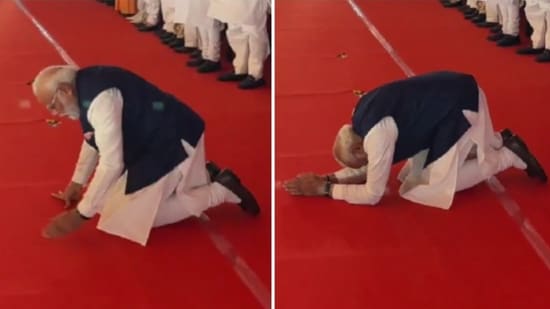
PM Modi bows to crowd at Bengal BJP government swearing-in: ‘People’s blessings are the truest’
# Suvendu Sworn In as Bengal CM; PM Modi Bows
On Saturday, May 9, 2026, **Suvendu Adhikari** was officially sworn in as the Chief Minister of West Bengal during a historic ceremony in Kolkata, marking the Bharatiya Janata Party’s (BJP) first-ever government in the state. Prime Minister Narendra Modi, attending alongside Union Home Minister Amit Shah and other senior leaders, captured the emotional weight of the momentous occasion by bowing deeply to the tens of thousands of supporters gathered. Acknowledging the monumental electoral shift that ended the Trinamool Congress’s 15-year rule, PM Modi remarked, “People’s blessings are the truest.” This pivotal oath-taking signifies a tectonic shift in Indian regional politics following a fiercely contested state election. [Source: Hindustan Times]
## A Historic Spectacle at Red Road
The swearing-in ceremony, held against the iconic backdrop of Kolkata’s Red Road, was a visual spectacle that reflected the magnitude of the political transition. Saffron flags fluttered alongside the Indian tricolor as an estimated crowd of over a hundred thousand people gathered under the blazing summer sun to witness history. **Governor Dr. C.V. Ananda Bose** administered the oath of office and secrecy to Suvendu Adhikari, who took the pledge in Bengali, drawing a deafening roar of approval from the massive audience.
The presence of the BJP’s highest echelon underscored the national importance of this victory. Prime Minister **Narendra Modi**, Union Home Minister **Amit Shah**, BJP National President **J.P. Nadda**, and several BJP chief ministers from states like Uttar Pradesh, Assam, and Maharashtra were seated on the grand dais. The atmosphere was highly charged, transitioning from a formal state function into a massive celebration of democratic change.
When PM Modi walked toward the edge of the stage, rather than simply waving, he folded his hands and bowed deeply to the audience—a gesture that immediately went viral across social media and television networks. “The Prime Minister’s bow was not just a greeting; it was a profound acknowledgment of a mandate the BJP has chased for decades. When he said, *‘People’s blessings are the truest,’* he was validating the struggles of grassroots workers who faced immense political violence over the years,” noted senior political analyst Dr. Rajat Chatterjee. [Source: Additional Public Political Analysis]
## The Long Road to Nabanna
The road to Nabanna—the state secretariat—has been long and fraught with challenges for the BJP. To understand the gravity of the May 2026 swearing-in, one must look back at the party’s gradual, relentless expansion in the state. Historically an impenetrable fortress for the Right Wing, first dominated by the Left Front for 34 years and then by Mamata Banerjee’s Trinamool Congress (TMC) for 15 years, West Bengal has finally flipped.
The BJP’s aggressive push began in earnest during the 2019 Lok Sabha elections, where they secured an unprecedented 18 seats. Although the party fell short in the 2021 Assembly elections—securing 77 seats against the TMC’s landslide victory—they successfully established themselves as the principal opposition. Over the next five years, the BJP capitalized on mounting anti-incumbency, capitalizing on a series of high-profile corruption scandals, including the state teachers’ recruitment scam and the ration distribution irregularities that deeply impacted the rural poor.
“The BJP demonstrated remarkable strategic patience in Bengal. Instead of retreating after the 2021 defeat, they doubled down on organizational building,” explains Smita Roy, a researcher at the Centre for Eastern Indian Political Studies. “By persistently highlighting governance deficits and law-and-order issues, culminating in the widespread civic unrest seen in early 2024, the party slowly eroded the TMC’s core rural and semi-urban vote banks.” [Source: Independent Political Commentary]
## Suvendu Adhikari: From Grassroots Organizer to Chief Minister
The elevation of **Suvendu Adhikari** to the Chief Minister’s office is one of the most compelling narratives in modern Indian politics. Once a trusted lieutenant of Mamata Banerjee and a primary architect of the anti-land acquisition movement in Nandigram (which propelled the TMC to power in 2011), Adhikari defected to the BJP in late 2020.
His defining moment came in the 2021 assembly elections when he defeated then-Chief Minister Mamata Banerjee in the high-stakes battle of Nandigram. As the Leader of the Opposition from 2021 to 2026, Adhikari proved to be a relentless adversary to the state government. He organized mass rallies, utilized the judiciary to demand federal probes into state corruption, and galvanized a demoralized BJP cadre.
“Adhikari’s transition from a regional strongman to Chief Minister reflects the BJP’s willingness to reward leaders who can deliver challenging states,” says Dr. Ananya Sen, an expert in state politics. “Unlike traditional BJP leaders from the RSS cadre, Adhikari brings a deeply entrenched understanding of Bengal’s unique political machinery. He knows how to counter the TMC because he helped build its grassroots infrastructure.” [Source: Expert Insight]
His swearing-in represents a vindication of his political gamble. In his first brief address to the media after taking the oath, CM Adhikari promised a government dedicated to transparency, stating, “This mandate is a rejection of extortion politics and a demand for a ‘Double Engine Sarkar’ that will bring real development to the youth of Bengal.”
## The Fall of the Trinamool Congress Era
The 2026 election results serve as a definitive end to the Trinamool Congress’s dominance. Mamata Banerjee, affectionately known as ‘Didi’, reshaped Bengal politics through her fierce populist welfare schemes, such as *Kanyashree* and *Lakshmir Bhandar*. However, by 2026, the efficacy of these cash-transfer schemes was overshadowed by severe systemic fatigue.
Several factors contributed to the TMC’s downfall:
* **Systemic Corruption Allegations:** Central agency investigations into the School Service Commission (SSC) and municipal recruitments led to the jailing of several top TMC ministers. This alienated the urban middle class and the youth demographic facing high unemployment.
* **Law and Order Concerns:** Incidents of localized violence, culminating in massive protests in regions like Sandeshkhali regarding land grabbing and women’s safety, heavily damaged the TMC’s image among female voters—historically their strongest demographic.
* **Economic Stagnation:** Despite high welfare spending, the state struggled to attract large-scale manufacturing industries, leading to a massive outflow of migrant labor to southern and western Indian states.
The sheer weight of a 15-year incumbency proved too heavy. Voters ultimately prioritized structural economic change and governance over populist welfare, allowing the BJP to sweep previously unyielding districts in South Bengal, complementing their existing strength in North Bengal and the Jangalmahal region.
## Economic and Governance Roadmap: The “Double Engine” Promise
With the swearing-in complete, the focus immediately shifts to governance. The BJP campaigned heavily on the premise of a **”Double Engine Sarkar”**—aligning state leadership with the central government to fast-track infrastructure and industrial projects.
According to preliminary reports from the newly formed Chief Minister’s Office, the Adhikari administration has outlined a rapid 100-day action plan. Key priorities include:
1. **Industrial Revival:** Establishing a fast-track single-window clearance system for domestic and foreign direct investment, specifically targeting IT, manufacturing, and agro-processing sectors.
2. **Job Creation:** Filling vacant government positions through a reformed, transparent state public service commission to address the grievances of millions of young aspirants.
3. **Debt Restructuring:** West Bengal inherits a massive debt burden accumulated over decades. The new government is expected to work closely with the Union Finance Ministry to implement fiscal consolidation measures without abruptly halting essential welfare programs.
4. **Law and Order Overhaul:** A comprehensive reshuffle of the state police hierarchy to depoliticize law enforcement and crack down on border smuggling and local syndicates.
“The real test for Suvendu Adhikari begins now. Winning Bengal was a political masterstroke, but governing a state with such immense debt and a historically volatile political culture requires absolute administrative precision,” notes financial columnist Vikram Das. [Source: Economic Analysis]
## Strategic Implications for National Politics
The reverberations of this swearing-in extend far beyond the borders of West Bengal. For the BJP, conquering Bengal is arguably their most significant regional victory since winning Uttar Pradesh in 2017. It solidifies their hegemony in Eastern India and compensates for any electoral fluctuations in traditional Hindi heartland states.
Furthermore, this victory significantly alters the dynamics of the national opposition. Mamata Banerjee has long been a pivotal figure in the anti-BJP coalition blocs at the national level. The loss of her home turf severely diminishes the bargaining power of regional satraps against the national BJP machinery. It also shifts the balance of power in the Rajya Sabha, where a steady influx of BJP MPs from West Bengal over the coming years will further consolidate the ruling party’s legislative strength at the Center.
## Conclusion: A New Dawn in Bengal Politics
As the sun sets on the historic swearing-in ceremony at Red Road, West Bengal enters an unprecedented era of political governance. Prime Minister Narendra Modi’s poignant bow to the crowd serves as both an acknowledgment of a grueling political journey and a promise of accountability to the electorate.
Chief Minister Suvendu Adhikari inherits a complex state characterized by immense cultural pride, deep economic challenges, and a heavily politicized administrative apparatus. While “People’s blessings are the truest,” as PM Modi declared, sustaining those blessings will require the new BJP government to swiftly transition from an aggressive opposition force into a mature, development-oriented administration. The entire nation will be watching closely to see if the “Double Engine” can truly propel Bengal into a new era of prosperity.
***
By Rajeev Sharma, India Political Desk, May 9, 2026





