
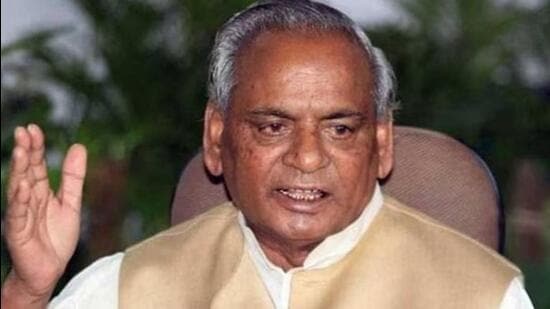
Keeping up with UP: The day when UP had 2 CMs and the Governor held sway
# When UP Had 2 CMs: Governors & Political Whims
**By Senior Political Correspondent, The National Desk, May 09, 2026**
In the volatile theater of Indian politics, few events rival the constitutional crisis that unfolded in Uttar Pradesh in February 1998, when the state briefly had two simultaneous Chief Ministers. Triggered by Governor Romesh Bhandari’s abrupt dismissal of the Kalyan Singh-led government and the midnight swearing-in of Jagdambika Pal, the unprecedented standoff brought the state’s administrative machinery to a grinding halt. Reflected upon today, this historical flashpoint serves as a stark reminder of how constitutional heads frequently bypass the Constitution of India, allowing personal whims and political loyalty to eclipse democratic mandates and legal precedents.
[Source: Hindustan Times | Additional: Indian Constitutional Archives]
## The Midnight Coup: A Democracy Derailed
The political landscape of Uttar Pradesh in the late 1990s was characterized by fractured mandates and fragile coalitions. On **February 21, 1998**, the state plunged into chaos when a faction of the Loktantrik Congress, led by Naresh Agarwal, abruptly withdrew support from the Bharatiya Janata Party (BJP) government headed by Chief Minister **Kalyan Singh**.
Instead of asking Singh to prove his majority on the floor of the legislative assembly—a fundamental democratic procedure established by the landmark *S.R. Bommai v. Union of India (1994)* Supreme Court judgment—Governor Romesh Bhandari took a drastic and highly partisan step. Acting with unprecedented haste, Bhandari dismissed Kalyan Singh’s government. Later that same night, in a hastily organized ceremony at the Raj Bhavan, the Governor swore in **Jagdambika Pal** as the new Chief Minister.
This late-night political maneuver bypassed established constitutional norms, prioritizing partisan allegiance over democratic process. Bureaucrats arrived the next morning to find two men laying claim to the highest executive office in the state, paralyzing the administrative apparatus of India’s most populous region.
## Judicial Intervention: Restoring Constitutional Order
The blatant disregard for parliamentary protocol immediately triggered a fierce legal battle. Kalyan Singh’s legal team approached the **Allahabad High Court**, challenging the Governor’s arbitrary decision. In a landmark interim order, the High Court stayed the Governor’s dismissal, effectively reinstating Kalyan Singh and rendering Jagdambika Pal’s appointment legally void.
However, the political theater was far from over. Pal, refusing to accept defeat, appealed to the **Supreme Court of India**. What followed was one of the most innovative and consequential judicial interventions in Indian democratic history.
To resolve the impasse definitively, the Supreme Court ordered a **”composite floor test.”** This unprecedented directive required the UP legislative assembly to convene for a special session where members would cast their votes to choose between Kalyan Singh and Jagdambika Pal in a transparent, dual-choice trust vote.
**Timeline of the 1998 Crisis:**
* **Feb 21, 1998:** Support withdrawn from Kalyan Singh; Governor Bhandari dismisses him and swears in Jagdambika Pal.
* **Feb 23, 1998:** Allahabad High Court stays the dismissal; Kalyan Singh is reinstated.
* **Feb 24, 1998:** Supreme Court orders a composite floor test.
* **Feb 26, 1998:** Kalyan Singh wins the composite floor test with 225 votes against Pal’s 196, securing his mandate.
[Source: Hindustan Times | Additional: Supreme Court Judgments Archives]
## The Partisan Governor: Whims Over Constitution
The crux of the 1998 crisis—and a persistent ailment in Indian politics up to 2026—lies in the role of the Governor. The original intent of the Constituent Assembly was for the Governor to act as a neutral, non-partisan constitutional head, serving as a vital link between the Union and the State.
Yet, as the historical snippet accurately notes, the reality is starkly different: *”The fact is quite often the constitutional heads are not guided by the Constitution of India, but by their personal whims or political loyalty.”*
Governor Romesh Bhandari’s actions in 1998 were widely criticized as a textbook example of a gubernatorial office acting as an extension of the ruling party at the center. By refusing a standard floor test, the Governor weaponized his discretionary powers under **Article 163** and **Article 164** of the Constitution, undermining the very federal structure he was sworn to protect.
## A Recurring Threat to Federalism
The shadow of the UP crisis extends far beyond the late 1990s. Over the past few decades, India has witnessed a recurring pattern of Governors stepping out of their constitutional boundaries to influence government formation or destabilize opposition-led state governments.
Whether it was the controversial midnight swearing-in ceremony in Maharashtra in 2019, the prolonged administrative standoffs in West Bengal and Kerala, or the delays in passing state legislations in Tamil Nadu, the politicization of the Governor’s office remains a critical vulnerability in India’s democracy.
The playbook remains largely the same: exploiting the gray areas of discretionary power to favor the political entities that appointed them. This consistent deviation from constitutional morality has forced the judiciary to repeatedly step in as the ultimate arbiter of legislative majority, effectively transforming political battles into courtroom dramas.
[Source: Hindustan Times | Additional: Political Science Reasearch up to 2026]
## Expert Perspectives on Institutional Reform
Legal scholars and political analysts have long debated the necessity of reforming the gubernatorial office to prevent the repetition of the 1998 UP fiasco.
“The fundamental flaw in our system is the tenure of the Governor, which operates solely at the ‘pleasure of the President’—which in practice means the ruling party at the Center,” notes Dr. Arvind M. Swaminathan, a senior constitutional lawyer and former member of the Law Commission. “Until we implement the recommendations of the Sarkaria Commission to ensure Governors are eminent figures detached from active politics, crises like the two-CM debacle will remain a latent threat.”
Dr. Swaminathan’s sentiments are echoed by advocates for constitutional reform who point to specific, long-ignored recommendations:
1. **Mandatory Floor Tests:** Governors must not subjectively determine majorities in Raj Bhavans; the floor of the House must be the sole testing ground.
2. **Consultative Appointments:** The Chief Minister of the respective state should be meaningfully consulted before a Governor is appointed.
3. **Fixed Tenures:** Removing the arbitrary dismissal of Governors would reduce their reliance on fulfilling the political whims of the central government to maintain their positions.
## Democratic Implications and the Role of the Judiciary
The UP crisis of 1998 fundamentally altered how trust votes are perceived and executed in India. The Supreme Court’s invention of the “composite floor test” was a masterstroke of judicial pragmatism that protected democratic integrity when the constitutional head failed.
However, over-reliance on the judiciary to resolve executive and legislative deadlocks is a symptom of institutional decay. When courts are forced to decide timelines for floor tests, appoint pro-tem speakers, or order live broadcasting of assembly proceedings, it highlights the erosion of trust in the Governor’s office. A healthy democracy relies on constitutional functionaries who adhere to both the letter and the spirit of the law, independent of judicial enforcement.
The historical episode of Jagdambika Pal’s 48-hour tenure as Chief Minister while Kalyan Singh marshaled his legal defenses is often viewed with a mix of political amusement and constitutional horror. It demonstrated how rapidly a state machinery catering to millions could be paralyzed by a single signature motivated by political allegiance.
## Conclusion: The Path Forward
Reflecting on the day Uttar Pradesh had two Chief Ministers provides a vital lesson in constitutional morality. The events of February 1998 were not just an anomaly; they were a glaring exposure of the systemic vulnerabilities inherent in the Indian federal framework regarding the Governor’s office.
As India progresses through 2026, the need to insulate the office of the Governor from partisan politics is more pressing than ever. True federalism requires constitutional heads who view themselves as custodians of the Constitution rather than agents of the central government. Ensuring that personal whims and political loyalties are structurally prevented from dictating state politics is essential to safeguard the democratic mandate of the electorate. Until comprehensive reforms are enacted, the ghost of the 1998 UP crisis will continue to haunt the corridors of power across the nation.
[Source: Hindustan Times | Additional: Public Policy Analysis 2026]





