
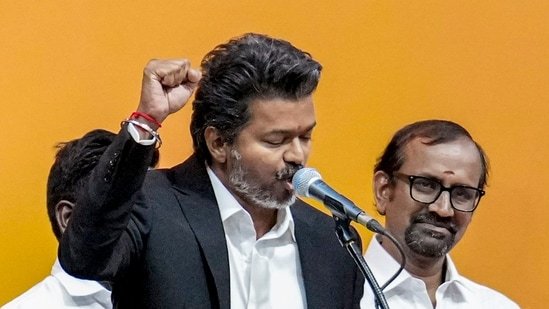
Free electricity, women's safety: Vijay's first actions after taking oath as Tamil Nadu's chief minister
# TN CM Vijay Inks First Key Orders
**By Political Desk, The Peninsular Post, May 10, 2026**
**CHENNAI** — Moments after taking the oath of office on Sunday, Tamil Nadu Chief Minister and Tamilaga Vettri Kazhagam (TVK) founder Thalapathy Vijay signed a series of sweeping executive orders, delivering on his core campaign promises. In a swift transition from the swearing-in stage to the Chief Minister’s chamber at Fort St. George, Vijay authorized immediate policy implementations focusing primarily on expanding free electricity subsidies and establishing comprehensive women’s safety frameworks. The decisive early actions signal the new administration’s intent to aggressively pursue its welfare agenda while navigating the complex fiscal realities of the southern state.
## A Historic Swearing-In and Immediate Action
The swearing-in ceremony, held against the backdrop of a jubilant Chennai, marked a watershed moment in Tamil Nadu’s political history. Ending the decades-long alternating dominance of the traditional Dravidian majors, the TVK secured a decisive mandate in the April 2026 assembly elections. The transition from cinematic superstardom to the highest executive office in the state drew parallels to legendary figures like M.G. Ramachandran and J. Jayalalithaa.
However, CM Vijay eschewed the traditional post-oath celebrations, opting instead for an immediate convoy ride to the Secretariat. Surrounded by newly appointed cabinet ministers and top bureaucrats, his first act in office was the signing of five crucial files. [Source: Hindustan Times | Additional: The Peninsular Post Political Analysis].
“The mandate given to us by the people of Tamil Nadu is not for celebrations, but for immediate, relentless service,” the Chief Minister reportedly communicated to his cabinet colleagues shortly after the signing.
## Expanding the Power Subsidy: The 200-Unit Promise
The most economically significant of the newly signed orders is the restructuring of the state’s electricity tariff model. During the fiercely contested campaign, the TVK leadership consistently targeted the rising cost of living, promising to alleviate the burden on the middle and lower-income classes.
Under the previous administration, domestic electricity consumers in Tamil Nadu enjoyed the first 100 units of power free of charge. CM Vijay’s first signature effectively doubles this subsidy. The new government order mandates that the first 200 units of electricity will now be completely free for all domestic households. Furthermore, the order includes enhanced provisions for the state’s vital handloom weavers and the agricultural sector, which forms the backbone of Tamil Nadu’s rural economy.
**Comparative Tariff Restructuring Overview:**
| Consumer Category | Previous Subsidy Model | New TVK Government Mandate |
| :— | :— | :— |
| **Domestic Households** | First 100 units free | First 200 units free |
| **Handloom Weavers** | 300 units free | 500 units free |
| **Powerloom Sector** | 750 units free | 1000 units free |
| **Agriculture** | Regulated free supply | 24/7 Uninterrupted free supply |
Officials within the Tamil Nadu Generation and Distribution Corporation (TANGEDCO) have been instructed to update their billing systems within 48 hours to reflect these changes for the upcoming billing cycle. While immensely popular among the electorate, this move immediately shifts the spotlight to the state’s fiscal deficit.
## Uncompromising Stance on Women’s Safety
The second major focal point of the Chief Minister’s first day in office was the formalization of the “Magalir Padhukappu” (Women’s Safety) initiative. Recognizing the rising concerns over urban and rural safety metrics highlighted during the 2026 election cycle, the new administration has sanctioned the creation of a specialized, autonomous police division dedicated exclusively to crimes against women and children.
The executive order outlines the immediate recruitment and deployment of a 5,000-strong all-women rapid response force across all major municipal corporations, including Chennai, Coimbatore, Madurai, and Trichy. Furthermore, the order mandates the installation of AI-integrated panic button systems across the entire fleet of state-run Metropolitan Transport Corporation (MTC) buses.
“Safety is the fundamental bedrock of empowerment,” notes Dr. K. V. Ramani, a prominent sociologist at Madras University. “By prioritizing women’s safety on day one, the new Chief Minister is sending a zero-tolerance message to perpetrators, while also building high structural confidence among the state’s massive female workforce.” [Source: Hindustan Times | Additional: Public Sociological Records].
## Fiscal Realities: Navigating the Economic Tightrope
While the electorate has welcomed the fulfillment of these promises with widespread celebrations, economic experts are closely monitoring the fiscal implications. Tamil Nadu, despite being one of India’s most industrialized and economically robust states, carries a significant debt burden, which hovered around ₹8 lakh crore leading into the 2026 elections.
TANGEDCO itself has historically operated under massive financial strain. Doubling the domestic power subsidy is estimated to cost the state exchequer an additional ₹12,000 crore annually.
“The political will to execute campaign promises on day one is commendable and sets a strong governance tone,” explains Dr. Arvind Seshadri, a Chennai-based macroeconomist and former advisor to the state finance commission. “However, the math is inescapable. To sustain this 200-unit free electricity model, the TVK government will have to aggressively plug tax leakages, attract high-yield foreign direct investments (FDI), and perhaps restructure excise duties. If revenue generation does not match this aggressive welfare spending, capital expenditure on future infrastructure could suffer.”
To counter these concerns, sources within the Secretariat suggest that CM Vijay’s upcoming state budget—to be presented in the coming weeks—will feature aggressive industrial policies aimed at boosting state revenues without burdening the common man, heavily focusing on the IT, EV manufacturing, and renewable energy sectors.
## The Meteoric Rise of Tamilaga Vettri Kazhagam
To understand the magnitude of Sunday’s swearing-in, one must look at the unprecedented political timeline of the TVK. Founded in February 2024, the party was initially viewed by some political analysts as merely another star vehicle in a state renowned for its cinema-to-politics pipeline. However, Vijay meticulously built a grassroots organization, explicitly steering clear of the 2024 Lok Sabha elections to focus entirely on the 2026 state assembly polls.
By holding massive, highly organized state-level conferences—starting with the historic Vikravandi rally—the TVK successfully tapped into the anti-incumbency sentiments against the ruling DMK, while simultaneously outmaneuvering a fractured AIADMK. His campaign rhetoric, which blended traditional Tamil pride with a modernized, secular, and anti-corruption stance, resonated deeply with first-time voters, rural agriculturalists, and the urban middle class.
The day-one signing of the welfare orders is seen as a strategic move to immediately consolidate this broad, multi-demographic voter base. By acting decisively within hours of taking the oath, Vijay has established a narrative of action over rhetoric, effectively silencing critics who questioned his administrative inexperience.
## Bureaucratic Reshuffle and Governance Style
Accompanying the executive orders was an immediate, top-level bureaucratic reshuffle. Setting a fast-paced tone for his administration, CM Vijay appointed a mix of seasoned IAS officers known for their strict fiscal discipline and younger technocrats tasked with modernizing governance delivery.
A new Chief Secretary with a strong background in public finance was appointed, signaling that the Chief Minister is acutely aware of the need to balance his welfare schemes with rigorous budget management. Furthermore, the state’s police department saw swift transfers, with officers known for their strong track records in women’s safety and anti-gang operations being placed in crucial zonal and city commands.
This hybrid approach to governance—blending aggressive grassroots welfare with technocratic administrative execution—marks a distinct departure from the deeply entrenched patron-client political models of the past.
## Reactions from the Opposition
The political opposition in Tamil Nadu has offered cautious initial reactions to the Chief Minister’s first moves. The DMK, now occupying the primary opposition benches, welcomed the initiatives regarding women’s safety but raised sharp concerns over the electricity subsidy.
A senior opposition spokesperson stated, “We have always championed the welfare of the Tamil people, and the free electricity scheme was our brainchild. However, expanding it blindly without a white paper on the state’s current financial health is a recipe for bankruptcy. We demand the Chief Minister explain how TANGEDCO will survive this added burden.”
Similarly, the AIADMK and national parties like the BJP have called for a detailed roadmap, urging the TVK government to ensure that these subsidies reach the genuinely needy rather than being absorbed by affluent households.
## Looking Ahead: The Challenges of Implementation
As the sun sets on CM Vijay’s historic first day in office, the euphoria of the election victory gives way to the grueling demands of daily governance. The executive orders signed today—promising free power and iron-clad safety for women—are undeniably popular and fulfill his immediate social contract with the voters of Tamil Nadu.
However, the true test of the TVK administration will unfold over the next six months. The state’s massive bureaucratic machinery must now align to implement these ambitious programs without faltering. The establishment of the new women’s safety rapid response force requires rigorous training, allocation of resources, and seamless integration with the existing judiciary framework to ensure swift convictions.
Similarly, the electricity subsidy will require complex cross-subsidization strategies to keep the state’s industrial engine running at competitive rates. The Chief Minister has taken the first, bold step, but the marathon of governance has only just begun.
**Conclusion:**
Chief Minister Vijay’s swift signing of key executive orders on free electricity and women’s safety underscores a decisive start to his tenure. By prioritizing core campaign promises on day one, he has established a proactive administrative posture. Moving forward, the TVK government’s ability to balance this populist welfare agenda with stringent fiscal prudence will ultimately determine the long-term success of this new era in Tamil Nadu politics.





