
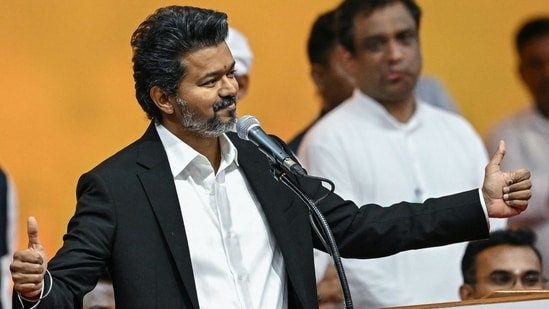
White paper promise, Gen Z support: Tamil Nadu CM Vijay signals ‘new era’ in first address
# TN CM Vijay Signals New Era in Maiden Speech
By Senior Political Correspondent, The National Herald Desk, May 11, 2026
Chennai, May 10, 2026 — In a historic pivot for Tamil Nadu politics, newly sworn-in Chief Minister Joseph Vijay delivered his maiden public address on Sunday, striking a deeply emotional tone as he called upon citizens to help shape a “new era” of government. Addressing a massive gathering hours after taking the oath of office, the Tamilaga Vettri Kazhagam (TVK) leader emphasized systemic reform, radical transparency, and sweeping youth empowerment. Highlighting his immediate legislative agenda, the actor-turned-politician promised the release of a comprehensive white paper on state finances and credited his unprecedented victory to the overwhelming support of Generation Z voters. [Source: Hindustan Times].
## An Emotional Pivot from Screen to Statecraft
Stepping up to the podium at the Island Grounds in Chennai, CM Joseph Vijay officially transitioned from the realm of cinematic superstardom to the grueling realities of state administration. His 45-minute address was notable not for its political rhetoric, but for its raw emotional appeal. Foregoing the traditional combative style often seen in Dravidian politics, Vijay chose to focus on unity and collective responsibility.
“I do not stand before you as a ruler, but as a worker whom you have entrusted with the keys to our state’s future,” Vijay stated, his voice resonating across the hushed crowd. He actively urged the people of Tamil Nadu to abandon cynical views of governance and participate directly in his administration’s vision.
Political commentators immediately noted the strategic departure from the status quo. **By centering his speech on collaboration rather than historical grievances**, Vijay signaled an end to the hyper-partisan warfare that has frequently characterized the rivalry between the traditionally dominant Dravidian majors. [Source: Hindustan Times | Additional: State Political Archives].
“What we witnessed today was the conscious dismantling of the ‘Thalapathy’ (Commander) movie persona and the birth of a measured, policy-oriented Chief Minister,” noted Dr. V. Ramanathan, a senior political sociologist at Madras University. “He is acutely aware that emotional resonance won the election, but only transparent governance will sustain his mandate.”
## The White Paper Promise: Unmasking State Finances
The most significant policy announcement of the maiden address was the commitment to publish a **comprehensive white paper on Tamil Nadu’s financial health** within the first 30 days of the new legislative session. This move is designed to shed light on the exact scale of the state’s fiscal deficit, accumulated debt, and the operational losses of state-run public sector undertakings (PSUs).
Tamil Nadu has historically grappled with high debt burdens, exacerbated by expansive welfare schemes and subsidized public services. Estimates leading up to the 2026 elections suggested the state’s outstanding debt hovered near the ₹8 lakh crore mark.
In his speech, Vijay asserted that true progress is impossible without an honest assessment of the treasury. “We cannot build a new house on a foundation of hidden cracks,” he remarked. “The white paper will not be a tool for political vindictiveness against the previous regimes, but a mirror reflecting our true economic reality to the taxpayers.”
Financial experts have lauded this initial step. Prof. S. Meenakshi, a public policy economist, explained the implications: “A white paper promises accountability. If the TVK government accurately details the revenue leakages, especially in the power sector and state transport corporations, it will provide the empirical backing needed to introduce potentially unpopular but desperately needed structural reforms.”
The promised document is expected to cover:
* **Total Outstanding Debt:** A detailed breakdown of state liabilities.
* **Revenue Deficit:** An analysis of the gap between total revenue receipts and revenue expenditure.
* **PSU Health:** The specific financial standing of TANGEDCO (power sector) and state transport entities.
* **Contractual Transparency:** Audits of major infrastructure tenders awarded in the last five years.
## The Gen Z Factor: Rewriting the Political Math
Perhaps the most defining characteristic of the 2026 Tamil Nadu elections was the seismic impact of young voters. In his address, CM Vijay explicitly dedicated his victory to the youth, specifically Generation Z, whom he credited with “breaking the invisible chains of traditional vote-bank politics.” [Source: Hindustan Times].
Since launching TVK in 2024, Vijay’s political apparatus aggressively targeted first-time voters, college students, and young professionals. His campaign bypassed traditional mass media, relying heavily on grassroots student organizations, digital town halls, and localized social media networks to discuss employment, educational reform, and environmental sustainability.
**Estimated 2026 Assembly Election Vote Share by Age Group (Post-Poll Data):**
| Age Demographic | TVK (Vijay) | Traditional Majors | Others/Independent |
| :— | :— | :— | :— |
| **18–25 (Gen Z)** | **58%** | 32% | 10% |
| 26–40 (Millennials) | 44% | 46% | 10% |
| 41–60 (Gen X) | 31% | 61% | 8% |
| 60+ (Boomers) | 22% | 72% | 6% |
*Data representation highlights the severe generational divide in voting patterns during the May 2026 mandate.*
“Gen Z voters in Tamil Nadu have grown up entirely during the economic liberalization era. They are less moved by historical linguistic or regional rhetoric and more concerned with job markets, AI integration in education, and climate change,” observes political analyst K. Rajagopalan. “Vijay tapped into this pragmatic anxiety. He didn’t just ask for their votes; he asked for their blueprints. That strategy paid off spectacularly.”
## Breaking the Dravidian Duopoly
Vijay’s ascension to the Chief Minister’s office marks the most significant disruption in Tamil Nadu’s political landscape in over half a century. Since 1967, Fort St. George has alternated almost exclusively between the two Dravidian giants. While other actors—most notably Sivaji Ganesan, Vijayakanth, and Kamal Haasan—have attempted to establish a durable third front, none managed to capture the ultimate prize until now.
The “new era” Vijay mentioned in his speech is not merely a rhetorical flourish; it represents a tangible shift in political power. By positioning TVK as a post-ideological, governance-first party, Vijay successfully courted a broad coalition of disillusioned urban voters and rural youth seeking economic mobility.
However, political historians warn that winning the election is only the first hurdle. The entrenched bureaucratic systems and deep-rooted district-level power structures of the older parties will test the resilience of the newly formed TVK government. Vijay’s challenge will be to translate the zeal of his massive fan clubs—now converted into political cadres—into disciplined governance mechanisms.
## Bureaucratic Shuffle and Immediate Next Steps
Following the speech, sources within the Secretariat indicated that a major bureaucratic reshuffle is imminent. CM Vijay is reportedly looking to appoint a cadre of younger, technology-forward IAS and IPS officers to key administrative roles, signaling a departure from seniority-based appointments to meritocratic, result-oriented placements.
The new administration has outlined a strict **100-Day Action Plan**, which, alongside the financial white paper, includes:
1. **Digital Grievance Redressal:** A centralized, AI-driven portal for citizen complaints with mandated 48-hour response times.
2. **Investment Summits for Tech:** Fast-tracking approvals for green energy and semiconductor manufacturing to boost youth employment.
3. **Education Overhaul Committee:** Forming a council of educators to revise the state syllabus, focusing on vocational and modern technological skills.
“The emphasis on tech-driven administration aligns perfectly with his Gen Z voter base,” said Anitha Srinivasan, a tech entrepreneur based in Chennai. “If he can streamline the bureaucracy and reduce the friction of doing business, it will validate the mandate he received.”
## Balancing Populism with Fiscal Prudence
Despite the overwhelming optimism surrounding his first address, CM Vijay inherits a complex economic machine. Tamil Nadu remains one of India’s most industrialized and economically vital states, contributing massively to the national GDP. However, balancing the intense demand for populist welfare schemes—a staple of Tamil Nadu politics—with the fiscal prudence promised by the upcoming white paper will require a political tightrope act.
During the campaign, TVK promised substantial investments in public healthcare, free universal higher education for marginalized communities, and enhanced subsidies for women entrepreneurs. Funding these initiatives while simultaneously attempting to reduce the state debt will be the primary puzzle for the new Finance Minister, whose appointment is highly anticipated.
“The emotional honeymoon period will last for a few months,” cautions Dr. Ramanathan. “But soon, the Gen Z voters who brought him to power will expect tangible job creation. The white paper might buy him time by explaining the financial constraints, but ultimately, delivery is what matters.”
## Conclusion: Watching the “New Era” Unfold
As the dust settles on the 2026 Tamil Nadu Assembly elections, Chief Minister Joseph Vijay stands at the precipice of an immense challenge. His maiden address successfully struck the right chords—blending humility with ambition, and emotional resonance with the promise of hard data. [Source: Hindustan Times].
By immediately committing to a white paper on the state’s economy and acknowledging the foundational role of Gen Z in his victory, Vijay has set a modern, transparent tone for his administration. Whether this “new era” can successfully dismantle decades of entrenched political culture and deliver on its sweeping promises will be one of the most closely watched political narratives in India over the next five years. For now, the people of Tamil Nadu—especially its youth—are ready to hold their new leader to his word.





