
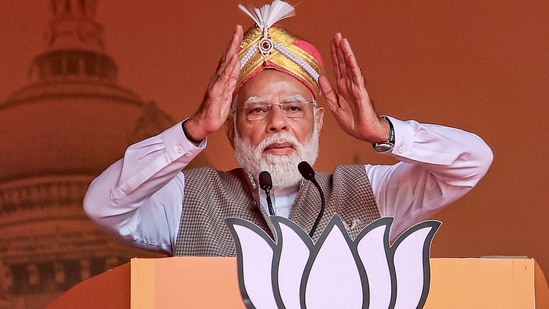
‘Parasitic Congress’: PM Modi's sharp attack as Rahul Gandhi attends Vijay's swearing-in
# Modi Slams ‘Parasitic’ Congress at Vijay Oath
**By Political Desk, The National Observer, May 10, 2026**
Prime Minister Narendra Modi launched a scathing critique of the Indian National Congress on Sunday, labeling the national party as “parasitic” following its high-profile alliance shift in Tamil Nadu. The political attack came precisely as senior Congress leader Rahul Gandhi attended the historic swearing-in ceremony of actor-turned-politician Thalapathy Vijay in Chennai. Breaking its longstanding alliance with the regional heavyweight Dravida Munnetra Kazhagam (DMK), the Congress party’s pivot to support Vijay’s newly ascendant political outfit has dramatically reshaped southern India’s electoral landscape, prompting swift condemnation from the Prime Minister over alleged political opportunism.
## The ‘Parasitic’ Label and Shifting Alliances
Addressing a massive public gathering, Prime Minister Narendra Modi characterized the Congress party’s recent strategic maneuvers as inherently unstable and detrimental to regional allies. Modi berated the national opposition party for severing ties with the DMK, an alliance that had formed the cornerstone of the opposition’s southern strategy for several electoral cycles.
“The Congress party has repeatedly demonstrated a parasitic tendency, draining its regional partners before turning on them when a more lucrative opportunity arises,” Prime Minister Modi asserted during his address. He further alleged that the national party lacks a grassroots foundation of its own in Tamil Nadu, relying entirely on the political capital of regional stalwarts to maintain relevance. [Source: Hindustan Times]
The breakdown of the Congress-DMK alliance marks a watershed moment in Tamil Nadu’s contemporary political history. For years, the two parties maintained a symbiotic relationship, culminating in sweeping victories during both the 2019 and 2024 parliamentary elections, as well as the 2021 Tamil Nadu state assembly elections. However, the sudden emergence of a viable third front fundamentally altered the calculus, prompting Congress to recalibrate its allegiances ahead of the 2026 state mandates. [Additional: General Political Records up to 2026].
## Rahul Gandhi’s Presence at the Historic Swearing-In
The Prime Minister’s sharp rhetoric coincided with a momentous event in Chennai: the swearing-in of Thalapathy Vijay as the Chief Minister of Tamil Nadu. Vijay, who launched his party, the **Tamilaga Vettri Kazhagam (TVK)**, in early 2024, successfully galvanized young voters and disenchanted electorates to disrupt the state’s traditional Dravidian duopoly.
Rahul Gandhi’s prominent seating at the ceremony sent a clear, undeniable message regarding the Congress party’s future trajectory in the South. By physically standing alongside the new Chief Minister, Gandhi signaled an official endorsement of the TVK-led administration. Political observers noted that Gandhi’s attendance was not merely ceremonial but represented a highly calculated gamble to align Congress with a rising regional force, distancing the party from the anti-incumbency sentiments that had recently plagued the DMK government.
“Rahul Gandhi’s presence on that stage is a visual confirmation of the end of the old order in Tamil Nadu,” explains Dr. S. R. Venkatraman, a Chennai-based political scientist. “Congress has read the writing on the wall. They recognized that the youth demographic was overwhelmingly shifting toward Vijay, and they chose to ride that wave rather than sink with traditional allies. The Prime Minister’s remarks reflect the undeniable reality that alliances in India are currently more fluid than they have been in decades.”
## The Meteoric Rise of Tamilaga Vettri Kazhagam (TVK)
To understand the weight of the Prime Minister’s accusations and the Congress party’s sudden pivot, one must examine the unprecedented rise of Vijay’s Tamilaga Vettri Kazhagam. Since its formal inception in February 2024, the TVK has positioned itself as an anti-corruption, pro-development alternative to both the ruling DMK and the opposition All India Anna Dravida Munnetra Kazhagam (AIADMK).
Vijay’s transition from a cinematic icon with a massive fan base to a grassroots political leader was marked by extensive state-wide touring and a manifesto promising radical administrative transparency. By tapping into voter fatigue associated with dynastic politics and legacy corruption scandals, TVK captured a substantial portion of the swing vote in the May 2026 assembly elections.
The Congress party, facing an internal crisis of relevance in a state where it has not held power independently since the 1960s, saw an alliance with TVK as an opportunity for revitalization. The Prime Minister’s assertion that Congress “turns on its own partners” directly addresses this pivot, framing the national party as lacking ideological consistency and acting purely out of electoral desperation.
## Expert Analysis on Congress’s Regional Strategy
Political strategists offer varying interpretations of the Congress party’s decision to abandon the DMK. On one hand, critics echo PM Modi’s sentiments, viewing the move as a betrayal of the unified national opposition front that was aggressively promoted just years prior.
“The fundamental risk Congress faces here is the erosion of trust among regional satraps nationwide,” states Malini Parthasarathy, a veteran journalist covering southern politics. “If Congress is willing to jettison the DMK—a partner that stood by them during their lowest national electoral phases—other regional leaders in Maharashtra, Bihar, and West Bengal will inevitably question the reliability of the national party. PM Modi is astutely exploiting this exact vulnerability.”
Conversely, defenders of the Congress strategy argue that political survival necessitates pragmatism. The DMK was battling natural anti-incumbency after five years in power. By aligning with the TVK, Congress managed to secure a share of power in a crucial southern state, ensuring its cadres remain energized and financially viable.
Furthermore, some analysts suggest that the Congress party’s pivot was inherently defensive. Had they remained aligned with the DMK and suffered electoral defeat, the BJP could have capitalized on the vacuum to establish itself as the primary opposition in Tamil Nadu. By hitching its wagon to Vijay, Congress effectively blocked the BJP from claiming the anti-DMK mandate.
## BJP’s Southern Push and Electoral Stakes
Prime Minister Modi’s sharp attack must also be analyzed through the lens of the Bharatiya Janata Party’s (BJP) broader ambitions in South India. Historically, Tamil Nadu has been an impregnable fortress for Dravidian ideology, heavily resistant to the BJP’s national narratives.
Over the past decade, the BJP has invested immense political capital in Tamil Nadu, promoting regional leaders, celebrating Tamil culture at national forums, and attempting to forge smaller, localized alliances. Modi’s critique of Congress as a “parasite” serves a dual purpose: it denigrates the primary national opposition while simultaneously pitching the BJP as a party of ideological steadfastness that respects its regional commitments.
By painting Congress as an untrustworthy ally, the BJP leadership hopes to sow discord within the newly formed TVK-Congress coalition. The implicit message to the newly sworn-in Chief Minister Vijay is clear: a partnership with Congress comes with inherent risks of betrayal. As the BJP looks to expand its footprint ahead of future parliamentary contests, preventing the consolidation of a stable TVK-Congress block is a strategic imperative.
## DMK’s Response and National Ramifications
The fallout from the Congress-DMK split has left the Dravidian major in a period of intense introspection. While DMK leadership has maintained a stoic public posture, insiders indicate deep frustration over what is perceived as political opportunism by Rahul Gandhi’s outfit.
The ramifications of this split extend far beyond the borders of Tamil Nadu. The DMK was a vital pillar of the national opposition alliance, providing crucial parliamentary numbers and ideological heft against the ruling BJP. With Congress severing regional ties for localized gains, the structural integrity of any unified national front against Prime Minister Modi’s government has been severely compromised.
National commentators are closely watching how other regional powers will respond to this development. The scenario raises pertinent questions regarding the viability of pre-poll alliances in an era where voter loyalties are increasingly volatile and the appeal of new, charismatic leaders like Vijay can upend established political arithmetic overnight.
## Future Outlook and Key Takeaways
As the political dust settles over Chennai, several key dynamics will dictate the immediate future of Tamil Nadu’s governance and India’s national political discourse:
* **The TVK-Congress Governance Dynamic:** All eyes will be on how Chief Minister Vijay accommodates his national partner in terms of cabinet portfolios and policy framing. Will the alliance remain harmonious, or will the “parasitic” tendencies alleged by PM Modi manifest in governance friction?
* **DMK’s Rebuilding Phase:** Operating from the opposition benches, the DMK will need to recalibrate its strategy to appeal to the demographic that migrated to the TVK, setting the stage for highly combative legislative sessions.
* **BJP’s Strategic Maneuvering:** Prime Minister Modi’s aggressive rhetoric indicates that the BJP will not remain a passive observer. Expect continuous efforts by the central government to highlight governance gaps in the new state administration, aiming to establish the BJP as the true alternative to Dravidian and TVK politics.
Prime Minister Narendra Modi’s branding of the Congress party as a “parasitic” entity is more than mere political theater; it is a calculated narrative designed to exploit the shifting tectonic plates of Indian regional politics. As Rahul Gandhi attempts to ride the wave of Thalapathy Vijay’s immense popularity, the national opposition faces the delicate task of balancing local pragmatism with the necessity of maintaining trust among its pan-India allies. The coming months will reveal whether Congress’s calculated risk pays long-term dividends or validates the Prime Minister’s sharpest criticisms.





