
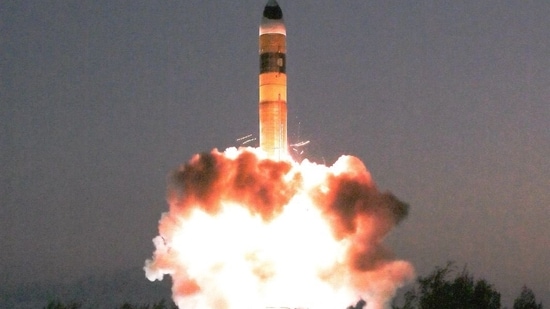
India successfully tests Agni-5 MIRV missile with 5,000 km range, multi-warhead capability; 5 key facts
# Agni-5 MIRV Missile Test: 5 Facts
By Defense Correspondent, Strategic Affairs Desk, May 10, 2026
On Sunday, May 10, 2026, India successfully flight-tested its highly advanced Agni-5 ballistic missile, now fully integrated with Multiple Independently Targetable Re-entry Vehicle (MIRV) technology. Launched from Dr. APJ Abdul Kalam Island off the coast of Odisha by the Defence Research and Development Organisation (DRDO), the missile was tested with multiple payloads aimed at different targets spread across a wide geographical area in the Indian Ocean region. This 5,000-kilometer range intercontinental-class system solidifies India’s position among elite nuclear powers, exponentially enhancing its strategic deterrence architecture and reshaping the geopolitical security matrix of the Indo-Pacific.
## Anatomy of the Agni-5 MIRV Flight Test
The latest successful launch of the Agni-5 MIRV system represents a monumental leap in India’s indigenous defense manufacturing and strategic strike capabilities. According to official telemetry and radar data, the missile followed its prescribed trajectory with textbook precision. High-speed cameras, naval tracking vessels positioned deep in the Indian Ocean, and sophisticated ground-based radar networks comprehensively monitored the flight path [Source: Hindustan Times].
The primary objective of this specific trial was to validate the dispersion mechanism of the MIRV “bus”—the post-boost vehicle responsible for carrying and releasing individual warheads. The RSS snippet provided by defense authorities confirmed that “the missile was tested with multiple payloads aimed at different targets spread across a wide geographical area in the Indian Ocean region.” This confirms that the test was not merely a distance trial, but a complex validation of independent targeting algorithms, atmospheric re-entry dynamics, and synchronized payload detonation.
By effectively coordinating the release of multiple mock warheads at varying altitudes and velocities, the DRDO has demonstrated that a single Agni-5 missile can now hold multiple geographically distinct targets at risk simultaneously. Prior to the launch, maritime security notices and NOTAMs (Notices to Airmen) were issued over a vast corridor of the Bay of Bengal and the Indian Ocean, signaling the sheer scale and reach of the weapon system.
## 5 Key Facts About the Agni-5 MIRV System
To understand the strategic gravity of this development, it is essential to break down the core capabilities of the newly tested weapon system. Here are five key facts about the Agni-5 MIRV:
1. **5,000 km Intercontinental Range:** With a proven operational range exceeding 5,000 kilometers, the Agni-5 is capable of reaching the deepest hinterlands of potential adversaries. It firmly places India in the realm of nations possessing Intercontinental Ballistic Missile (ICBM) capabilities, effectively blanketing the entirety of the Asian landmass and parts of Europe and Africa.
2. **Multi-Warhead MIRV Technology:** Unlike traditional missiles that carry a single, monolithic warhead, the MIRV-enabled Agni-5 can carry several independent nuclear warheads. Each warhead can be programmed to strike a distinct target separated by hundreds of kilometers, making the weapon exponentially more lethal and cost-effective.
3. **Evasion of Ballistic Missile Defenses (BMD):** By deploying multiple warheads alongside metallic decoys and chaff, the Agni-5 MIRV is designed to overwhelm adversary anti-missile defense shields. A defensive interceptor network would struggle to distinguish real warheads from decoys, ensuring a high probability of successful target prosecution.
4. **Advanced Indigenous Avionics:** The missile utilizes cutting-edge, domestically developed avionics. It relies on highly accurate Ring Laser Gyroscope-based Inertial Navigation Systems (INS) supplemented by Micro Navigation Systems (MINS). This is further cross-referenced with India’s indigenous NavIC satellite constellation, ensuring pinpoint accuracy with an exceptionally low Circular Error Probable (CEP).
5. **Canisterized Solid-Fuel Design:** The Agni-5 operates on a three-stage solid-fueled propulsion system. Crucially, it is canisterized—meaning it is sealed in a climate-controlled silo that acts as both a transport mechanism and a launch tube. This allows for rapid deployment via road or rail mobile launchers, reducing launch preparation time from hours to mere minutes [Source: Additional Defense Analysis].
## Unpacking MIRV Technology
Multiple Independently Targetable Re-entry Vehicle (MIRV) technology is one of the most complex engineering feats in modern aerospace defense. Originally developed during the Cold War by the United States and the Soviet Union, MIRV technology fundamentally altered the mathematics of nuclear deterrence.
The operation of a MIRV-equipped Agni-5 begins identically to a standard ballistic missile. The solid-fueled booster stages propel the weapon out of the Earth’s atmosphere. However, once in the exoatmosphere, the final stage does not simply fall back to Earth. Instead, a specialized “bus” or post-boost vehicle takes over.
This bus is equipped with its own computerized navigation and micro-thrusters. It subtly maneuvers through space, aligning itself with the trajectory of the first target before releasing a warhead. It then fires its thrusters to adjust course, aligns with a second target, and releases another warhead, repeating the process until all payloads—and decoys—are deployed. The warheads then independently re-enter the Earth’s atmosphere at hypersonic speeds, forming a “shotgun” effect that strikes multiple targets simultaneously. Developing the miniaturized warheads, heat shields capable of surviving re-entry, and the precise bus maneuvering software requires decades of dedicated research, making India’s indigenous breakthrough highly significant.
## Strategic Implications for the Indo-Pacific
The successful operationalization of the Agni-5 MIRV profoundly impacts the balance of power in the Indo-Pacific, a region already fraught with complex geopolitical tensions. Historically, India’s deterrence posture has been defined by a need to maintain strategic equilibrium against a dual-threat environment from its northern and western borders.
“The integration of MIRV capabilities into the Agni-5 platform is not merely a technological upgrade; it is a paradigm shift in Asian geopolitics,” notes Dr. Arvind Menon, an independent strategic affairs analyst based in New Delhi. “As China rapidly expands its nuclear arsenal and fields its own MIRV-capable DF-41 missiles, India requires a parallel capability to maintain deterrence stability. This test guarantees that India possesses a second-strike capability that cannot be easily neutralized by advanced missile defense systems.”
Furthermore, the test signals to global powers that India is actively modernizing its Strategic Forces Command (SFC). By demonstrating the ability to strike targets across a “wide geographical area in the Indian Ocean region,” India is implicitly projecting power and safeguarding its maritime security interests. This aligns with New Delhi’s broader foreign policy goal of acting as a net security provider and a stabilizing force in the Indo-Pacific basin.
## Alignment with India’s Nuclear Doctrine
India’s nuclear doctrine is famously anchored by two core tenets: “No First Use” (NFU) and “Credible Minimum Deterrence” (CMD). The development of the Agni-5 MIRV fits seamlessly into this doctrinal framework, reinforcing its credibility.
Because India has committed to never using nuclear weapons first, its deterrence relies entirely on the guarantee of a devastating, unacceptably punitive retaliatory strike—a “second strike.” For a second-strike capability to be credible, India’s missile systems must be able to survive a preemptive enemy attack and successfully penetrate enemy defenses during retaliation.
The canisterized nature of the Agni-5 ensures it can be heavily camouflaged and constantly moved on road or rail networks, making it highly survivable against a first strike. Furthermore, the MIRV payload guarantees that even if only a handful of Agni-5 missiles survive an enemy attack, they can still inflict massive, dispersed damage that a single-warhead missile could not. In this way, MIRV technology allows India to maximize its deterrence potential without necessarily engaging in a massive quantitative arms race, strictly adhering to the “minimum” aspect of its doctrine while enhancing the “credible” aspect.
## The Global Nuclear Club and MIRV Capabilities
With the Agni-5 MIRV system, India cements its place in an exclusive technological club. To understand the scale of this achievement, one must look at the global landscape of MIRV-capable powers.
| Nation | MIRV-Capable ICBM Systems | Status |
| :— | :— | :— |
| **United States** | Minuteman III, Trident II (SLBM) | Operational / Highly Advanced |
| **Russia** | RS-24 Yars, RS-28 Sarmat, Bulava | Operational / Highly Advanced |
| **China** | DF-5B, DF-41, JL-3 (SLBM) | Operational / Rapidly Expanding |
| **France** | M51 (SLBM) | Operational |
| **United Kingdom**| Trident II (SLBM – via US tech) | Operational |
| **India** | **Agni-5 MIRV** | **Successfully Tested / Operationalizing** |
India is only the sixth nation globally to successfully test and integrate MIRV technology onto a long-range ballistic missile [Source: Public Domain Defense Databases]. This technological parity acts as a major diplomatic equalizer. In international security dialogues and arms control frameworks, possessing demonstrated, high-end delivery systems affords India significant diplomatic leverage and commands respect from both allies and adversaries alike.
## Future Outlook: Beyond Agni-5
The successful May 2026 test of the Agni-5 MIRV marks a major milestone, but it is not the final destination for India’s strategic missile program. Defense experts anticipate that the technological groundwork laid by the DRDO during these trials will directly fuel future projects.
The next logical evolution in India’s defense roadmap is the speculated Agni-VI project, which is rumored to have a significantly longer range (potentially up to 8,000 – 10,000 km) and a larger payload capacity capable of carrying more MIRVs. Furthermore, miniaturizing these warheads ensures they can be adapted for India’s sea-based deterrence. Integrating MIRV technology onto Submarine-Launched Ballistic Missiles (SLBMs), such as the under-development K-5 missile for the Arihant-class nuclear submarines, will complete the most robust and survivable leg of India’s nuclear triad.
## Conclusion
The Agni-5 MIRV test is a defining moment for India’s indigenous defense sector. By successfully demonstrating the ability to deliver multiple payloads to different targets across a wide geographic expanse in the Indian Ocean, the DRDO has showcased absolute mastery over complex atmospheric re-entry, independent targeting, and solid-fueled propulsion systems.
As the geopolitical climate of the 21st century grows increasingly volatile, New Delhi’s approach to national security relies heavily on self-reliance (Aatmanirbharta) and technological superiority. The 5,000-km range Agni-5 MIRV achieves exactly that—fortifying the nation’s No First Use doctrine with an impregnable, credible second-strike capability that will secure India’s strategic sovereignty for decades to come.





