
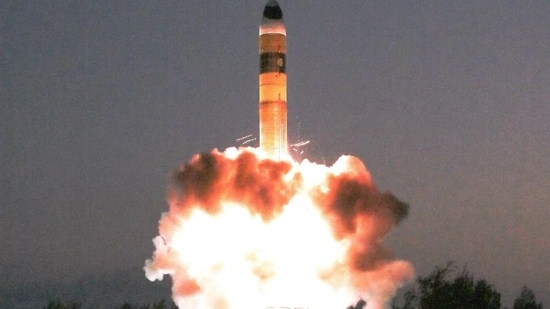
India successfully tests Agni-5 MIRV missile with 5,000 km range, multi-warhead capability; 5 key facts
# India Tests Agni-5 MIRV Missile
**By Staff Correspondent, Defense & Security Desk | May 10, 2026**
In a major demonstration of its evolving strategic deterrence capabilities, India successfully test-fired the nuclear-capable Agni-5 ballistic missile equipped with Multiple Independently Targetable Re-entry Vehicle (MIRV) technology on Sunday, May 10, 2026. Conducted by the Defence Research and Development Organisation (DRDO) from Dr. APJ Abdul Kalam Island off the coast of Odisha, the launch saw the missile deliver multiple payloads to diverse targets spread across a vast geographical expanse in the Indian Ocean region. This milestone test confirms the operational maturity of India’s multi-warhead delivery systems, solidifying its strategic posture and altering the security architecture of the broader Indo-Pacific. [Source: Hindustan Times]
## Validating Advanced Strategic Capabilities
The test conducted on Sunday represents a monumental leap in India’s indigenous missile development program. While India first demonstrated its MIRV capability during the “Mission Divyastra” test in early 2024, the May 2026 launch serves as a crucial operational validation of the system’s reliability, accuracy, and payload distribution mechanics under varied atmospheric conditions.
According to defense officials, the Agni-5 missile followed a pre-determined trajectory before releasing its multiple payloads in the exosphere. These individual re-entry vehicles then maneuvered independently to strike distinct, widely separated coordinates in the Indian Ocean. The successful simultaneous tracking of these multiple warheads by down-range telemetry stations, naval vessels—including the missile tracking ship INS Dhruv—and radar networks confirms the sophisticated nature of the missile’s onboard avionics and guidance mechanisms.
“The ability to coordinate and strike multiple geographically dispersed targets from a single launch platform is a force multiplier,” notes Dr. Rajesh Venugopal, an independent defense analyst based in New Delhi. “This test moves India from simply possessing the technology to having a reliable, deployable MIRV capability that any adversary must calculate into their strategic planning.” [Source: Hindustan Times | Additional: Defense Analysis Consensus]
## The Complex Mechanics of MIRV Technology
Understanding the significance of Sunday’s test requires looking at the complex physics and engineering behind MIRV technology. Traditional ballistic missiles carry a single warhead, meaning one missile launch equals one target strike. MIRV technology revolutionizes this dynamic.
A MIRV-equipped missile acts as an orbital bus. Once the missile reaches the peak of its trajectory just outside the Earth’s atmosphere, the “bus” maneuvers to specific points in space, releasing individual warheads—along with electronic decoys and chaff—on highly precise, independent trajectories back through the atmosphere.
Developing this technology requires overcoming massive engineering hurdles. The nuclear warheads must be significantly miniaturized to fit multiple units within the nose cone of the Agni-5. Furthermore, the re-entry vehicles must withstand intense thermal dynamics, facing temperatures exceeding 4,000 degrees Celsius as they re-enter the Earth’s atmosphere at hypersonic speeds. The successful deployment across the Indian Ocean indicates that the DRDO has mastered the metallurgical, miniaturization, and software algorithms required for such a sophisticated weapon system. [Source: Hindustan Times | Additional: DRDO Technical Bulletins]
## 5 Key Facts About the Agni-5 MIRV Test
The recent launch highlights several critical aspects of India’s strategic defense posture. Here are the five key facts defining this milestone:
**1. A formidable 5,000 km Operational Range**
The Agni-5 falls squarely into the category of an Intercontinental Ballistic Missile (ICBM) for regional intents, boasting an operational range of over 5,000 kilometers. This extensive reach ensures that the entirety of Asia, parts of Europe, and the deep Indo-Pacific fall within its protective deterrence umbrella.
**2. Multi-Warhead Deployment Capability**
Unlike its predecessors, this iteration of the Agni-5 is integrated with MIRV payloads. This means a single missile can carry multiple nuclear warheads, each programmed to strike a different target. This not only maximizes the impact of a single launch but is specifically designed to overwhelm and bypass enemy Ballistic Missile Defense (BMD) systems.
**3. State-of-the-Art Indigenous Avionics**
The entire MIRV system is a product of indigenous research and development. The missile is equipped with highly advanced, Indian-made avionics, high-precision sensor packages, and micro-navigation systems. These ensure that despite the turbulent atmospheric re-entry, the individual warheads strike their targets with pinpoint accuracy, minimizing the circular error probable (CEP).
**4. Expansive Indian Ocean Target Footprint**
During this test, the payloads were not aimed at a single cluster. They were distributed across a wide geographical area within the Indian Ocean region. This wide-area targeting proves the lateral maneuverability of the post-boost vehicle (the bus), demonstrating that India can strike vastly separated targets—such as multiple military bases or industrial centers—simultaneously.
**5. Bolstering the “No First Use” Doctrine**
India maintains a strict “No First Use” (NFU) nuclear doctrine, pledging never to use nuclear weapons first in a conflict. To maintain the credibility of this doctrine, India requires a highly survivable and overwhelmingly potent second-strike capability. The Agni-5 MIRV guarantees that even if India suffers a first strike, a handful of surviving missiles can inflict unacceptable damage on an adversary, thereby maintaining strong deterrence. [Source: Hindustan Times | Additional: Ministry of Defence Statements]
## Redrawing the Indo-Pacific Security Architecture
The geopolitical timing and implications of this test cannot be understated. Over the last decade, the Indo-Pacific has witnessed a rapid acceleration in strategic arms development. China has aggressively expanded its nuclear arsenal, frequently demonstrating its MIRV-capable DF-41 missiles and advancing its regional ballistic missile defense networks.
For New Delhi, the primary utility of the Agni-5 MIRV is deterrence against Beijing’s expanding capabilities. By showcasing a missile capable of breaching advanced anti-missile shields and delivering multiple warheads over 5,000 kilometers away, India signals a restoration of strategic parity.
“Deterrence is only effective if your adversary believes your weapons work and cannot be intercepted,” explains Dr. Meenakshi Iyer, a geopolitical strategist specializing in Asian security dynamics. “With adversaries deploying sophisticated kinetic interceptors and laser-based defense shields, single-warhead missiles are increasingly vulnerable. The MIRV test signals to the region that India’s second-strike capability remains impregnable.”
Furthermore, the test serves as a subtle message regarding the militarization of the Indian Ocean. By utilizing the vast expanse of the ocean as its testing range and successfully monitoring the multi-point impacts, India underscores its dominant maritime domain awareness and its ability to project decisive power across the very waters through which critical global trade flows. [Source: Hindustan Times | Additional: SIPRI Arms Transfers and Deterrence Database]
## India’s Position in the Global Nuclear Hierarchy
With the operational maturation of the Agni-5 MIRV, India firmly cements its position within an exclusive global club. Prior to India’s recent advancements, only a handful of nations—the United States, Russia, the United Kingdom, France, and China—possessed operational MIRV technology.
Historically, MIRV technology was developed during the Cold War by the US and the Soviet Union specifically to overwhelm each other’s burgeoning anti-ballistic missile (ABM) defenses. Today, the technology remains the ultimate hallmark of a mature nuclear power. India’s entry into this elite group without participating in explosive nuclear testing since 1998 speaks volumes about the country’s advancements in supercomputing, aerodynamic simulation, and precision engineering.
The transition to a MIRV-capable force also requires a modernization of the command and control structure. India’s Strategic Forces Command (SFC), which manages the nuclear arsenal, will now operate a leaner but far more lethal stockpile. Instead of requiring a massive inventory of delivery vehicles, a smaller number of MIRV-equipped Agni-5s can achieve the same strategic deterrence objectives, optimizing defense expenditures while maximizing security. [Source: Hindustan Times | Additional: Global Security Nuclear Forces Estimates]
## Conclusion: A Paradigm Shift in Deterrence
The successful May 10 test of the Agni-5 MIRV is not merely a technological triumph for the DRDO; it is a definitive paradigm shift in South Asian and Indo-Pacific deterrence models. By successfully demonstrating the ability to disperse multiple payloads across a wide area in the Indian Ocean, India has proven that its strategic forces are sophisticated, resilient, and ready.
Looking forward, this technological foundation paves the way for future platforms, such as the widely speculated Agni-6, and further solidifies the sea-based leg of India’s nuclear triad—specifically the integration of MIRV capabilities into submarine-launched ballistic missiles (SLBMs).
As global security dynamics become increasingly volatile and regional powers expand their military footprints, India’s measured but highly advanced modernization of its strategic arsenal ensures that its defense posture remains unassailable. The Agni-5 MIRV stands today not just as a weapon of ultimate resort, but as a stabilizing instrument of deterrence, ensuring peace through undeniable strength.





